Department of Immunology and Infectious Diseases, Harvard School of Public Health AIDS Initiative, Harvard School of Public Health, Boston, MA, USA.
Botswana-Harvard AIDS Institute, Gaborone, Botswana.
Viruses. 2010 Jan;2(1):33-54. doi: 10.3390/v2010033. Epub 2010 Jan 7.
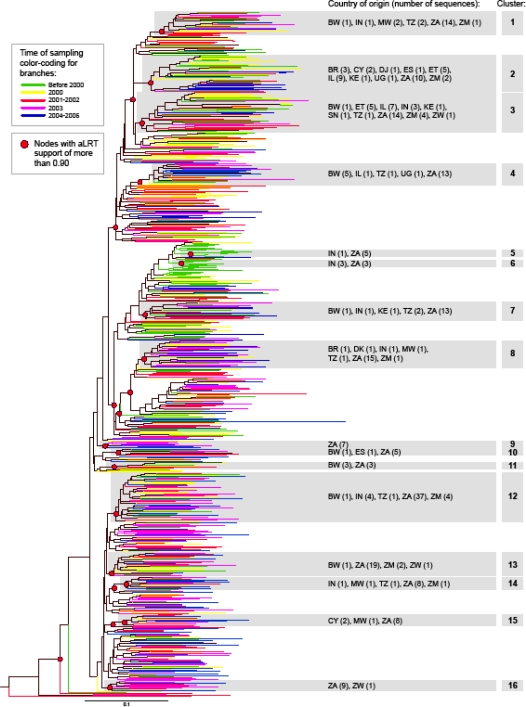
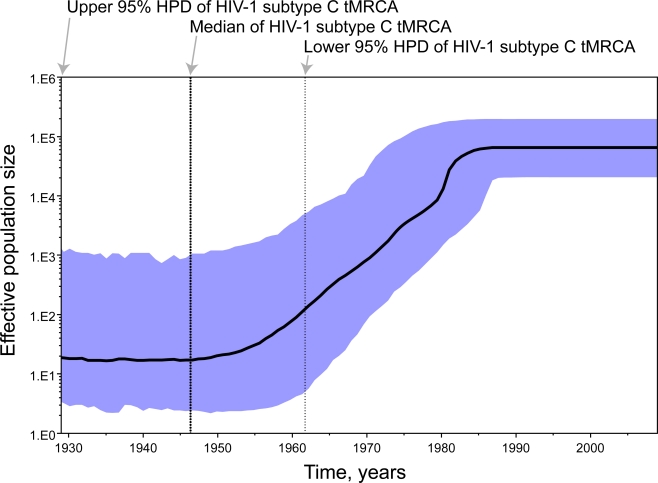
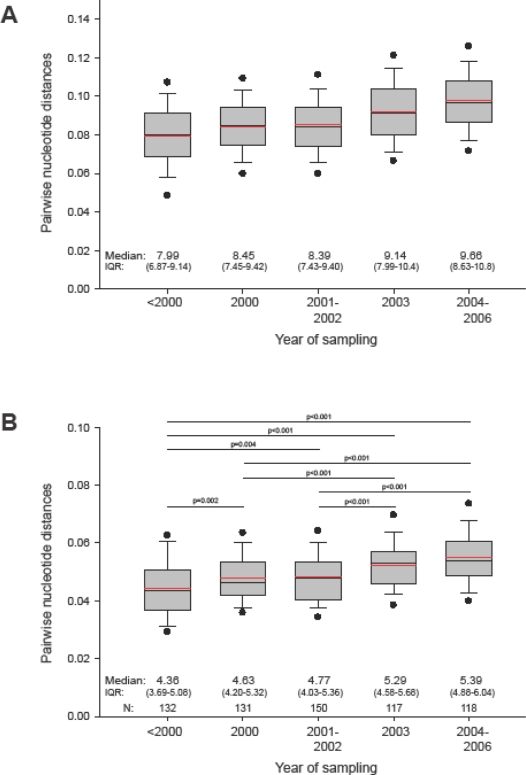
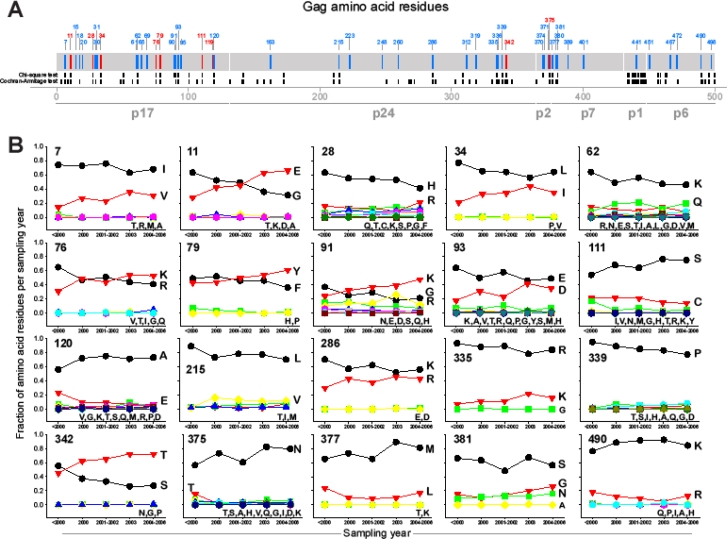
The diversity of HIV-1 and its propensity to generate escape mutants present fundamental challenges to control efforts, including HIV vaccine design. Intra-host diversification of HIV is determined by immune responses elicited by an HIV-infected individual over the course of the infection. Complex and dynamic patterns of transmission of HIV lead to an even more complex population viral diversity over time, thus presenting enormous challenges to vaccine development. To address inter-patient viral evolution over time, a set of 653 unique HIV-1 subtype C gag sequences were retrieved from the LANL HIV Database, grouped by sampling year as <2000, 2000, 2001-2002, 2003, and 2004-2006, and analyzed for the site-specific frequency of translated amino acid residues. Phylogenetic analysis revealed that a total of 289 out of 653 (44.3%) analyzed sequences were found within 16 clusters defined by aLRT of more than 0.90. Median (IQR) inter-sample diversity of analyzed gag sequences was 8.7% (7.7%; 9.8%). Despite the heterogeneous origins of analyzed sequences, the gamut and frequency of amino acid residues in wild-type Gag were remarkably stable over the last decade of the HIV-1 subtype C epidemic. The vast majority of amino acid residues demonstrated minor frequency fluctuation over time, consistent with the conservative nature of the HIV-1 Gag protein. Only 4.0% (20 out of 500; HXB2 numbering) amino acid residues across Gag displayed both statistically significant (p<0.05 by both a trend test and heterogeneity test) changes in amino acid frequency over time as well as a range of at least 10% in the frequency of the major amino acid. A total of 59.2% of amino acid residues with changing frequency of 10%+ were found within previously identified CTL epitopes. The time of the most recent common ancestor of the HIV-1 subtype C was dated to around 1950 (95% HPD from 1928 to 1962). This study provides evidence for the overall stability of HIV-1 subtype C Gag among viruses circulating in the epidemic over the last decade. However selected sites across HIV-1C Gag with changing amino acid frequency are likely to be under selection pressure at the population level.
HIV-1 的多样性及其产生逃逸突变的倾向给包括 HIV 疫苗设计在内的控制工作带来了根本性的挑战。宿主内 HIV 的多样化是由感染个体在感染过程中产生的免疫反应决定的。HIV 传播的复杂和动态模式导致随着时间的推移病毒多样性更加复杂,从而给疫苗开发带来了巨大的挑战。为了解决随时间推移的患者间病毒进化问题,从 LANL HIV 数据库中检索了一组 653 个独特的 HIV-1 亚型 C gag 序列,按采样年份分为<2000、2000、2001-2002、2003 和 2004-2006,并分析了翻译氨基酸残基的特定位置频率。系统发育分析显示,在所分析的 653 个序列中,共有 289 个(44.3%)序列属于 aLRT 大于 0.90 的 16 个簇定义。所分析 gag 序列的中位数(IQR)样本间多样性为 8.7%(7.7%;9.8%)。尽管分析序列的来源不同,但在过去 10 年的 HIV-1 亚型 C 流行中,野生型 Gag 中的氨基酸残基范围和频率都非常稳定。绝大多数氨基酸残基随时间的推移表现出较小的频率波动,这与 HIV-1 Gag 蛋白的保守性质一致。只有 4.0%(20 个中的 500 个;HXB2 编号)的氨基酸残基在 gag 中表现出统计学显著变化(趋势检验和异质性检验均 p<0.05),以及至少 10%的主要氨基酸频率变化范围。59.2%的频率变化为 10%+的氨基酸残基位于先前鉴定的 CTL 表位内。HIV-1 亚型 C 的最近共同祖先时间可追溯到 1950 年左右(95% HPD 为 1928 年至 1962 年)。本研究为过去十年流行中循环病毒 HIV-1 亚型 C gag 的整体稳定性提供了证据。然而,Gag 中具有变化氨基酸频率的选定部位可能受到群体水平的选择压力。