Laboratory of Cancer Prevention, National Cancer Institute, Frederick, MD 21702, USA.
Viruses. 2010 Oct;2(10):2235-2257. doi: 10.3390/v2102235. Epub 2010 Oct 11.
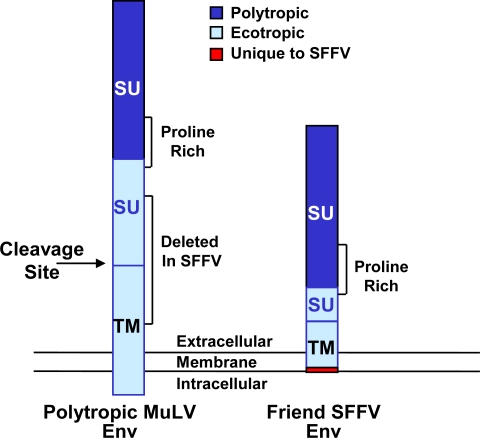
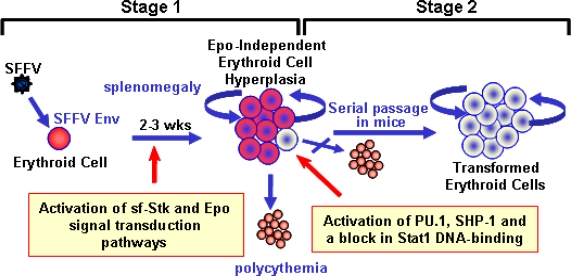
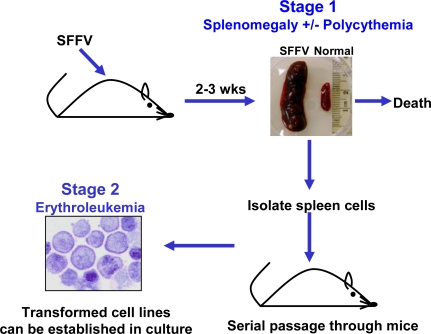
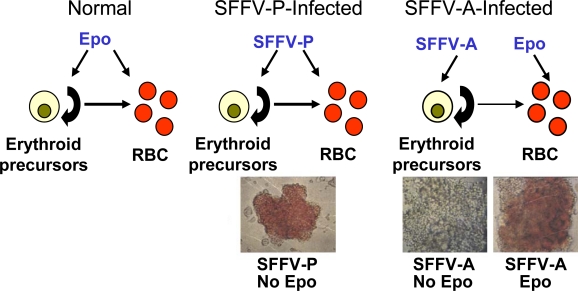
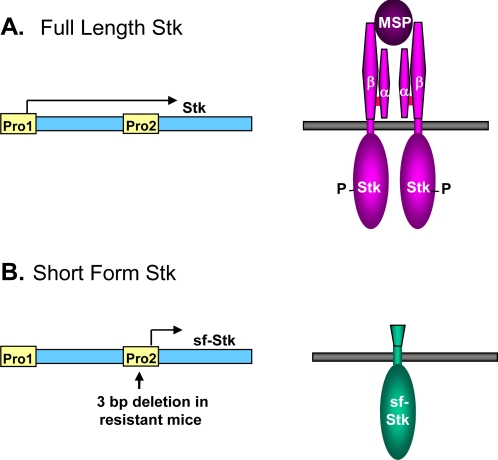
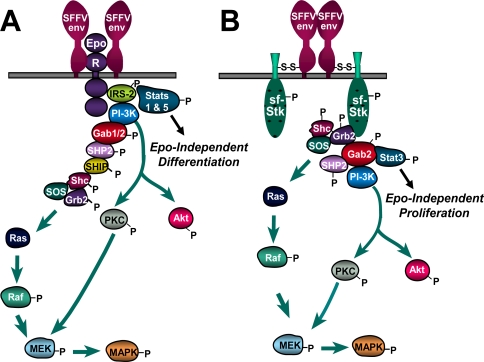
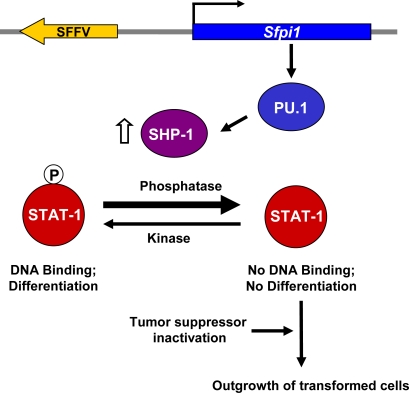
those that promote hematopoietic cell proliferation and survival (often the result of activation of tyrosine kinases) and those that impair hematopoietic cell differentiation (often the result of changes in transcription factors). The multi-stage erythroleukemia induced in mice by Friend spleen focus-forming virus (SFFV) is an excellent animal model for studying the molecular basis for both of these changes. Significant progress has been made in understanding the molecular basis for the multi-stage erythroleukemia induced by Friend SFFV. In the first stage of leukemia, the envelope protein encoded by SFFV interacts with and activates the erythropoietin (Epo) receptor and the receptor tyrosine kinase sf-Stk in erythroid cells, causing their Epo-independent proliferation, differentiation and survival. In the second stage, SFFV integration into the Sfpi1 locus activates the myeloid transcription factor PU.1, blocking erythroid cell differentiation, and in conjunction with the loss of p53 tumor suppressor activity, results in the outgrowth of malignant cells. In this review, we discuss the current level of understanding of how SFFV alters the growth and differentiation of erythroid cells and results in the development of erythroleukemia. Our knowledge of how SFFV causes erythroleukemia in mice may give us clues as to how the highly related human retrovirus XMRV causes malignancies in humans.
那些促进造血细胞增殖和存活的改变(通常是酪氨酸激酶激活的结果),以及那些损害造血细胞分化的改变(通常是转录因子变化的结果)。Friend 脾集落形成病毒(SFFV)诱导的多阶段红白血病是研究这两种改变的分子基础的极好动物模型。在理解 Friend SFFV 诱导的多阶段红白血病的分子基础方面已经取得了重大进展。在白血病的第一阶段,SFFV 编码的包膜蛋白与红细胞生成素(Epo)受体和 sf-Stk 受体酪氨酸激酶相互作用并激活它们,导致它们的 Epo 非依赖性增殖、分化和存活。在第二阶段,SFFV 整合到 Sfpi1 基因座中激活髓系转录因子 PU.1,阻断红细胞分化,与 p53 肿瘤抑制活性丧失一起,导致恶性细胞的生长。在这篇综述中,我们讨论了目前对 SFFV 如何改变红细胞的生长和分化并导致红白血病发展的理解水平。我们对 SFFV 如何在小鼠中引起红白血病的了解可能为我们提供线索,说明高度相关的人类逆转录病毒 XMRV 如何导致人类的恶性肿瘤。