TWINCORE †, Division of Experimental Virology, Centre for Experimental and Clinical Infection Research, Feodor-Lynen-Str. 7, 30625 Hannover, Germany.
Viruses. 2010 Sep;2(9):2078-2095. doi: 10.3390/v2092078. Epub 2010 Sep 27.
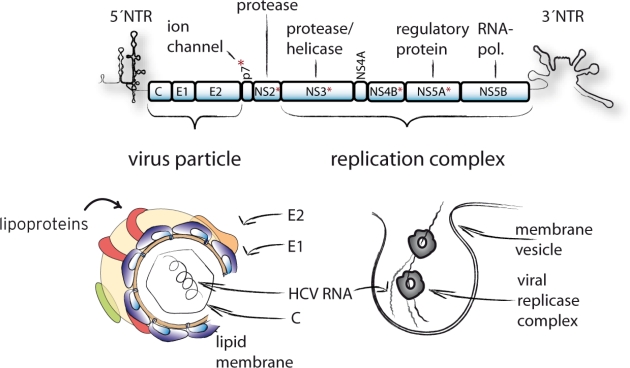
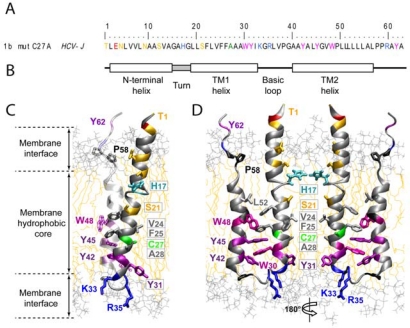
The hepatitis C virus (HCV), a hepatotropic plus-strand RNA virus of the family Flaviviridae, encodes a set of 10 viral proteins. These viral factors act in concert with host proteins to mediate virus entry, and to coordinate RNA replication and virus production. Recent evidence has highlighted the complexity of HCV assembly, which not only involves viral structural proteins but also relies on host factors important for lipoprotein synthesis, and a number of viral assembly co-factors. The latter include the integral membrane protein p7, which oligomerizes and forms cation-selective pores. Based on these properties, p7 was included into the family of viroporins comprising viral proteins from multiple virus families which share the ability to manipulate membrane permeability for ions and to facilitate virus production. Although the precise mechanism as to how p7 and its ion channel function contributes to virus production is still elusive, recent structural and functional studies have revealed a number of intriguing new facets that should guide future efforts to dissect the role and function of p7 in the viral replication cycle. Moreover, a number of small molecules that inhibit production of HCV particles, presumably via interference with p7 function, have been reported. These compounds should not only be instrumental in increasing our understanding of p7 function, but may, in the future, merit further clinical development to ultimately optimize HCV-specific antiviral treatments.
丙型肝炎病毒 (HCV) 是黄病毒科的一种嗜肝正链 RNA 病毒,它编码一套 10 种病毒蛋白。这些病毒因子与宿主蛋白协同作用,介导病毒进入,并协调 RNA 复制和病毒产生。最近的证据突出了 HCV 组装的复杂性,它不仅涉及病毒结构蛋白,还依赖于对脂蛋白合成很重要的宿主因子,以及一些病毒组装辅助因子。后者包括整合膜蛋白 p7,它寡聚化并形成阳离子选择性孔。基于这些特性,p7 被归入包含来自多种病毒科的病毒蛋白的病毒孔蛋白家族,这些病毒蛋白具有操纵离子通过膜的通透性和促进病毒产生的能力。尽管 p7 及其离子通道功能如何促进病毒产生的确切机制仍不清楚,但最近的结构和功能研究揭示了一些有趣的新方面,这些方面应该指导未来努力剖析 p7 在病毒复制周期中的作用和功能。此外,已经报道了一些抑制 HCV 颗粒产生的小分子,推测是通过干扰 p7 功能。这些化合物不仅有助于加深我们对 p7 功能的理解,而且在未来可能值得进一步的临床开发,以最终优化 HCV 特异性抗病毒治疗。