Department of Medicine, University of Alabama at Birmingham, Birmingham, Alabama, United States of America.
PLoS One. 2011;6(10):e25843. doi: 10.1371/journal.pone.0025843. Epub 2011 Oct 5.
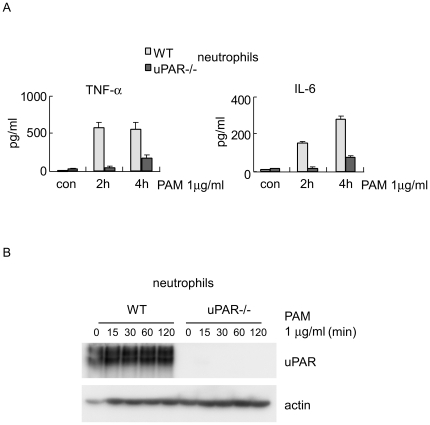
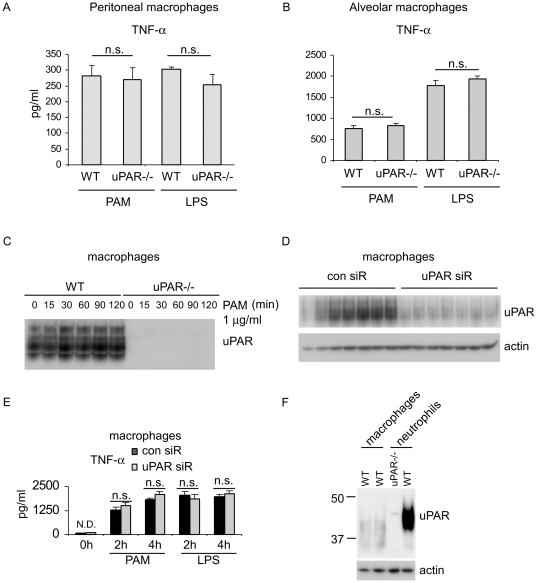
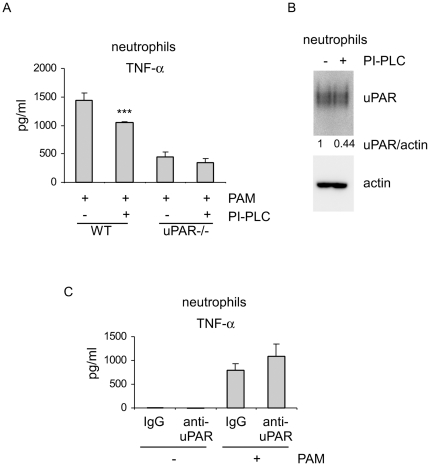
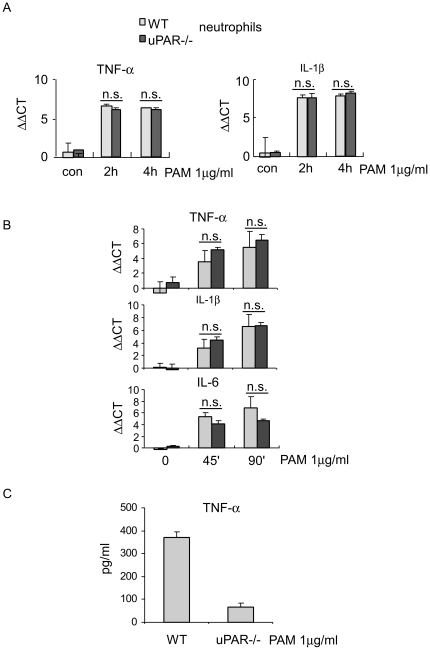
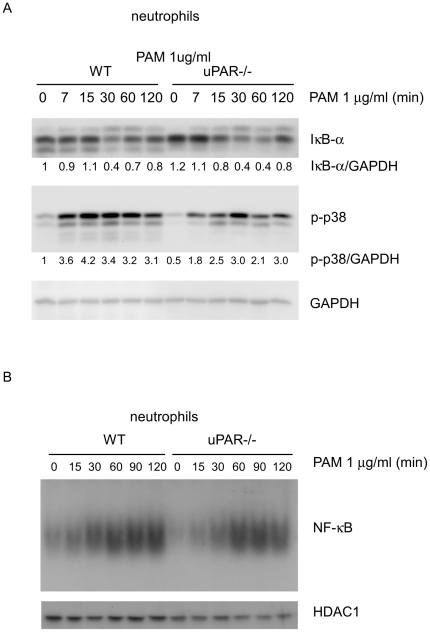
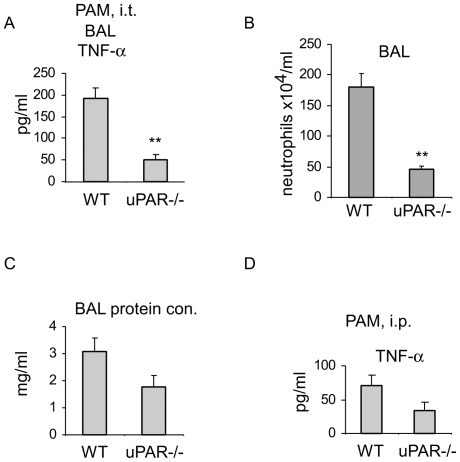
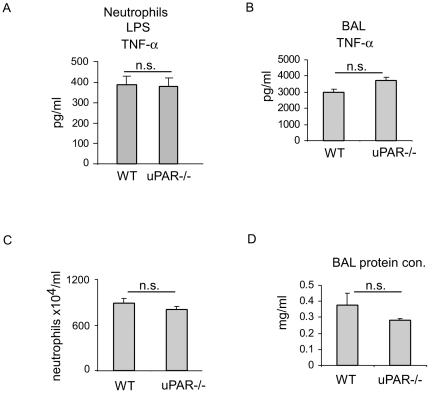
The urokinase-type plasminogen activator receptor (uPAR), a glycosylphosphatidylinositol (GPI) anchored membrane protein, regulates urokinase (uPA) protease activity, chemotaxis, cell-cell interactions, and phagocytosis of apoptotic cells. uPAR expression is increased in cytokine or bacteria activated cell populations, including macrophages and monocytes. However, it is unclear if uPAR has direct involvement in the response of inflammatory cells, such as neutrophils and macrophages, to Toll like receptor (TLR) stimulation. In this study, we found that uPAR is required for optimal neutrophil activation after TLR2, but not TLR4 stimulation. We found that the expression of TNF-α and IL-6 induced by TLR2 engagement in uPAR-/- neutrophils was less than that in uPAR+/+ (WT) neutrophils. Pretreatment of neutrophils with PI-PLC, which cleaves GPI moieties, significantly decreased TLR2 induced expression of TNF-α in WT neutrophils, but demonstrated only marginal effects on TNF-α expression in PAM treated uPAR-/- neutrophils. IκB-α degradation and NF-κB activation were not different in uPAR-/- or WT neutrophils after TLR2 stimulation. However, uPAR is required for optimal p38 MAPK activation after TLR2 engagement. Consistent with the in vitro findings that uPAR modulates TLR2 engagement induced neutrophil activation, we found that pulmonary and systemic inflammation induced by TLR2, but not TLR4 stimulation is reduced in uPAR-/- mice compared to WT counterparts. Therefore, our data suggest that neutrophil associated uPAR could be a potential target for treating acute inflammation, sepsis, and organ injury related to severe bacterial and other microbial infections in which TLR2 engagement plays a major role.
尿激酶型纤溶酶原激活物受体(uPAR)是一种糖基磷脂酰肌醇(GPI)锚定的膜蛋白,调节尿激酶(uPA)蛋白酶活性、趋化性、细胞-细胞相互作用和凋亡细胞的吞噬作用。uPAR 的表达在细胞因子或细菌激活的细胞群体中增加,包括巨噬细胞和单核细胞。然而,目前尚不清楚 uPAR 是否直接参与炎症细胞(如中性粒细胞和巨噬细胞)对 Toll 样受体(TLR)刺激的反应。在这项研究中,我们发现 uPAR 是 TLR2 刺激后中性粒细胞最佳激活所必需的,但不是 TLR4 刺激。我们发现,TLR2 结合后 uPAR-/-中性粒细胞中诱导的 TNF-α 和 IL-6 的表达少于 uPAR+/+(WT)中性粒细胞。用 PI-PLC(一种切割 GPI 部分的酶)预处理中性粒细胞,可显著降低 WT 中性粒细胞中 TLR2 诱导的 TNF-α表达,但对 PAM 处理的 uPAR-/-中性粒细胞中 TNF-α表达的影响较小。TLR2 刺激后,uPAR-/-或 WT 中性粒细胞中 IκB-α降解和 NF-κB 激活无差异。然而,TLR2 结合后 uPAR 是最佳 p38 MAPK 激活所必需的。与体外研究结果一致,即 uPAR 调节 TLR2 结合诱导的中性粒细胞激活,我们发现与 WT 对照相比,TLR2 而不是 TLR4 刺激引起的肺和全身炎症在 uPAR-/-小鼠中减少。因此,我们的数据表明,中性粒细胞相关的 uPAR 可能是治疗与严重细菌和其他微生物感染相关的急性炎症、败血症和器官损伤的潜在靶点,其中 TLR2 结合发挥主要作用。