The Second Medical College, Jinan University, Shenzhen Clinical Medical Research Center, Shenzhen People's Hospital, 518020 Shenzhen, PR China.
J Exp Clin Cancer Res. 2011 Oct 17;30(1):98. doi: 10.1186/1756-9966-30-98.
DNA methylation has been widely used in classification, early diagnosis, therapy and prediction of metastasis as well as recurrence of cervical cancer. DNMT methyltransferase 1 (DNMT1), which plays a significant role in maintaining DNA methylation status and regulating the expression of tumor suppressor genes. The aim of this research was to investigate the relationship between DNMT1 and abnormal methylation of tumor suppressor genes and malignant phenotype in cervical cancer.
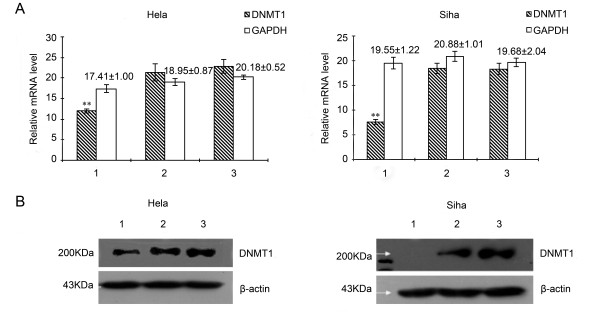
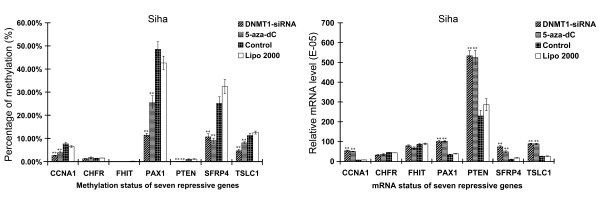
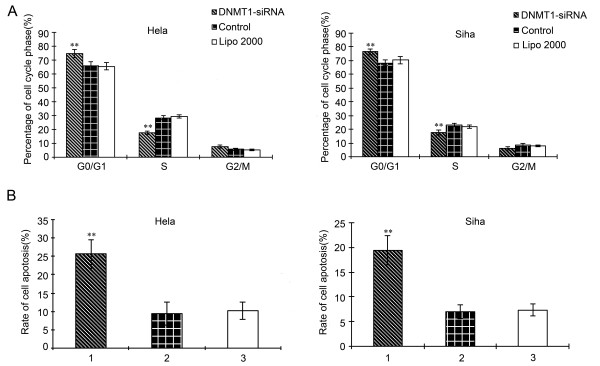
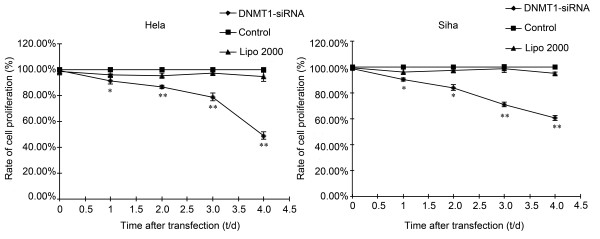
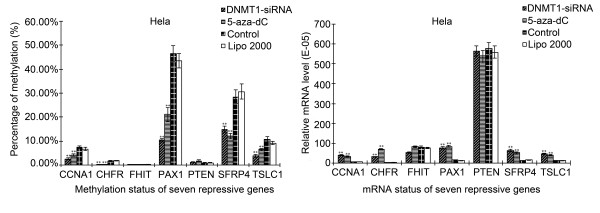
Levels of DNMT1 mRNA and protein were detected using qPCR and Western blot, respectively. Cell proliferation was analyzed by MTT and apoptosis was performed by Annexin V-FITC/PI double staining flow cytometry, respectively. MeDIP-qPCR and qPCR were performed to measure demethylation status and mRNA re-expression level of 7 tumor-suppressor genes (CCNA1, CHFR, FHIT, PAX1, PTEN, SFRP4, TSLC1) in Hela and Siha cells after silencing DNMT1.
The average expression levels of DNMT1 mRNA and protein in Hela and Siha cells were decreased significantly compared with control group. The flow cytometry and MTT results showed that Hela and Siha cells apoptosis rates and cell viabilities were 19.4 ± 2.90%, 25.7 ± 3.92% as well as 86.7 ± 3.12%, 84.16 ± 2.67% respectively 48 h after transfection (P < 0.01). Furthermore, the promoter methylation of five tumor suppressor genes was decreased with the increased mRNA expression after silencing DNMT1, whereas there were no significant changes in PTEN and FHIT genes in Hela cells, and CHFR and FHIT genes in Siha cells.
Our experimental results demonstrate that methylation status of DNMT1 can influence several important tumor suppressor genes activity in cervical tumorigenesis and may have the potential to become an effective target for treatment of cervical cancer.
DNA 甲基化已广泛应用于宫颈癌的分类、早期诊断、治疗以及转移和复发的预测。DNMT 甲基转移酶 1(DNMT1)在维持 DNA 甲基化状态和调节肿瘤抑制基因的表达方面起着重要作用。本研究旨在探讨 DNMT1 与肿瘤抑制基因异常甲基化和宫颈癌恶性表型之间的关系。
使用 qPCR 和 Western blot 分别检测 DNMT1mRNA 和蛋白的水平。通过 MTT 分析细胞增殖,通过 Annexin V-FITC/PI 双染流式细胞术分析细胞凋亡。在沉默 DNMT1 后,通过 MeDIP-qPCR 和 qPCR 测量 Hela 和 Siha 细胞中 7 个肿瘤抑制基因(CCNA1、CHFR、FHIT、PAX1、PTEN、SFRP4、TSLC1)的去甲基化状态和 mRNA 再表达水平。
与对照组相比,Hela 和 Siha 细胞中 DNMT1mRNA 和蛋白的平均表达水平显著降低。流式细胞术和 MTT 结果显示,转染 48 h 后,Hela 和 Siha 细胞的凋亡率和细胞活力分别为 19.4±2.90%、25.7±3.92%以及 86.7±3.12%、84.16±2.67%(P<0.01)。此外,沉默 DNMT1 后,五个肿瘤抑制基因的启动子甲基化减少,同时在 Hela 细胞中,PTEN 和 FHIT 基因以及 Siha 细胞中 CHFR 和 FHIT 基因的 mRNA 表达没有明显变化。
我们的实验结果表明,DNMT1 的甲基化状态可以影响宫颈癌发生过程中几个重要的肿瘤抑制基因的活性,并且可能成为治疗宫颈癌的有效靶点。