Department of Pathology, Stony Brook University, Stony Brook, New York 11794, USA.
J Cell Biochem. 2012 Feb;113(2):433-9. doi: 10.1002/jcb.23400.
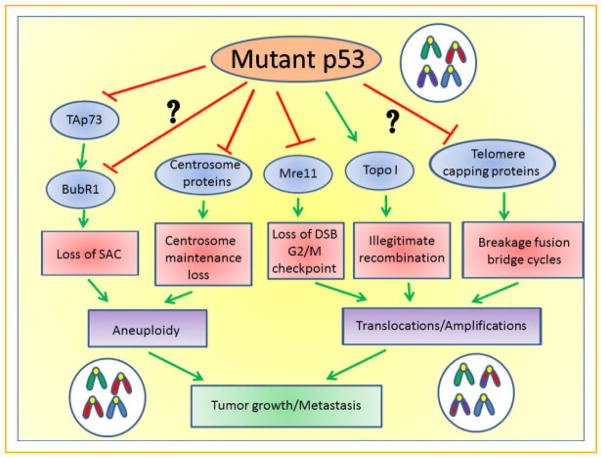
The tumor suppressor p53 has long been known to play a central role in maintaining a stable genome in the face of toxic insults through its role in promoting cell-cycle checkpoints, DNA repair, and apoptosis. However, p53 null cells still retain some function of certain checkpoint and repair processes, reducing the genomic changes that otherwise would occur if these mechanisms were absent. Accumulating evidence suggests that mutant forms of p53 proteins may drastically perturb these residual genome-stabilizing mechanisms through gain-of-function interactions with multiple proteins leading to a higher level of genomic instability than in p53 null cells. This review summarizes the current body of evidence that mutp53 plays a role in promoting various forms of genomic instability and provides an overview of current mechanistic proposals.
抑癌基因 p53 长期以来一直被认为在应对有毒物质的侵害时,通过促进细胞周期检查点、DNA 修复和细胞凋亡,在维持稳定的基因组方面发挥着核心作用。然而,p53 缺失细胞仍然保留了某些检查点和修复过程的功能,从而减少了如果这些机制缺失时本会发生的基因组变化。越来越多的证据表明,p53 蛋白的突变形式可能通过与多种蛋白的功能获得性相互作用,严重扰乱这些残留的基因组稳定机制,导致比 p53 缺失细胞更高水平的基因组不稳定性。这篇综述总结了目前关于 mutp53 促进各种形式基因组不稳定性的证据,并概述了目前的机制假说。