Department of Internal Medicine, Seoul National University Hospital, Seoul, Korea.
Korean J Intern Med. 2011 Sep;26(3):328-39. doi: 10.3904/kjim.2011.26.3.328. Epub 2011 Sep 13.
BACKGROUND/AIMS: We investigated the clinical characteristics and prognosis of elderly patients with acute lymphoblastic leukemia (ALL).
We reviewed the clinical data, laboratory findings, bone marrow findings, and cytogenetic analysis of elderly patients (≥ 60 years) with ALL, and data of an additional 101 younger adult patients (< 60 years) with ALL were reviewed for comparison.
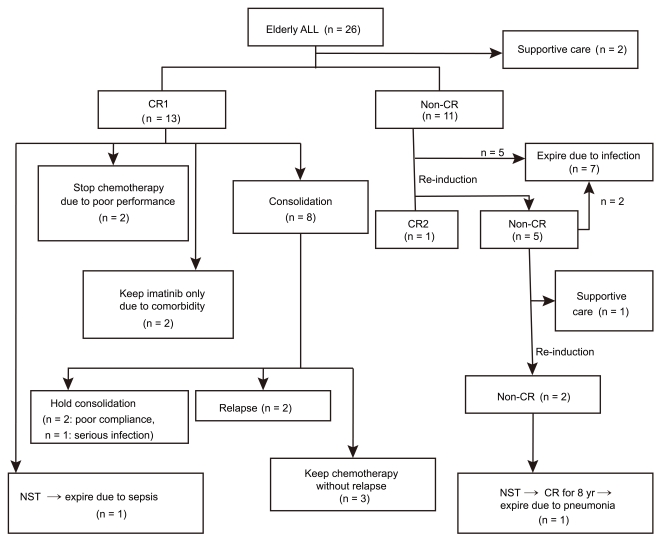
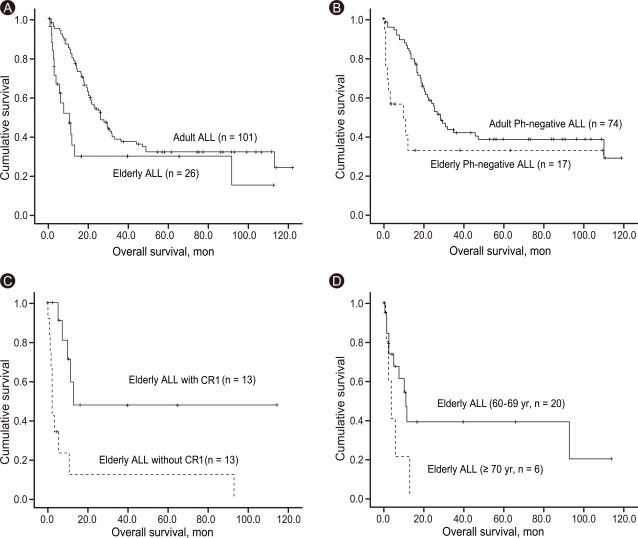
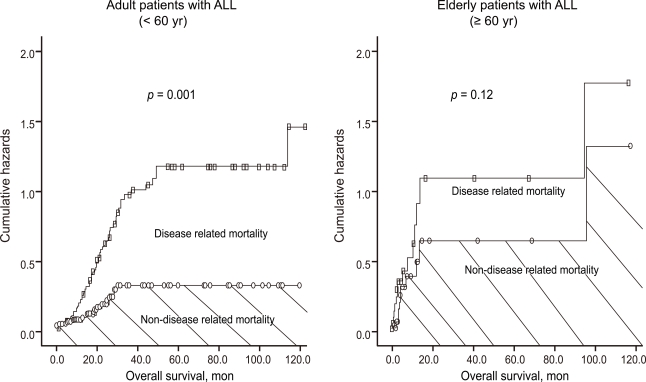
Twenty-six elderly patients (≥ 60 years) and 101 younger adult patients (< 60 years) with ALL were retrospectively enrolled. The median follow-up duration was 6.0 months (range, 0.4 to 113.2) in the elderly patients and 21.7 months (range, 1.0 to 122.7) in the adult patients. In total, 34.6% (9 patients) of the elderly patients and 24.8% (25 patients) of the adult patients had Philadelphia chromosome positive ALL. The overall complete remission (CR) rate was much higher in the younger than in the elderly patients (94.1% vs. 57.7%, p < 0.001). The median overall survival (OS) of the younger patients (< 60 years) was 26.3 months, whereas that of the elderly patients (≥ 60 years) was 10.3 months (p = 0.003). In the elderly patients with ALL, T cell lineage and the presence of lymphadenopathy were significant prognostic factors for OS in a univariate analysis (p = 0.033 and 0.041, respectively).
The outcomes of Korean elderly patients with ALL were poor, and the shorter OS was mainly due to the low CR rate. T-cell lineage and the presence of lymphadenopathy were significant prognostic factors in Korean elderly patients with ALL.
背景/目的:我们研究了老年急性淋巴细胞白血病(ALL)患者的临床特征和预后。
我们回顾了老年(≥ 60 岁)ALL 患者的临床资料、实验室检查结果、骨髓检查结果和细胞遗传学分析,并对另外 101 例年轻成年 ALL 患者(< 60 岁)的资料进行了回顾性比较。
共纳入 26 例老年(≥ 60 岁)和 101 例年轻成年(< 60 岁)ALL 患者。老年患者的中位随访时间为 6.0 个月(范围,0.4 至 113.2),成年患者为 21.7 个月(范围,1.0 至 122.7)。老年患者中 34.6%(9 例)和成年患者中 24.8%(25 例)为费城染色体阳性 ALL。年轻患者的总体完全缓解(CR)率明显高于老年患者(94.1% vs. 57.7%,p < 0.001)。年轻患者(< 60 岁)的中位总生存(OS)为 26.3 个月,而老年患者(≥ 60 岁)为 10.3 个月(p = 0.003)。在老年 ALL 患者中,T 细胞谱系和淋巴结病在单因素分析中是 OS 的显著预后因素(p = 0.033 和 0.041)。
韩国老年 ALL 患者的预后较差,OS 较短主要是由于 CR 率较低。T 细胞谱系和淋巴结病是韩国老年 ALL 患者的显著预后因素。