Department of Microbiology, Immunology and Tropical Medicine, George Washington University Medical Center, Washington, D. C., United States of America.
PLoS One. 2011;6(10):e25996. doi: 10.1371/journal.pone.0025996. Epub 2011 Oct 7.
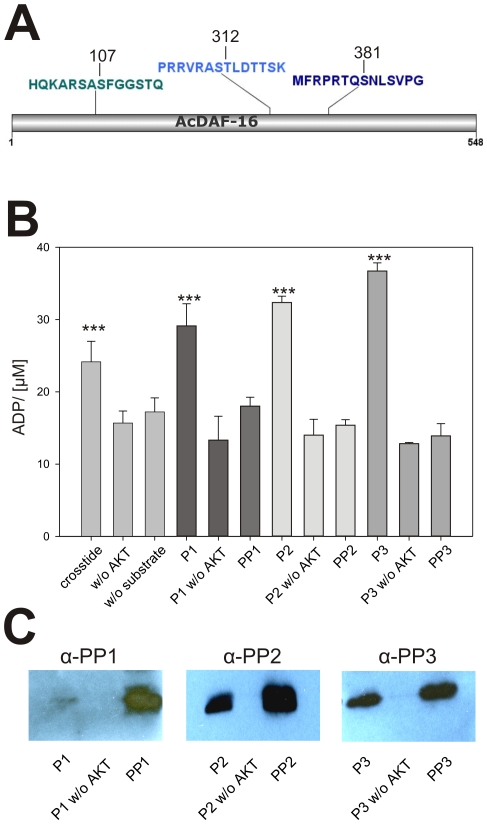
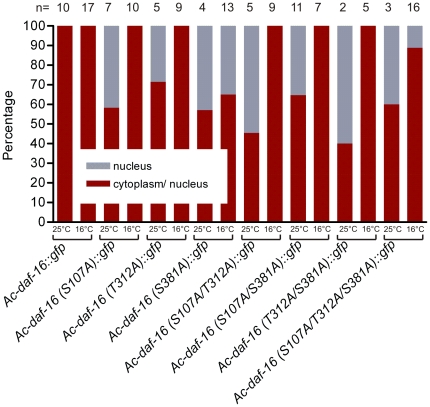
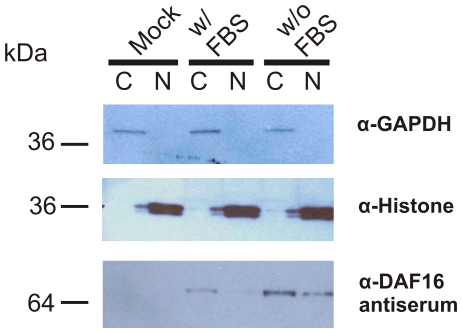
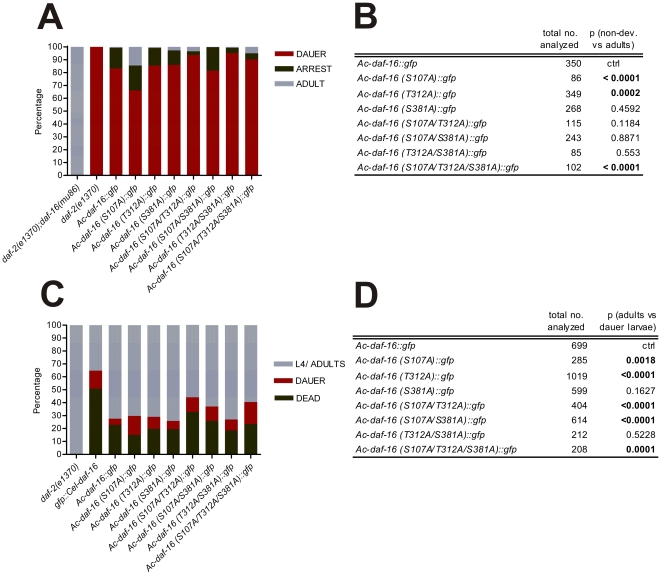
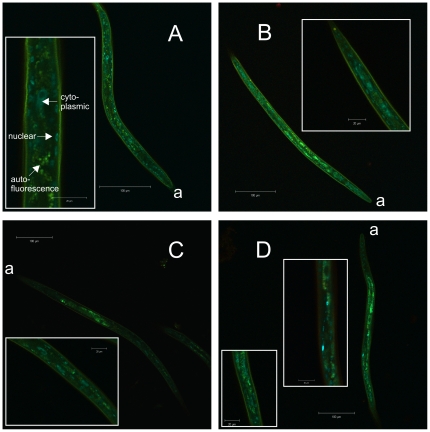
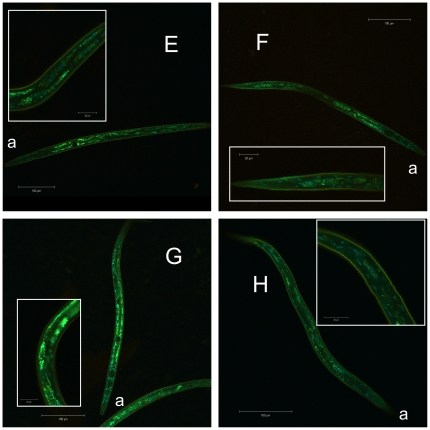
Parasitic hookworms and the free-living model nematode Caenorhabtidis elegans share a developmental arrested stage, called the dauer stage in C. elegans and the infective third-stage larva (L3) in hookworms. One of the key transcription factors that regulate entrance to and exit from developmental arrest is the forkhead transcription factor DAF-16/FoxO. During the dauer stage, DAF-16 is activated and localized in the nucleus. DAF-16 is negatively regulated by phosphorylation by the upstream kinase AKT, which causes DAF-16 to localize out of the nucleus and the worm to exit from dauer. DAF-16 is conserved in hookworms, and hypothesized to control recovery from L3 arrest during infection. Lacking reverse genetic techniques for use in hookworms, we used C. elegans complementation assays to investigate the function of Ancylostoma caninum DAF-16 during entrance and exit from L3 developmental arrest. We performed dauer switching assays and observed the restoration of the dauer phenotype when Ac-DAF-16 was expressed in temperature-sensitive dauer defective C. elegans daf-2(e1370);daf-16(mu86) mutants. AKT phosphorylation site mutants of Ac-DAF-16 were also able to restore the dauer phenotype, but surprisingly allowed dauer exit when temperatures were lowered. We used fluorescence microscopy to localize DAF-16 during dauer and exit from dauer in C. elegans DAF-16 mutant worms expressing Ac-DAF-16, and found that Ac-DAF-16 exited the nucleus during dauer exit. Surprisingly, Ac-DAF-16 with mutated AKT phosphorylation sites also exited the nucleus during dauer exit. Our results suggest that another mechanism may be involved in the regulation DAF-16 nuclear localization during recovery from developmental arrest.
寄生钩虫和自由生活的模式线虫秀丽隐杆线虫有一个共同的发育停滞阶段,在秀丽隐杆线虫中称为 dauer 阶段,在钩虫中称为感染性的第三阶段幼虫(L3)。调节进入和退出发育停滞的关键转录因子之一是叉头转录因子 DAF-16/FoxO。在 dauer 阶段,DAF-16 被激活并定位于细胞核内。DAF-16 被上游激酶 AKT 的磷酸化负调控,导致 DAF-16 从核内定位并使线虫从 dauer 中退出。DAF-16 在钩虫中保守,被假设控制感染期间从 L3 停滞中恢复。由于缺乏用于钩虫的反向遗传技术,我们使用秀丽隐杆线虫互补测定来研究Ancylostoma caninum DAF-16 在进入和退出 L3 发育停滞期间的功能。我们进行了 dauer 转换测定,并观察到当 Ac-DAF-16 在温度敏感的 dauer 缺陷型 C. elegans daf-2(e1370);daf-16(mu86) 突变体中表达时,dauer 表型得到恢复。Ac-DAF-16 的 AKT 磷酸化位点突变体也能够恢复 dauer 表型,但令人惊讶的是,当温度降低时,它们允许 dauer 退出。我们使用荧光显微镜在表达 Ac-DAF-16 的 C. elegans DAF-16 突变体线虫中定位 dauer 和退出 dauer 期间的 DAF-16,并发现 Ac-DAF-16 在 dauer 退出期间离开细胞核。令人惊讶的是,具有突变 AKT 磷酸化位点的 Ac-DAF-16 也在 dauer 退出期间离开细胞核。我们的结果表明,在从发育停滞中恢复期间,可能涉及另一种机制来调节 DAF-16 的核定位。