Division of Cancer Epidemiology and Genetics, National Cancer Institute, National Institutes of Health, Bethesda, Maryland, United States of America.
PLoS Genet. 2011 Oct;7(10):e1002312. doi: 10.1371/journal.pgen.1002312. Epub 2011 Oct 13.
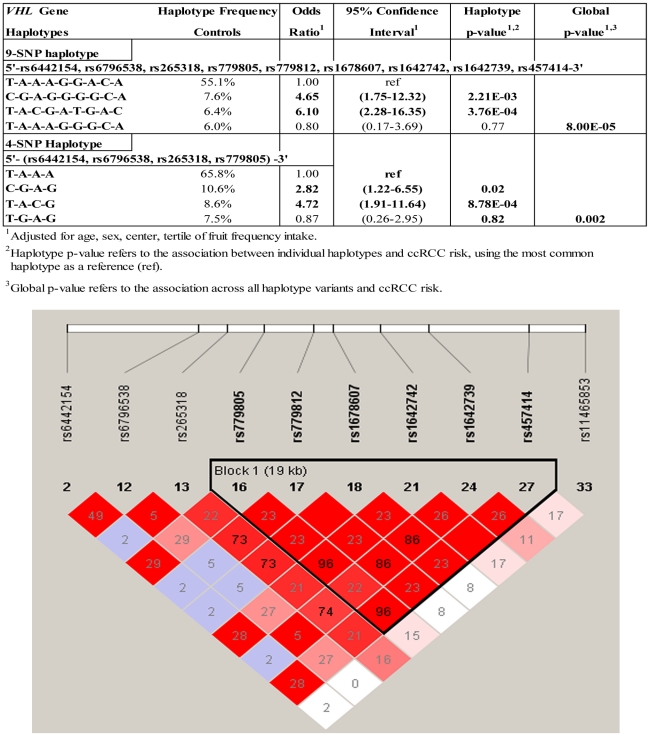
Renal tumor heterogeneity studies have utilized the von Hippel-Lindau VHL gene to classify disease into molecularly defined subtypes to examine associations with etiologic risk factors and prognosis. The aim of this study was to provide a comprehensive analysis of VHL inactivation in clear cell renal tumors (ccRCC) and to evaluate relationships between VHL inactivation subgroups with renal cancer risk factors and VHL germline single nucleotide polymorphisms (SNPs). VHL genetic and epigenetic inactivation was examined among 507 sporadic RCC/470 ccRCC cases using endonuclease scanning and using bisulfite treatment and Sanger sequencing across 11 CpG sites within the VHL promoter. Case-only multivariate analyses were conducted to identify associations between alteration subtypes and risk factors. VHL inactivation, either through sequence alterations or promoter methylation in tumor DNA, was observed among 86.6% of ccRCC cases. Germline VHL SNPs and a haplotype were associated with promoter hypermethylation in tumor tissue (OR = 6.10; 95% CI: 2.28-16.35, p = 3.76E-4, p-global = 8E-5). Risk of having genetic VHL inactivation was inversely associated with smoking due to a higher proportion of wild-type ccRCC tumors [former: OR = 0.70 (0.20-1.31) and current: OR = 0.56 (0.32-0.99); P-trend = 0.04]. Alteration prevalence did not differ by histopathologic characteristics or occupational exposure to trichloroethylene. ccRCC cases with particular VHL germline polymorphisms were more likely to have VHL inactivation through promoter hypermethylation than through sequence alterations in tumor DNA, suggesting that the presence of these SNPs may represent an example of facilitated epigenetic variation (an inherited propensity towards epigenetic variation) in renal tissue. A proportion of tumors from current smokers lacked VHL alterations and may represent a biologically distinct clinical entity from inactivated cases.
肾肿瘤异质性研究利用 von Hippel-Lindau(VHL)基因将疾病分为分子定义的亚型,以检查与病因风险因素和预后的关联。本研究旨在提供透明细胞肾肿瘤(ccRCC)中 VHL 失活的综合分析,并评估 VHL 失活亚组与肾癌风险因素和 VHL 种系单核苷酸多态性(SNP)之间的关系。使用内切酶扫描和亚硫酸氢盐处理以及在 VHL 启动子内的 11 个 CpG 位点进行 Sanger 测序,对 507 例散发性 RCC/470 例 ccRCC 病例中的 VHL 遗传和表观遗传失活进行了检查。仅进行病例的多变量分析,以确定改变亚型与风险因素之间的关联。在 86.6%的 ccRCC 病例中观察到肿瘤 DNA 中通过序列改变或启动子甲基化导致的 VHL 失活。种系 VHL SNP 和单倍型与肿瘤组织中的启动子过度甲基化相关(OR=6.10;95%CI:2.28-16.35,p=3.76E-4,p-global=8E-5)。由于野生型 ccRCC 肿瘤的比例较高,遗传 VHL 失活的风险与吸烟呈负相关[前吸烟者:OR=0.70(0.20-1.31)和当前吸烟者:OR=0.56(0.32-0.99);P 趋势=0.04]。改变的患病率不因组织病理学特征或职业性接触三氯乙烯而异。具有特定 VHL 种系多态性的 ccRCC 病例更有可能通过肿瘤 DNA 中的启动子过度甲基化而不是通过序列改变导致 VHL 失活,这表明这些 SNP 的存在可能代表肾组织中易发生表观遗传变异(对表观遗传变异的遗传倾向)的一个例子。一部分当前吸烟者的肿瘤缺乏 VHL 改变,可能代表与失活病例不同的生物学实体。