Department of Preventive Medicine, Keck School of Medicine, University of Southern California, Los Angeles, California, United States of America.
PLoS One. 2011;6(10):e25985. doi: 10.1371/journal.pone.0025985. Epub 2011 Oct 20.
Adenocarcinomas located near the gastroesophageal junction have unclear etiology and are difficult to classify. We used DNA methylation analysis to identify subtype-specific markers and new subgroups of gastroesophageal adenocarcinomas, and studied their association with epidemiological risk factors and clinical outcomes.
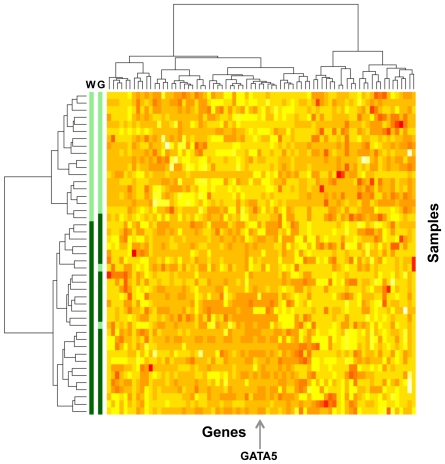
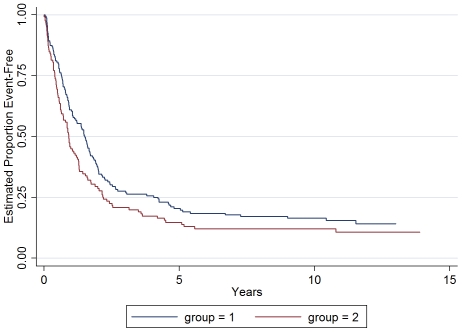
METHODOLOGY/PRINCIPAL FINDINGS: We used logistic regression models and unsupervised hierarchical cluster analysis of 74 DNA methylation markers on 45 tumor samples (44 patients) of esophageal and gastric adenocarcinomas obtained from a population-based case-control study to uncover epigenetic markers and cluster groups of gastroesophageal adenocarcinomas. No distinct epigenetic differences were evident between subtypes of gastric and esophageal cancers. However, we identified two gastroesophageal adenocarcinoma subclusters based on DNA methylation profiles. Group membership was best predicted by GATA5 DNA methylation status. We analyzed the associations between these two epigenetic groups and exposure using logistic regression, and the associations with survival time using Cox regression in a larger set of 317 tumor samples (278 patients). There were more males with esophageal and gastric cardia cancers in Cluster Group 1 characterized by higher GATA5 DNA methylation values (all p<0.05). This group also showed associations of borderline statistical significance with having ever smoked (p-value = 0.07), high body mass index (p-value = 0.06), and symptoms of gastroesophageal reflux (p-value = 0.07). Subjects in cluster Group 1 showed better survival than those in Group 2 after adjusting for tumor differentiation grade, but this was not found to be independent of tumor stage.
CONCLUSIONS/SIGNIFICANCE: DNA methylation profiling can be used in population-based studies to identify epigenetic subclasses of gastroesophageal adenocarcinomas and class-specific DNA methylation markers that can be linked to epidemiological data and clinical outcome. Two new epigenetic subgroups of gastroesophageal adenocarcinomas were identified that differ to some extent in their survival rates, risk factors of exposure, and GATA5 DNA methylation.
位于胃食管交界处的腺癌病因不明,难以分类。我们使用 DNA 甲基化分析来鉴定具有亚型特异性的标志物和胃食管腺癌的新亚群,并研究它们与流行病学风险因素和临床结果的关联。
方法/主要发现:我们使用逻辑回归模型和无监督层次聚类分析,对来自基于人群的病例对照研究的 45 个肿瘤样本(44 名患者)中的 74 个 DNA 甲基化标志物进行分析,以揭示胃食管腺癌的表观遗传标志物和聚类组。胃和食管癌症的亚型之间没有明显的表观遗传差异。然而,我们根据 DNA 甲基化谱鉴定了两个胃食管腺癌亚群。GATA5 DNA 甲基化状态最佳预测了群体归属。我们使用逻辑回归分析了这些两个表观遗传组与暴露之间的关联,并在更大的 317 个肿瘤样本(278 名患者)中使用 Cox 回归分析了与生存时间的关联。在特征为 GATA5 DNA 甲基化值较高的聚类组 1 中,有更多的男性患有食管和胃贲门癌(所有 p 值均<0.05)。该组还与曾经吸烟(p 值=0.07)、高体重指数(p 值=0.06)和胃食管反流症状(p 值=0.07)呈边缘统计学意义的关联。在调整肿瘤分化程度后,聚类组 1 中的患者比聚类组 2 中的患者生存更好,但这并不是独立于肿瘤分期的。
结论/意义:DNA 甲基化谱分析可用于基于人群的研究,以鉴定胃食管腺癌的表观遗传亚群和具有特定亚群的 DNA 甲基化标志物,这些标志物可与流行病学数据和临床结果相关联。鉴定了两个新的胃食管腺癌表观遗传亚群,它们在生存率、暴露风险因素和 GATA5 DNA 甲基化方面存在一定差异。