Institute of Human Genetics, Helmholtz Zentrum München-German Research Center for Environmental Health, Neuherberg, Germany.
BMC Neurol. 2011 Oct 27;11:134. doi: 10.1186/1471-2377-11-134.
Action myoclonus-renal failure syndrome is a hereditary form of progressive myoclonus epilepsy associated with renal failure. It is considered to be an autosomal-recessive disease related to loss-of-function mutations in SCARB2. We studied a German AMRF family, additionally showing signs of demyelinating polyneuropathy and dilated cardiomyopathy. To test the hypothesis whether isolated appearance of individual AMRF syndrome features could be related to heterozygote SCARB2 mutations, we screened for SCARB2 mutations in unrelated patients showing isolated AMRF features.
In the AMRF family all exons of SCARB2 were analyzed by Sanger sequencing. The mutation screening of unrelated patients with isolated AMRF features affected by either epilepsy (n = 103, progressive myoclonus epilepsy or generalized epilepsy), demyelinating polyneuropathy (n = 103), renal failure (n = 192) or dilated cardiomyopathy (n = 85) was performed as high resolution melting curve analysis of the SCARB2 exons.
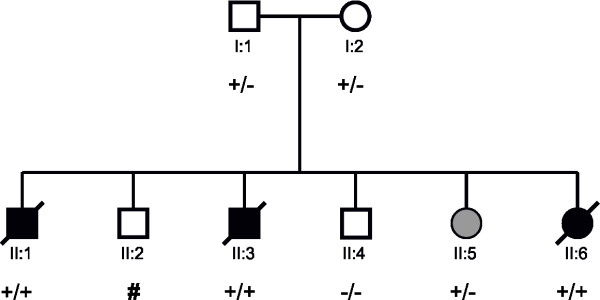
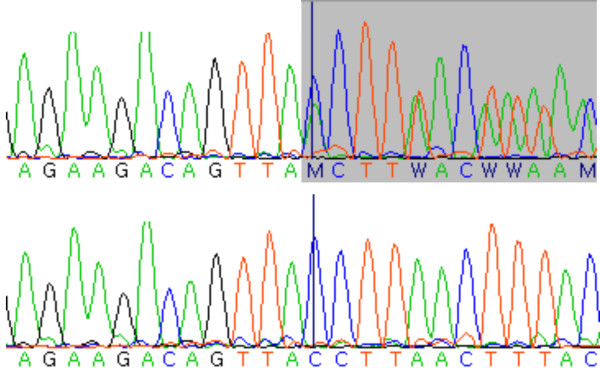
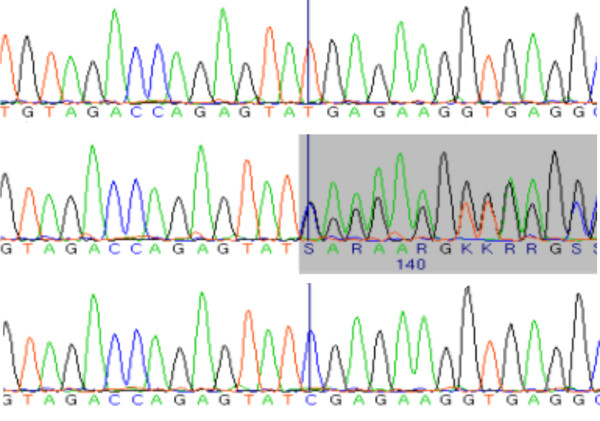
A novel homozygous 1 bp deletion (c.111delC) in SCARB2 was found by sequencing three affected homozygous siblings of the affected family. A heterozygous sister showed generalized seizures and reduction of nerve conduction velocity in her legs. No mutations were found in the epilepsy, renal failure or dilated cardiomyopathy samples. In the polyneuropathy sample two individuals with demyelinating disease were found to be carriers of a SCARB2 frameshift mutation (c.666delCCTTA).
Our findings indicate that demyelinating polyneuropathy and dilated cardiomyopathy are part of the action myoclonus-renal failure syndrome. Moreover, they raise the possibility that in rare cases heterozygous SCARB2 mutations may be associated with PNP features.
动作性肌阵挛-肾衰竭综合征是一种与肾衰竭相关的遗传性进行性肌阵挛性癫痫,被认为是一种常染色体隐性疾病,与 SCARB2 功能丧失突变有关。我们研究了一个德国 AMRF 家族,该家族还表现出脱髓鞘性多发性神经病和扩张型心肌病的迹象。为了检验个体 AMRF 综合征特征的单独表现是否与杂合 SCARB2 突变有关的假说,我们筛选了具有孤立 AMRF 特征的无关患者的 SCARB2 突变。
通过 Sanger 测序分析 AMRF 家族中 SCARB2 的所有外显子。对受影响的无关患者进行 SCARB2 突变筛查,这些患者具有孤立的 AMRF 特征,受影响的患者分别患有癫痫(n = 103,进行性肌阵挛性癫痫或全身性癫痫)、脱髓鞘性多发性神经病(n = 103)、肾衰竭(n = 192)或扩张型心肌病(n = 85)。对 SCARB2 外显子进行高分辨率熔解曲线分析。
通过对受影响的家族中三个受影响的纯合子兄弟姐妹进行测序,发现了一个新的纯合 1 个碱基缺失(c.111delC)。一个杂合姐姐表现出全身性癫痫和腿部神经传导速度降低。在癫痫、肾衰竭或扩张型心肌病样本中未发现突变。在多发性神经病样本中,发现两个患有脱髓鞘疾病的个体为 SCARB2 移码突变(c.666delCCTTA)的携带者。
我们的发现表明脱髓鞘性多发性神经病和扩张型心肌病是动作性肌阵挛-肾衰竭综合征的一部分。此外,它们提出了在罕见情况下,杂合 SCARB2 突变可能与 PNP 特征相关的可能性。