Katua A M, Ankrah A O, Vorster M, van Gelder A, Sathekge M M
Department of Nuclear Medicine, University of Pretoria and Steve Biko Academic Hospital, Pretoria, South Africa.
World J Nucl Med. 2011 Jan;10(1):3-8. doi: 10.4103/1450-1147.82108.
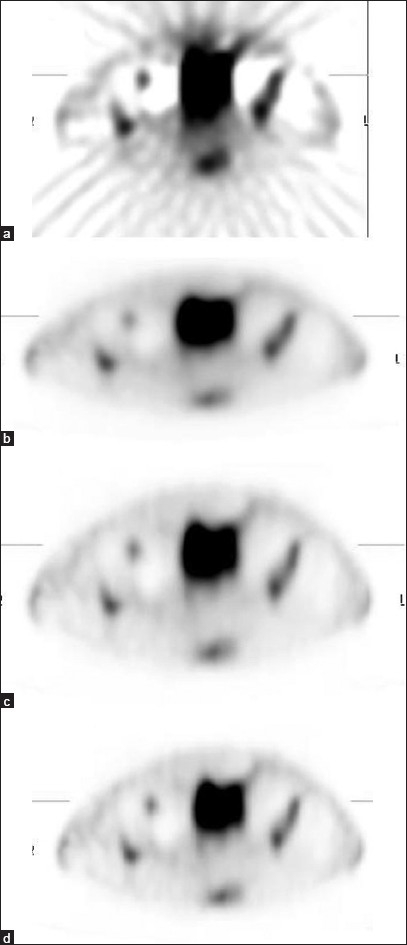
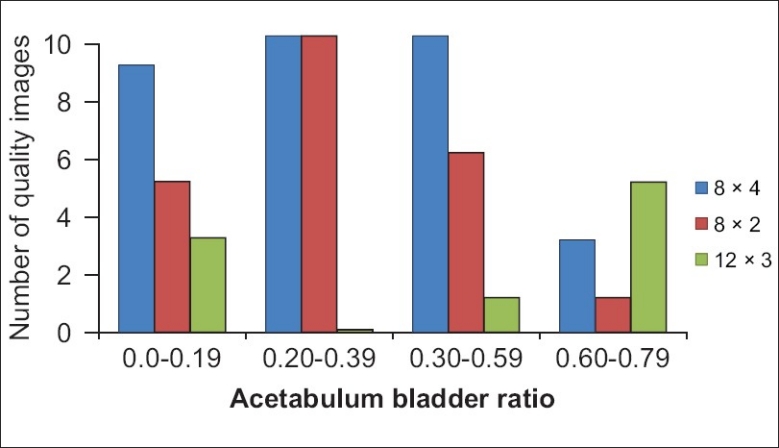
Bladder artifact during bone single-photon emission computed tomography (SPECT) is a common source of error. The extent and severity of bladder artifacts have been described for filtered back projection (FBP) reconstruction. Ordered subset expectation maximization (OSEM) may help to address this problem of bladder artifacts, which render up to 20% of the SPECT images unreadable. The objective of this study was to evaluate the relationship of the bladder to acetabulum ratio in guiding the choice of the number of iterations and subsets used for OSEM reconstruction, for reducing bladder artifacts found on FBP reconstruction. One hundred five patients with various indications for bone scans were selected and planar and SPECT images were acquired. The SPECT images were reconstructed with both FBP and OSEM using four different combinations of iterations and subsets. The images were given to three experienced nuclear physicians who were blinded to the diagnosis and type of reconstruction used. They then labeled images from the best to the worst after which the data were analyzed. The bladder to acetabulum ratio for each image was determined which was then correlated with the different iterations and subsets used. The study demonstrated that reconstruction using OSEM led to better lesion detectability compared to FBP in 87.62% of cases. It further demonstrated that the iterations and subsets used for reconstruction of an image correlate with the bladder to acetabulum ratio. Four iterations and 8 subsets yielded the best results in 48.5% of the images, whilst 2 iterations and 8 subsets yielded the best results in 33.8%. The number of reconstructed images which yielded the best results with 2 iterations and 8 subsets was the same as or more than those with 4 iterations and 8 subsets when the bladder/acetabulum ratio (A/B) was between 0.2 and 0.39. A ratio below 0.2 or above 0.39 supports the usage of 4 iterations and 8 subsets over 2 iterations and 8 subsets. We conclude that bladder to acetabulum ratio can be used to select the optimum number of iterations and subsets for reconstruction of bone SPECT for accurate characterization of lesions. This study also confirms that reconstruction with OSEM (vs. FBP) leads to better lesion detectability and characterization.
骨单光子发射计算机断层扫描(SPECT)期间的膀胱伪影是常见的误差来源。已针对滤波反投影(FBP)重建描述了膀胱伪影的程度和严重性。有序子集期望最大化(OSEM)可能有助于解决膀胱伪影问题,该问题会使高达20%的SPECT图像无法解读。本研究的目的是评估膀胱与髋臼比值在指导用于OSEM重建的迭代次数和子集数量选择方面的关系,以减少FBP重建中出现的膀胱伪影。选择了105例有各种骨扫描指征的患者,并采集了平面和SPECT图像。使用四种不同的迭代和子集组合,用FBP和OSEM对SPECT图像进行重建。将图像交给三位经验丰富的核医学医师,他们对诊断和所用重建类型不知情。然后他们将图像从最佳到最差进行标记,之后对数据进行分析。确定每张图像的膀胱与髋臼比值,然后将其与所用的不同迭代次数和子集进行关联。研究表明,在87.62%的病例中,与FBP相比,使用OSEM重建能更好地检测病变。研究还表明,用于图像重建的迭代次数和子集与膀胱与髋臼比值相关。在48.5%的图像中,4次迭代和8个子集产生了最佳结果,而在33.8%的图像中,2次迭代和8个子集产生了最佳结果。当膀胱/髋臼比值(A/B)在0.2至0.39之间时,2次迭代和8个子集产生最佳结果的重建图像数量与4次迭代和8个子集的相同或更多。比值低于0.2或高于0.39支持使用4次迭代和8个子集而非2次迭代和8个子集。我们得出结论,膀胱与髋臼比值可用于选择骨SPECT重建的最佳迭代次数和子集数量,以准确表征病变。本研究还证实,与FBP相比,OSEM重建能更好地检测和表征病变。