Institute of Molecular Biology/CMBI; Leopold-Francis University, Technikerstrasse 25, A-6020 Innsbruck, Austria.
BMC Biol. 2011 Oct 31;9:75. doi: 10.1186/1741-7007-9-75.
Insulin-producing beta cells emerge during pancreas development in two sequential waves. Recently described later-forming beta cells in zebrafish show high similarity to second wave mammalian beta cells in developmental capacity. Loss-of-function studies in mouse and zebrafish demonstrated that the homeobox transcription factors Pdx1 and Hb9 are both critical for pancreas and beta cell development and discrete stage-specific requirements for these genes have been uncovered. Previously, exocrine and endocrine cell recovery was shown to follow loss of pdx1 in zebrafish, but the progenitor cells and molecular mechanisms responsible have not been clearly defined. In addition, interactions of pdx1 and hb9 in beta cell formation have not been addressed.
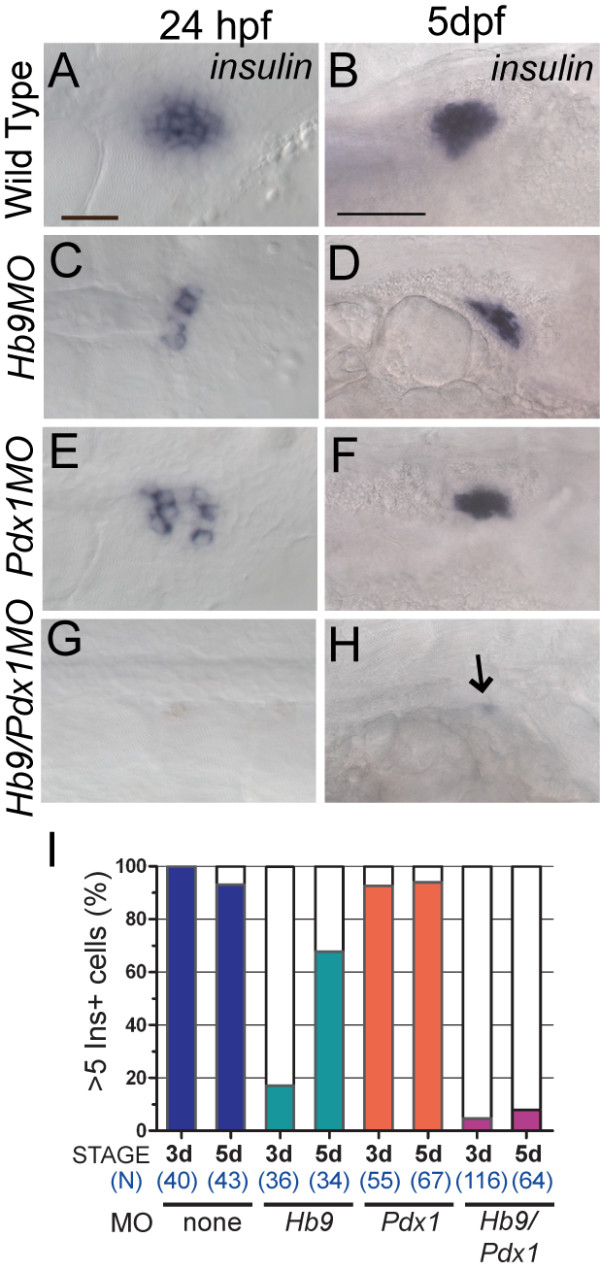
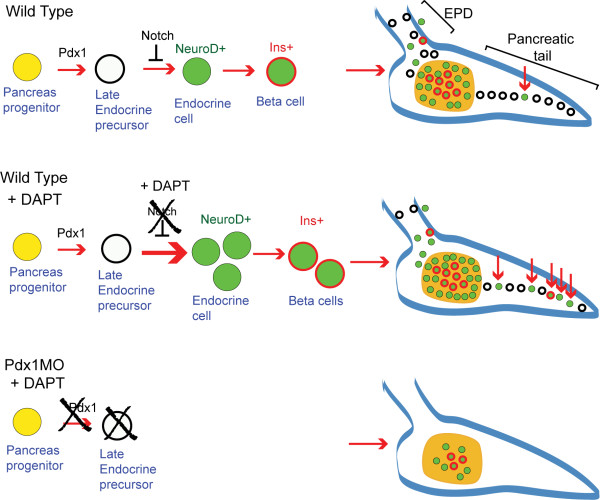
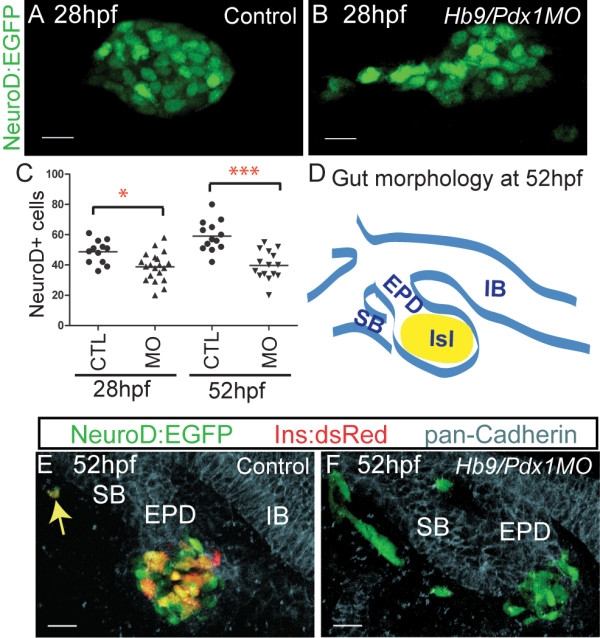
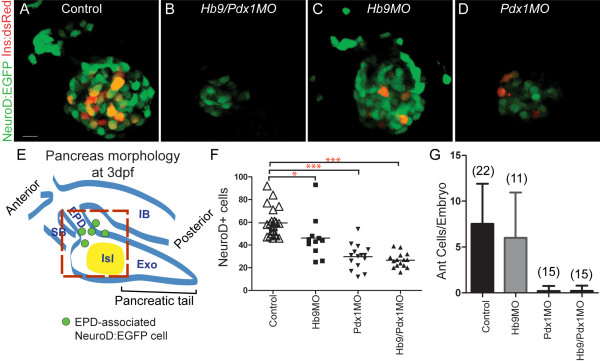
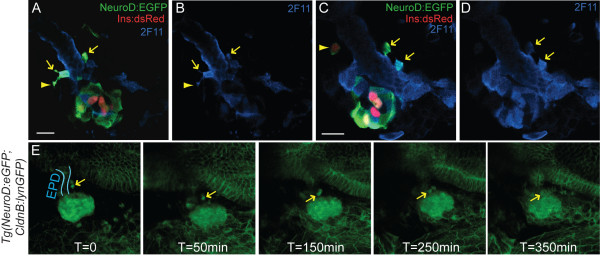
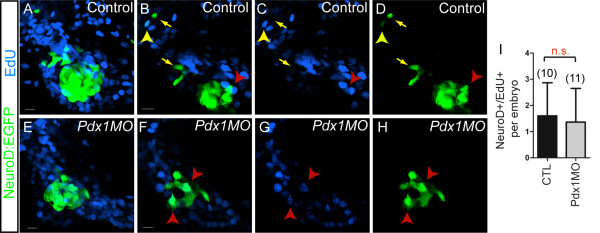
To learn more about endocrine progenitor specification, we examined beta cell formation following morpholino-mediated depletion of pdx1 and hb9. We find that after early beta cell reduction, recovery occurs following loss of either pdx1 or hb9 function. Unexpectedly, simultaneous knockdown of both hb9 and pdx1 leads to virtually complete and persistent beta cell deficiency. We used a NeuroD:EGFP transgenic line to examine endocrine cell behavior in vivo and developed a novel live-imaging technique to document emergence and migration of late-forming endocrine precursors in real time. Our data show that Notch-responsive progenitors for late-arising endocrine cells are predominantly post mitotic and depend on pdx1. By contrast, early-arising endocrine cells are specified and differentiate independent of pdx1.
The nearly complete beta cell deficiency after combined loss of hb9 and pdx1 suggests functional cooperation, which we clarify as distinct roles in early and late endocrine cell formation. A novel imaging approach permitted visualization of the emergence of late endocrine cells within developing embryos for the first time. We demonstrate a pdx1-dependent progenitor population essential for the formation of duct-associated, second wave endocrine cells. We further reveal an unexpectedly low mitotic activity in these progenitor cells, indicating that they are set aside early in development.
胰岛素分泌β细胞在胰腺发育过程中会分两个连续的波出现。最近在斑马鱼中描述的形成较晚的β细胞,在发育能力上与第二波哺乳动物β细胞具有高度相似性。在小鼠和斑马鱼中的功能丧失研究表明,同源盒转录因子 Pdx1 和 Hb9 对于胰腺和β细胞的发育都是至关重要的,并且已经发现了这些基因的离散阶段特异性要求。此前,已经表明在斑马鱼中 pdx1 的缺失会导致外分泌和内分泌细胞的恢复,但负责的祖细胞和分子机制尚未明确界定。此外,pdx1 和 hb9 在β细胞形成中的相互作用尚未得到解决。
为了更深入地了解内分泌祖细胞的特化,我们研究了在 pdx1 和 hb9 功能获得性抑制后β细胞的形成。我们发现,在早期β细胞减少后,pdx1 或 hb9 功能丧失后会恢复。出乎意料的是,同时敲低 hb9 和 pdx1 会导致几乎完全和持续的β细胞缺乏。我们使用 NeuroD:EGFP 转基因系在体内检查内分泌细胞的行为,并开发了一种新的活体成像技术,实时记录晚期形成的内分泌前体细胞的出现和迁移。我们的数据表明,晚期出现的内分泌细胞的 Notch 反应性祖细胞主要是有丝分裂后期的,并且依赖于 pdx1。相比之下,早期出现的内分泌细胞是特异性的,并且独立于 pdx1 分化。
hb9 和 pdx1 联合缺失后几乎完全的β细胞缺乏表明存在功能合作,我们通过早期和晚期内分泌细胞形成中的不同作用阐明了这种合作。一种新的成像方法首次允许在发育中的胚胎中可视化晚期内分泌细胞的出现。我们证明了一个依赖于 pdx1 的祖细胞群体对于形成导管相关的、第二波内分泌细胞是必不可少的。我们进一步揭示了这些祖细胞中出乎意料的低有丝分裂活性,表明它们在发育早期就被搁置了。