Clinical Pharmacology, Celgene Corporation, 86 Morris Avenue, Summit, NJ 07920, USA.
Cancer Chemother Pharmacol. 2012 Mar;69(3):789-97. doi: 10.1007/s00280-011-1760-3. Epub 2011 Oct 29.
Assessment of the absorption, metabolism and excretion of [(14)C]-lenalidomide in healthy male subjects following a single oral dose.
Six healthy male subjects were administered a single 25 mg oral suspension dose of [(14)C]-lenalidomide. Blood (plasma), semen and excreta were collected. Mass balance assessments were done by radioactivity measurements. Metabolite profiling and quantitation were accomplished using liquid chromatography with mass spectrometric and radiochemical detection.
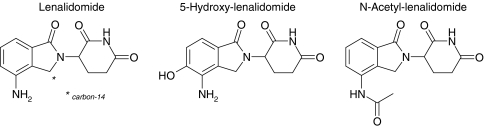
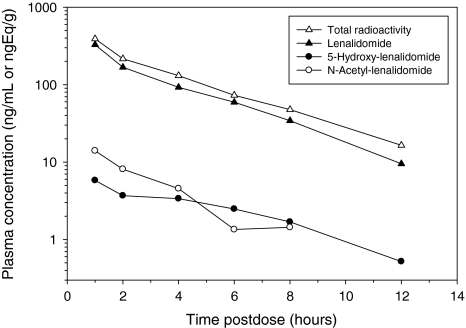
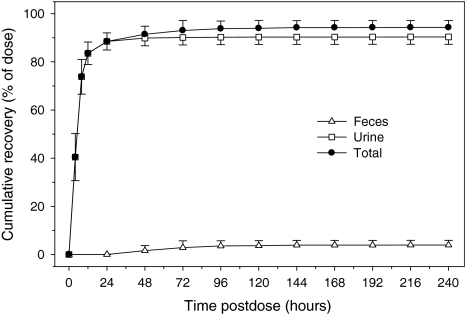
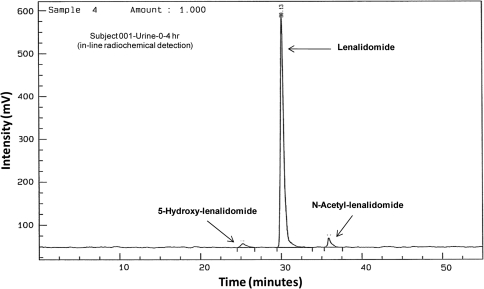
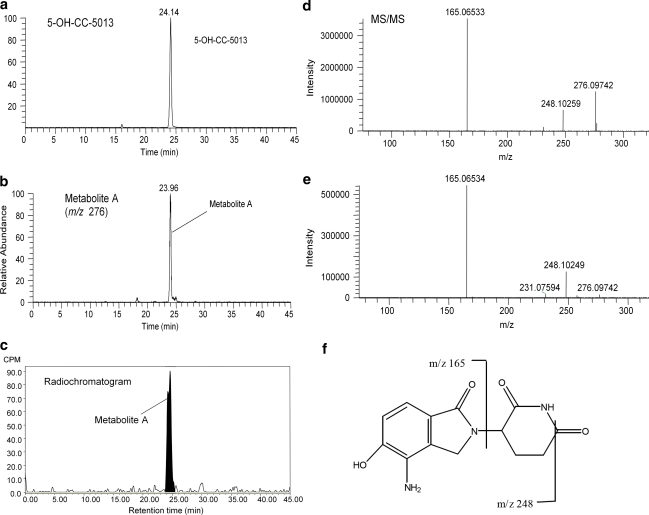
[(14)C]-Lenalidomide was rapidly absorbed (T (max) 0.77-1.0 h), and the levels declined with a terminal half-life of approximately 3 h, with similar profiles for total blood and plasma radioactivity as well as plasma lenalidomide. The whole blood to plasma radioactivity exposure levels were comparable, suggesting equal distribution between plasma and blood cells. On average, 94% of the administered radioactivity was recovered within 10 days, with >88% recovered within 24 h. Urinary excretion was the primary route of elimination (90% of radioactive dose), with minor amounts excreted in feces (4%). Semen contained a small amount of the radioactive dose (0.0062%). Lenalidomide was the primary radioactive component in plasma (92% of the [(14)C]-area under the concentration-time curve) and urine (>90% of the radioactivity in urine). The remaining radioactivity was composed of primarily two metabolites: 5-hydroxy-lenalidomide and N-acetyl-lenalidomide, each accounting for less than 5% of the total radioactivity as well as lenalidomide levels in plasma and excreta.
In summary, following oral administration, lenalidomide is highly absorbed and bioavailable, metabolized minimally, and eliminated predominantly via urinary excretion in the unchanged form in humans.
评估健康男性单次口服[(14)C]-来那度胺后的吸收、代谢和排泄。
6 名健康男性单次口服 25mg 口服混悬剂[(14)C]-来那度胺。采集血(血浆)、精液和排泄物。通过放射性测量进行质量平衡评估。使用液质联用和放射化学检测进行代谢产物谱分析和定量。
[(14)C]-来那度胺吸收迅速(Tmax 0.77-1.0h),水平下降,终末半衰期约 3h,总血和血浆放射性以及血浆来那度胺的曲线相似。全血与血浆放射性暴露水平相当,表明在血浆和血细胞之间分布均匀。平均而言,给药后 10 天内回收 94%的放射性,24h 内回收 88%以上。尿排泄是主要的消除途径(放射性剂量的 90%),粪便中排泄量较小(4%)。精液中含有少量放射性剂量(0.0062%)。来那度胺是血浆中主要的放射性成分([(14)C]-曲线下面积的 92%)和尿液(尿液中放射性的>90%)。其余放射性主要由两种代谢物组成:5-羟基来那度胺和 N-乙酰来那度胺,两者分别占血浆和排泄物中总放射性以及来那度胺水平的不到 5%。
总之,口服给药后,来那度胺在人体内高度吸收和生物利用度高,代谢极少,主要以原形经尿液排泄。