Population Services International, Malaria & Child Survival Department, PO Box 43640, Nairobi, Kenya, Africa.
Malar J. 2011 Oct 31;10:327. doi: 10.1186/1475-2875-10-327.
Access to artemisinin-based combination therapy (ACT) remains limited in high malaria-burden countries, and there are concerns that the poorest people are particularly disadvantaged. This paper presents new evidence on household treatment-seeking behaviour in six African countries. These data provide a baseline for monitoring interventions to increase ACT coverage, such as the Affordable Medicines Facility for malaria (AMFm).
Nationally representative household surveys were conducted in Benin, the Democratic Republic of Congo (DRC), Madagascar, Nigeria, Uganda and Zambia between 2008 and 2010. Caregivers responded to questions about management of recent fevers in children under five. Treatment indicators were tabulated across countries, and differences in case management provided by the public versus private sector were examined using chi-square tests. Logistic regression was used to test for association between socioeconomic status and 1) malaria blood testing, and 2) ACT treatment.
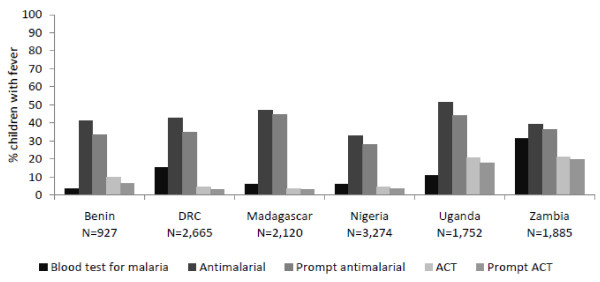
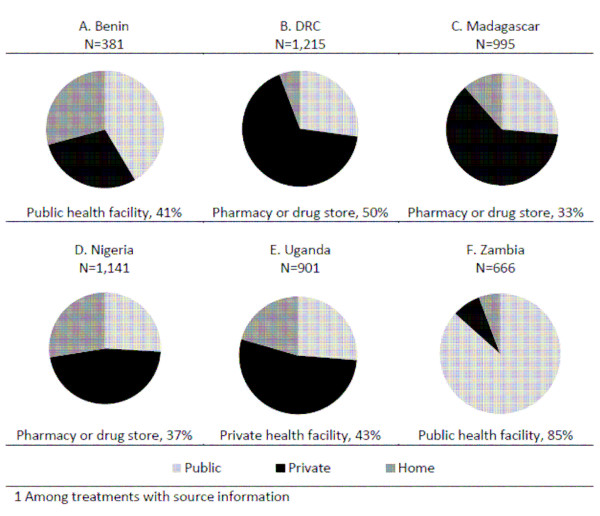
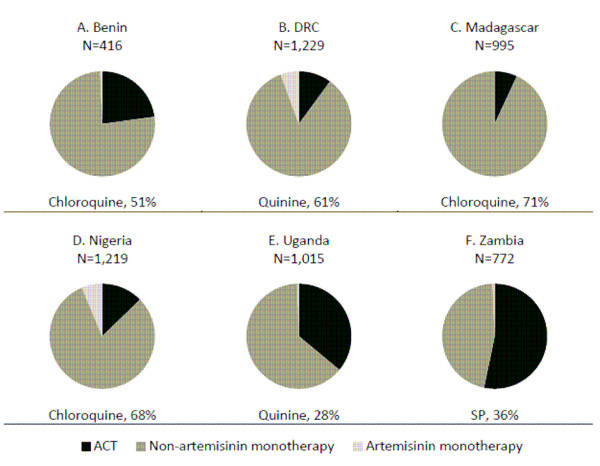
Fever treatment with an ACT is low in Benin (10%), the DRC (5%), Madagascar (3%) and Nigeria (5%), but higher in Uganda (21%) and Zambia (21%). The wealthiest children are significantly more likely to receive ACT compared to the poorest children in Benin (OR = 2.68, 95% CI = 1.12-6.42); the DRC (OR = 2.18, 95% CI = 1.12-4.24); Madagascar (OR = 5.37, 95% CI = 1.58-18.24); and Nigeria (OR = 6.59, 95% CI = 2.73-15.89). Most caregivers seek treatment outside of the home, and private sector outlets are commonly the sole external source of treatment (except in Zambia). However, children treated in the public sector are significantly more likely to receive ACT treatment than those treated in the private sector (except in Madagascar). Nonetheless, levels of testing and ACT treatment in the public sector are low. Few caregivers name the national first-line drug as most effective for treating malaria in Madagascar (2%), the DRC (2%), Nigeria (4%) and Benin (10%). Awareness is higher in Zambia (49%) and Uganda (33%).
Levels of effective fever treatment are low and inequitable in many contexts. The private sector is frequently accessed however case management practices are relatively poor in comparison with the public sector. Supporting interventions to inform caregiver demand for ACT and to improve provider behaviour in both the public and private sectors are needed to achieve maximum gains in the context of improved access to effective treatment.
青蒿素类复方疗法(ACT)在疟疾负担较高的国家仍然难以获得,人们担心最贫困的人尤其处于不利地位。本文提供了六个非洲国家家庭求医行为的新证据。这些数据为监测旨在提高 ACT 覆盖率的干预措施提供了基线,例如负担得起的疟疾治疗设施(AMFm)。
2008 年至 2010 年期间,在贝宁、刚果民主共和国(DRC)、马达加斯加、尼日利亚、乌干达和赞比亚进行了全国代表性的家庭调查。护理人员回答了有关五岁以下儿童近期发热管理的问题。在各国之间列出了治疗指标,并使用卡方检验检查了公共部门与私营部门提供的病例管理差异。使用逻辑回归检验社会经济地位与 1)疟疾血液检测和 2)ACT 治疗之间的关联。
在贝宁(10%)、刚果民主共和国(5%)、马达加斯加(3%)和尼日利亚(5%),用 ACT 治疗发热的比例较低,但在乌干达(21%)和赞比亚(21%)较高。最富有的儿童与最贫穷的儿童相比,接受 ACT 的可能性显著更高,在贝宁(OR=2.68,95%CI=1.12-6.42);刚果民主共和国(OR=2.18,95%CI=1.12-4.24);马达加斯加(OR=5.37,95%CI=1.58-18.24);尼日利亚(OR=6.59,95%CI=2.73-15.89)。大多数护理人员在家外寻求治疗,私营部门是外部治疗的常见唯一来源(赞比亚除外)。然而,在公立医院接受治疗的儿童比在私立部门接受治疗的儿童更有可能接受 ACT 治疗(赞比亚除外)。尽管如此,公立医院的检测和 ACT 治疗水平仍然很低。在马达加斯加(2%)、刚果民主共和国(2%)、尼日利亚(4%)和贝宁(10%),很少有护理人员将国家一线药物称为治疗疟疾最有效的药物。在赞比亚(49%)和乌干达(33%),认识度较高。
在许多情况下,有效的发热治疗水平较低且不平等。然而,私营部门经常被使用,但其病例管理实践与公共部门相比相对较差。需要支持干预措施来满足护理人员对 ACT 的需求,并改善公共和私营部门提供者的行为,以在获得有效治疗的改善背景下实现最大收益。