Dipartimento di Medicina Clinica e Sperimentale, Università degli Studi di Perugia, Perugia, Italy.
PLoS One. 2011;6(10):e25637. doi: 10.1371/journal.pone.0025637. Epub 2011 Oct 27.
GP-BAR1, a member G protein coupled receptor superfamily, is a cell surface bile acid-activated receptor highly expressed in the ileum and colon. In monocytes, ligation of GP-BAR1 by secondary bile acids results in a cAMP-dependent attenuation of cytokine generation.
To investigate the role GP-BAR1 in regulating intestinal homeostasis and inflammation-driven immune dysfunction in rodent models of colitis.
Colitis was induced in wild type and GP-BAR1(-/-) mice by DSS and TNBS administration. Potential GP-BAR1 agonists were identified by in silico screening and computational docking studies.
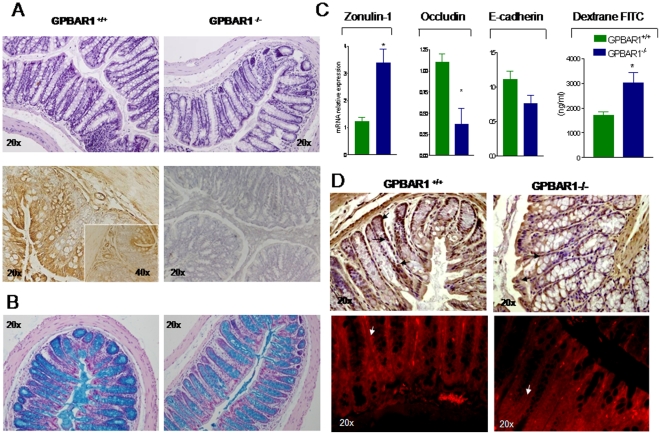
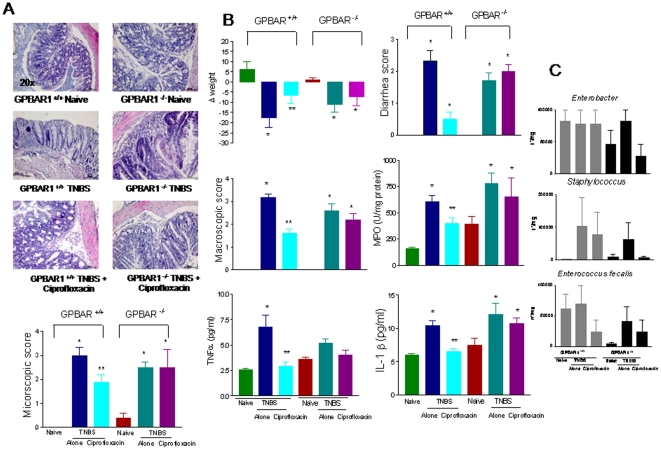
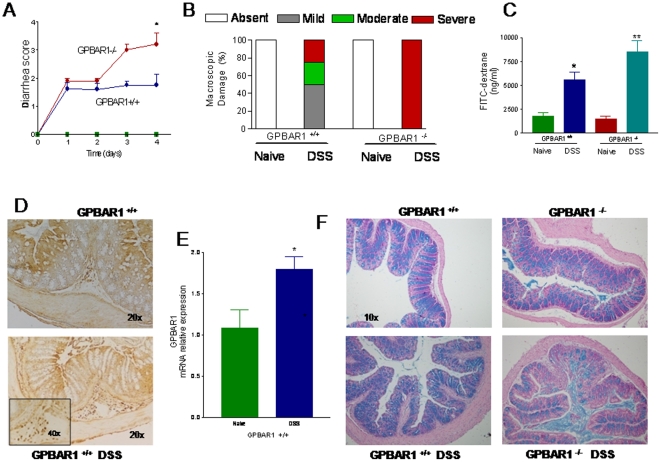
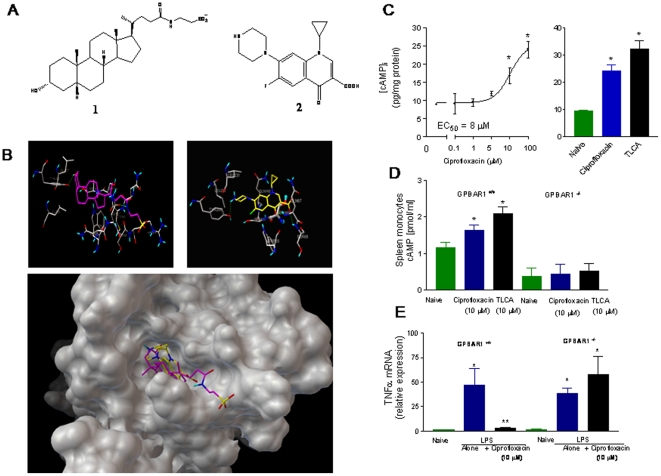
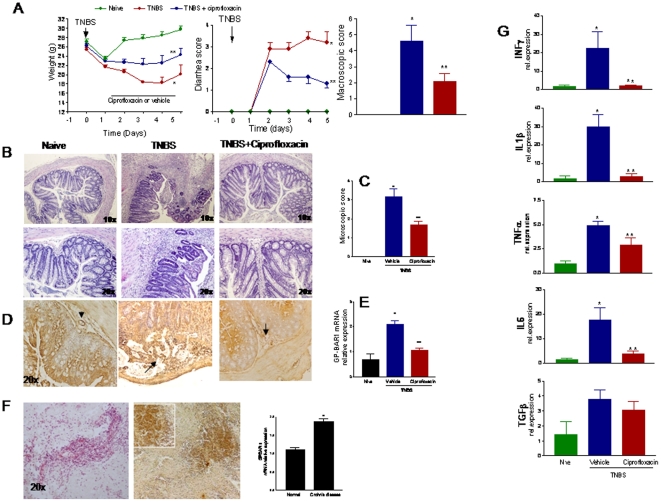
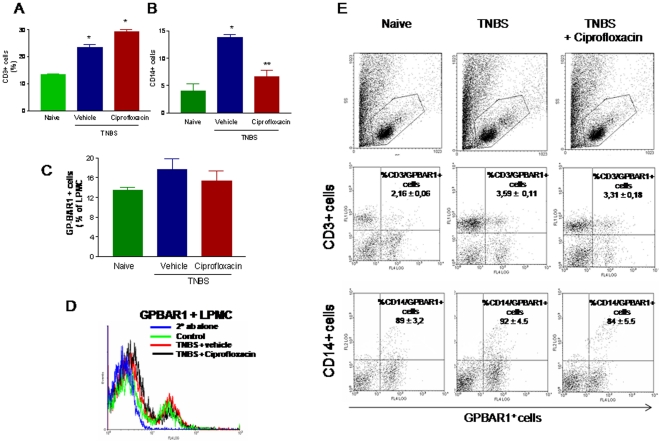
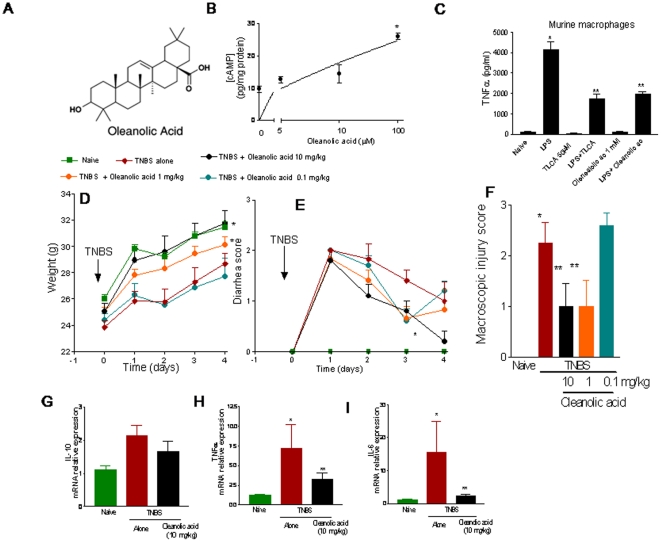
GP-BAR1(-/-) mice develop an abnormal morphology of colonic mucous cells and an altered molecular architecture of epithelial tight junctions with increased expression and abnormal subcellular distribution of zonulin 1 resulting in increased intestinal permeability and susceptibility to develop severe colitis in response to DSS at early stage of life. By in silico screening and docking studies we identified ciprofloxacin as a GP-BAR1 ligand. In monocytes, ciprofloxacin increases cAMP concentrations and attenuates TNFα release induced by TLR4 ligation in a GP-BAR1 dependent manner. Treating mice rendered colitic by TNBS with ciprofloxacin and oleanolic acid, a well characterized GP-BAR1 ligand, abrogates signs and symptoms of colitis. Colonic expression of GP-BAR1 mRNA increases in rodent models of colitis and tissues from Crohn's disease patients. Flow cytometry analysis demonstrates that ≈90% of CD14+ cells isolated from the lamina propria of TNBS-treated mice stained positively for GP-BAR1.
GP-BAR1 regulates intestinal barrier structure. Its expression increases in rodent models of colitis and Crohn's disease. Ciprofloxacin is a GP-BAR1 ligand.
GP-BAR1 是 G 蛋白偶联受体超家族的成员,是一种细胞表面胆汁酸激活受体,在回肠和结肠中高度表达。在单核细胞中,次级胆汁酸与 GP-BAR1 的结合导致细胞内环磷酸腺苷(cAMP)依赖性细胞因子生成减少。
在 DSS 和 TNBS 诱导的结肠炎啮齿动物模型中,研究 GP-BAR1 调节肠道稳态和炎症驱动免疫功能障碍的作用。
通过 DSS 和 TNBS 给药在野生型和 GP-BAR1(-/-)小鼠中诱导结肠炎。通过计算机筛选和计算对接研究鉴定潜在的 GP-BAR1 激动剂。
GP-BAR1(-/-)小鼠的结肠粘蛋白细胞形态异常,上皮紧密连接的分子结构改变,zonulin 1 的表达增加且亚细胞分布异常,导致肠道通透性增加,对 DSS 的易感性增加,从而在生命早期发展为严重结肠炎。通过计算机筛选和对接研究,我们鉴定出环丙沙星是一种 GP-BAR1 配体。在单核细胞中,环丙沙星以 GP-BAR1 依赖的方式增加 cAMP 浓度并减弱 TLR4 配体诱导的 TNFα 释放。用环丙沙星和齐墩果酸(一种公认的 GP-BAR1 配体)治疗 TNBS 诱导的结肠炎小鼠可消除结肠炎的体征和症状。GP-BAR1 mRNA 在结肠炎啮齿动物模型和克罗恩病患者的组织中表达增加。流式细胞术分析表明,从 TNBS 处理的小鼠的固有层中分离出的约 90%的 CD14+细胞对 GP-BAR1 染色呈阳性。
GP-BAR1 调节肠道屏障结构。其在结肠炎和克罗恩病的啮齿动物模型中表达增加。环丙沙星是一种 GP-BAR1 配体。