Departments of Medicine and Dermatology, University of Pittsburgh, PA 15213, USA.
Clin Cancer Res. 2012 Jan 15;18(2):555-67. doi: 10.1158/1078-0432.CCR-11-1491. Epub 2011 Nov 2.
To compare the efficacy and tolerability of the mitogen-activated protein (MAP)/extracellular signal-regulated (ERK) kinase (MEK) 1/2 inhibitor selumetinib versus temozolomide in chemotherapy-naive patients with unresectable stage III/IV melanoma.
This phase II, open-label, multicenter, randomized, parallel-group study examined the effect of 100 mg oral selumetinib twice daily in 28-day cycles versus oral temozolomide (200 mg/m(2)/d for 5 days, then 23 days off-treatment). The primary endpoint was progression-free survival.
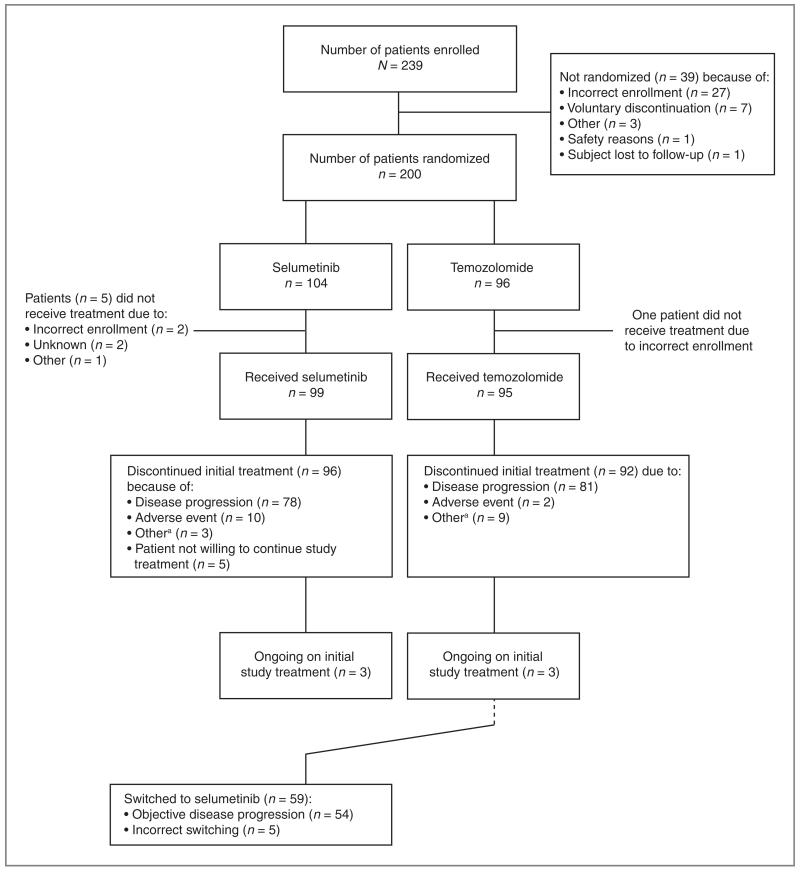
Two hundred patients were randomized. Progression-free survival did not differ significantly between selumetinib and temozolomide (median time to event 78 and 80 days, respectively; hazard ratio, 1.07; 80% confidence interval, 0.86-1.32). Objective response was observed in six (5.8%) patients receiving selumetinib and nine (9.4%) patients in the temozolomide group. Among patients with BRAF mutations, objective responses were similar between selumetinib and temozolomide groups (11.1% and 10.7%, respectively). However, five of the six selumetinib partial responders were BRAF mutated. Frequently reported adverse events with selumetinib were dermatitis acneiform (papular pustular rash; 59.6%), diarrhea (56.6%), nausea (50.5%), and peripheral edema (40.4%), whereas nausea (64.2%), constipation (47.4%), and vomiting (44.2%) were reported with temozolomide.
No significant difference in progression-free survival was observed between patients with unresectable stage III/IV melanoma unselected for BRAF/NRAS mutations, who received therapy with selumetinib or temozolomide. Five of six patients with partial response to selumetinib had BRAF mutant tumors.
比较丝裂原活化蛋白(MAP)/细胞外信号调节激酶(ERK)激酶(MEK)1/2 抑制剂 selumetinib 与替莫唑胺在未经化疗的不可切除 III/IV 期黑色素瘤患者中的疗效和耐受性。
这是一项 II 期、开放标签、多中心、随机、平行组研究,检查了每天两次口服 100mg selumetinib (28 天为一个周期)与口服替莫唑胺(每天 200mg/m2,连用 5 天,然后停药 23 天)的疗效。主要终点是无进展生存期。
200 名患者被随机分组。Selumetinib 与替莫唑胺之间的无进展生存期无显著差异(中位无进展时间分别为 78 天和 80 天;风险比,1.07;80%置信区间,0.86-1.32)。接受 selumetinib 治疗的患者中有 6 例(5.8%)和接受替莫唑胺治疗的患者中有 9 例(9.4%)观察到客观缓解。在 BRAF 突变的患者中,selumetinib 与替莫唑胺组的客观缓解率相似(分别为 11.1%和 10.7%)。然而,selumetinib 部分缓解的 6 例患者中有 5 例存在 BRAF 突变。Selumetinib 常见的不良反应包括痤疮样皮炎(丘疹脓疱性皮疹;59.6%)、腹泻(56.6%)、恶心(50.5%)和外周水肿(40.4%),而替莫唑胺组报告的不良反应包括恶心(64.2%)、便秘(47.4%)和呕吐(44.2%)。
未选择 BRAF/NRAS 突变的不可切除 III/IV 期黑色素瘤患者接受 selumetinib 或替莫唑胺治疗,无进展生存期无显著差异。Selumetinib 部分缓解的 6 例患者中有 5 例存在 BRAF 突变肿瘤。