Department of Pathology and Laboratory Medicine, University of North Carolina at Chapel Hill, Chapel Hill, North Carolina 27599-7525, USA.
Curr Opin Nephrol Hypertens. 2012 Jan;21(1):92-6. doi: 10.1097/MNH.0b013e32834d54b1.
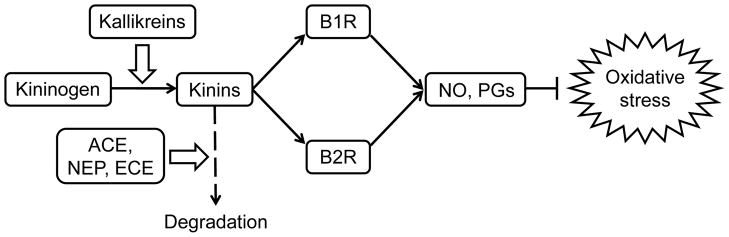
The kallikrein-kinin system (KKS) constitutes a complex multienzyme cascade that produces several bioactive kinin peptides and their derivatives including bradykinin. In addition to the classical notion of the KKS as a potent vasodilator and a mediator of inflammatory responses, recent studies suggest a link between the KKS and oxidative stress. A number of established mouse models with altered levels of KKS components opened the way to evaluate precise functions of the KKS. Here we review recent findings on the role of the KKS in cardiovascular diseases and chronic kidney diseases, and discuss potential benefits of KKS activation in these diseases.
Deletion of both B1R and B2R in a diabetic mouse model exacerbates its renal phenotypes, suggesting that the KKS exerts protective effects on diabetic nephropathy by suppressing oxidative stress, presumably via nitric oxide and prostaglandins.
Accumulating evidence has highlighted the importance of the KKS as a protective system against oxidative stress and organ damage in the heart and kidney. The activation of the KKS by angiotensin I-converting enzyme inhibitors and vasopeptidase inhibitors is likely to be beneficial in senescence-associated cardiovascular diseases and chronic kidney diseases.
目的综述:激肽释放酶-激肽系统(KKS)是一个复杂的多酶级联系统,能产生几种生物活性激肽肽及其衍生物,包括缓激肽。除了激肽释放酶-激肽系统作为一种强效血管舒张剂和炎症反应介质的经典概念外,最近的研究表明激肽释放酶-激肽系统与氧化应激之间存在联系。一些改变激肽释放酶-激肽系统成分水平的既定小鼠模型为评估激肽释放酶-激肽系统的精确功能开辟了道路。在这里,我们综述了激肽释放酶-激肽系统在心血管疾病和慢性肾病中的作用的最新发现,并讨论了激肽释放酶-激肽系统激活在这些疾病中的潜在益处。
最新发现:在糖尿病小鼠模型中,B1R 和 B2R 的缺失加剧了其肾脏表型,这表明激肽释放酶-激肽系统通过抑制氧化应激,可能通过一氧化氮和前列腺素,对糖尿病肾病发挥保护作用。
总结:越来越多的证据强调了激肽释放酶-激肽系统作为一种对抗心脏和肾脏氧化应激和器官损伤的保护系统的重要性。血管紧张素转化酶抑制剂和血管肽酶抑制剂对激肽释放酶-激肽系统的激活可能对与衰老相关的心血管疾病和慢性肾病有益。