Laboratory of Neurogenesis and CNS Repair, Hyogo College of Medicine, 1-1 Mukogawacho, Nishinomiya, Hyogo 663-8501, Japan.
Cell Death Differ. 2012 May;19(5):756-67. doi: 10.1038/cdd.2011.145. Epub 2011 Nov 4.
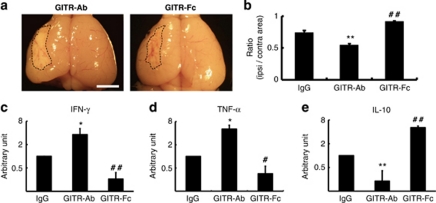
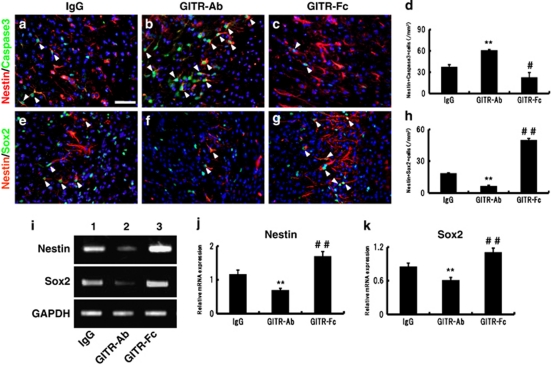
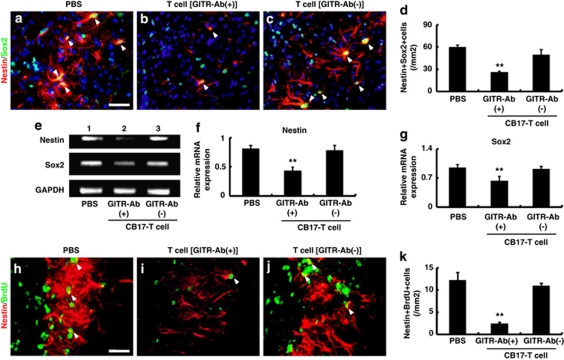
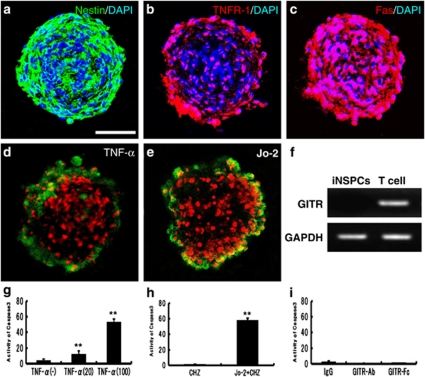
Increasing evidences show that immune response affects the reparative mechanisms in injured brain. Recently, we have demonstrated that CD4(+)T cells serve as negative modulators in neurogenesis after stroke, but the mechanistic detail remains unclear. Glucocorticoid-induced tumor necrosis factor (TNF) receptor (GITR), a multifaceted regulator of immunity belonging to the TNF receptor superfamily, is expressed on activated CD4(+)T cells. Herein, we show, by using a murine model of cortical infarction, that GITR triggering on CD4(+)T cells increases poststroke inflammation and decreases the number of neural stem/progenitor cells induced by ischemia (iNSPCs). CD4(+)GITR(+)T cells were preferentially accumulated at the postischemic cortex, and mice treated with GITR-stimulating antibody augmented poststroke inflammatory responses with enhanced apoptosis of iNSPCs. In contrast, blocking the GITR-GITR ligand (GITRL) interaction by GITR-Fc fusion protein abrogated inflammation and suppressed apoptosis of iNSPCs. Moreover, GITR-stimulated T cells caused apoptosis of the iNSPCs, and administration of GITR-stimulated T cells to poststroke severe combined immunodeficient mice significantly reduced iNSPC number compared with that of non-stimulated T cells. These observations indicate that among the CD4(+)T cells, GITR(+)CD4(+)T cells are major deteriorating modulators of poststroke neurogenesis. This suggests that blockade of the GITR-GITRL interaction may be a novel immune-based therapy in stroke.
越来越多的证据表明,免疫反应会影响受损大脑的修复机制。最近,我们已经证明 CD4(+)T 细胞在中风后神经发生中充当负调节剂,但机制细节尚不清楚。糖皮质激素诱导的肿瘤坏死因子(TNF)受体(GITR)是 TNF 受体超家族中一种多效性的免疫调节剂,在活化的 CD4(+)T 细胞上表达。在此,我们通过使用皮质梗死的小鼠模型表明,CD4(+)T 细胞上的 GITR 触发会增加中风后的炎症反应,并减少缺血诱导的神经干细胞/祖细胞(iNSPCs)的数量。CD4(+)GITR(+)T 细胞优先聚集在缺血后皮质,用 GITR 刺激抗体处理的小鼠增强了中风后的炎症反应,并增加了 iNSPCs 的凋亡。相比之下,用 GITR-Fc 融合蛋白阻断 GITR-GITRL 相互作用可消除炎症并抑制 iNSPCs 的凋亡。此外,GITR 刺激的 T 细胞会导致 iNSPCs 凋亡,并且将 GITR 刺激的 T 细胞给予中风后的严重联合免疫缺陷小鼠会导致 iNSPC 数量明显减少,与非刺激的 T 细胞相比。这些观察结果表明,在 CD4(+)T 细胞中,GITR(+)CD4(+)T 细胞是中风后神经发生的主要恶化调节剂。这表明阻断 GITR-GITRL 相互作用可能是中风的一种新的基于免疫的治疗方法。