Informatics Institute, University of Missouri, MO, USA.
Genome Biol Evol. 2011;3:1369-80. doi: 10.1093/gbe/evr115. Epub 2011 Nov 4.
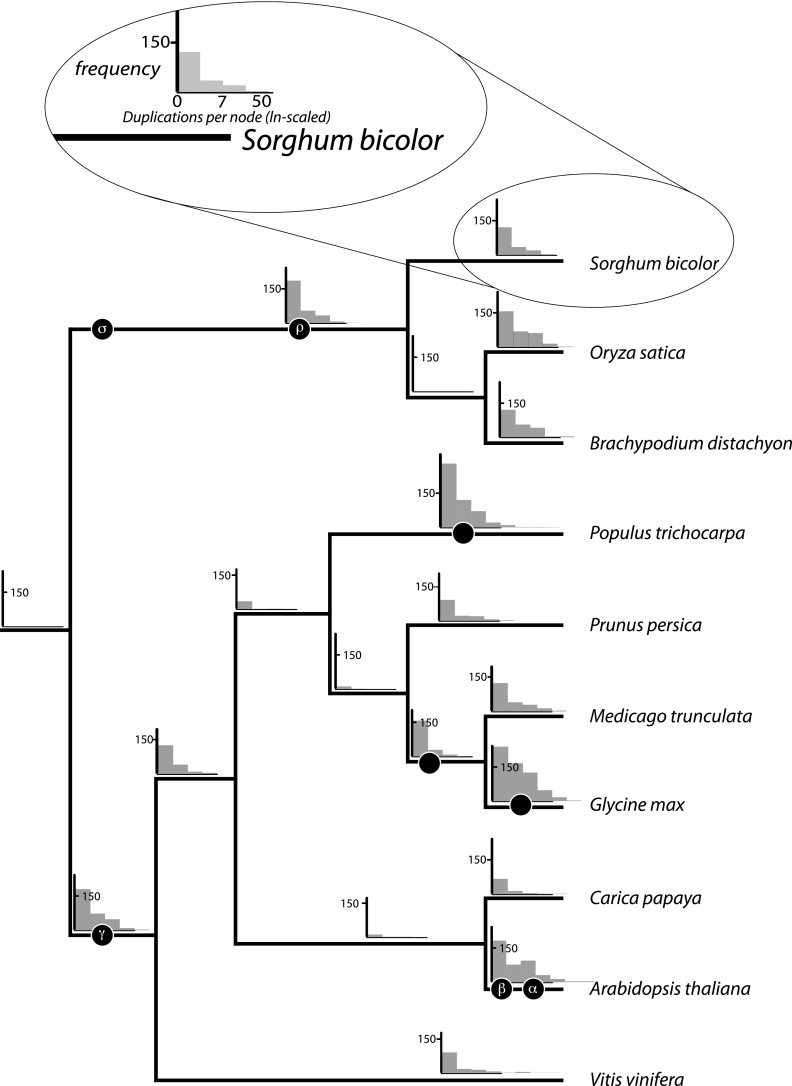
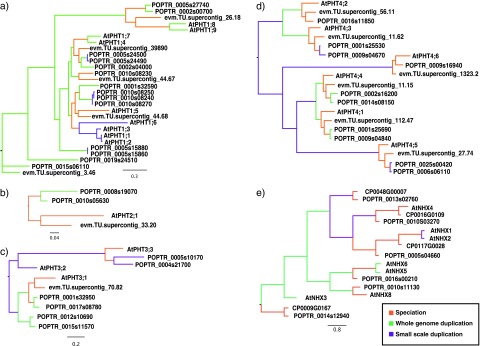
The evolutionary origins of the multitude of duplicate genes in the plant genomes are still incompletely understood. To gain an appreciation of the potential selective forces acting on these duplicates, we phylogenetically inferred the set of metabolic gene families from 10 flowering plant (angiosperm) genomes. We then compared the metabolic fluxes for these families, predicted using the Arabidopsis thaliana and Sorghum bicolor metabolic networks, with the families' duplication propensities. For duplications produced by both small scale (small-scale duplications) and genome duplication (whole-genome duplications), there is a significant association between the flux and the tendency to duplicate. Following this global analysis, we made a more fine-scale study of the selective constraints observed on plant sodium and phosphate transporters. We find that the different duplication mechanisms give rise to differing selective constraints. However, the exact nature of this pattern varies between the gene families, and we argue that the duplication mechanism alone does not define a duplicated gene's subsequent evolutionary trajectory. Collectively, our results argue for the interplay of history, function, and selection in shaping the duplicate gene evolution in plants.
植物基因组中大量重复基因的进化起源仍不完全清楚。为了了解这些重复基因所受到的潜在选择压力,我们从 10 种开花植物(被子植物)基因组中系统发育推断了一套代谢基因家族。然后,我们比较了使用拟南芥和高粱代谢网络预测的这些家族的代谢通量与家族的重复倾向。对于由小尺度(小尺度重复)和基因组重复(全基因组重复)产生的重复,通量和重复倾向之间存在显著关联。在进行了全局分析之后,我们对植物钠离子和磷酸盐转运蛋白上观察到的选择限制进行了更精细的研究。我们发现,不同的复制机制导致了不同的选择限制。然而,这种模式的具体性质在基因家族之间有所不同,我们认为复制机制本身并不能定义一个重复基因的后续进化轨迹。总的来说,我们的结果表明,历史、功能和选择在塑造植物中重复基因的进化中相互作用。