Neuroscience Research Australia, Sydney, New South Wales, Australia.
PLoS One. 2011;6(10):e27041. doi: 10.1371/journal.pone.0027041. Epub 2011 Oct 31.
To determine clinically related characteristics in patients with pure lower motor neuron (LMN) syndromes, not fulfilling accepted diagnostic criteria, who were likely to respond to intravenous immunoglobulin (IVIg) treatment.
Demographic, clinical, laboratory and neurophysiological characteristics were prospectively collected from patients with undifferentiated isolated LMN syndromes who were then treated with IVIg. Patients were classified as either responders or non-responders to therapy with IVIg based on clinical data and the two groups were compared.
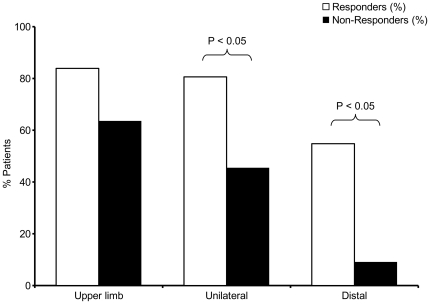
From a total cohort of 42 patients (30 males, 12 females, aged 18-83 years), 31 patients responded to IVIg and 11 did not. Compared to patients that developed progressive neurological decline, responders were typically younger (45.8 compared to 56.0 years, P<0.05) and had upper limb (83.9% compared to 63.6%, NS), unilateral (80.6% compared to 45.5%, P<0.05), and isolated distal (54.1% compared to 9.1%, P<0.05) weakness. Patients with predominantly upper limb, asymmetrical, and distal weakness were more likely to respond to IVIg therapy. Of the patients who responded to treatment, only 12.9% had detectable GM(1) antibodies and conduction block (not fulfilling diagnostic criteria) was only identified in 22.6%.
More than 70% of patients with pure LMN syndromes from the present series responded to treatment with IVIg therapy, despite a low prevalence of detectable GM(1) antibodies and conduction block. Patients with isolated LMN presentations, not fulfilling accepted diagnostic criteria, may respond to IVIg therapy, irrespective of the presence of conduction block or GM(1) antibodies, and should be given an empirical trial of IVIg to determine treatment responsiveness.
确定不符合公认诊断标准的单纯下运动神经元(LMN)综合征患者的临床相关特征,这些患者可能对静脉注射免疫球蛋白(IVIg)治疗有反应。
前瞻性收集未分化孤立 LMN 综合征患者的人口统计学、临床、实验室和神经生理学特征,然后对其进行 IVIg 治疗。根据临床数据将患者分为对 IVIg 治疗有反应者和无反应者,并对两组进行比较。
在总共 42 名患者(30 名男性,12 名女性,年龄 18-83 岁)中,31 名患者对 IVIg 有反应,11 名患者无反应。与发生进行性神经功能下降的患者相比,有反应者通常更年轻(45.8 岁比 56.0 岁,P<0.05),上肢(83.9%比 63.6%,无统计学差异)、单侧(80.6%比 45.5%,P<0.05)和孤立的远端(54.1%比 9.1%,P<0.05)无力。上肢、不对称和远端无力为主的患者更有可能对 IVIg 治疗有反应。在对治疗有反应的患者中,只有 12.9%检测到 GM(1)抗体,而传导阻滞(不符合诊断标准)仅在 22.6%的患者中发现。
尽管 GM(1)抗体和传导阻滞的检出率较低,但本研究系列中超过 70%的单纯 LMN 综合征患者对 IVIg 治疗有反应。不符合公认诊断标准的单纯 LMN 表现的患者可能对 IVIg 治疗有反应,无论是否存在传导阻滞或 GM(1)抗体,都应给予 IVIg 的经验性治疗,以确定治疗反应性。