Laboratory of Novel Therapeutic Targets, Division of Oncology, Center for Applied Medical Research, University of Navarra, Pamplona, Spain.
Br J Cancer. 2011 Nov 8;105(10):1608-14. doi: 10.1038/bjc.2011.432.
Mortality rates in lung cancer patients have not decreased significantly in recent years, even with the implementation of new therapeutic regimens. One of the main problems is that a large proportion of patients present local or distant metastasis at the time of diagnosis. The need for identification of novel biomarkers and therapeutic targets for a more effective management of lung cancer led us to investigate TMPRSS4, a protease reported to promote tumour growth and metastasis.
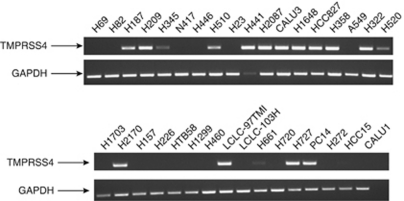
In all, 34 lung cancer cell lines were used to evaluate the TMPRSS4 expression. Cell migration and clonogenic assays, and an in-vivo lung metastasis model were used for functional analysis of the TMPRSS4 downregulation in H358, H441 and H2170 cell lines. The TMPRSS4 expression analysis in normal and malignant lung tissue samples was performed by qPCR. Five different microarray-based publicly available expression databases were used to validate our results and to study prognosis.
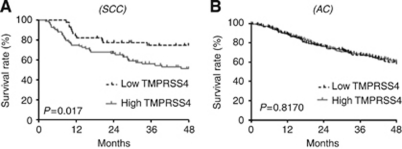
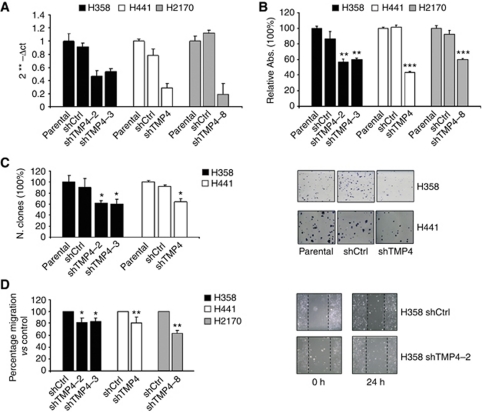
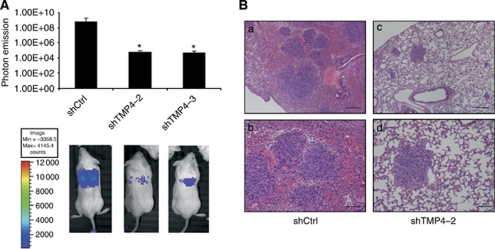
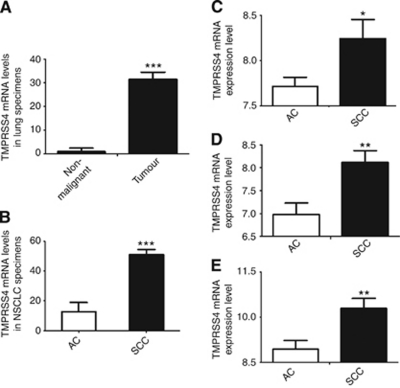
The TMPRSS4 knock down in H358, H441 and H2170 cells resulted in a significant reduction in proliferation, clonogenic capacity and invasion. A significant (P<0.05) decrease in the lung colonisation and growth was found when mice were injected with TMPRSS4-depleated H358-derived clones, as compared with controls. Expression of TMPRSS4 showed a >30-fold increase (P<0.001) in tumours in comparison with non-malignant samples. Levels in tumours with squamous cell carcinoma (SCC) histology were found to be significantly higher (P<0.001) than those with adenocarcinoma (AC) histology, which was confirmed in data retrieved from the microarrays. Kaplan-Meier curves demonstrated that high levels of TMPRSS4 were significantly associated (P=0.017) with reduced overall survival in the patients with SCC histology, whereas no correlation was found for the AC histology.
Our results demonstrate that TMPRSS4 has a role in the lung cancer development. The potential use of TMPRSS4 as a biomarker for lung cancer detection or as a predictor of patient's outcome warrants further investigation.
近年来,尽管实施了新的治疗方案,肺癌患者的死亡率并没有显著下降。一个主要问题是,很大一部分患者在诊断时已经出现局部或远处转移。为了寻找新的生物标志物和治疗靶点,以更有效地治疗肺癌,我们研究了 TMPRSS4,这是一种被报道能促进肿瘤生长和转移的蛋白酶。
我们共使用了 34 种肺癌细胞系来评估 TMPRSS4 的表达。在 H358、H441 和 H2170 细胞系中,我们通过细胞迁移和克隆形成实验以及体内肺转移模型来研究 TMPRSS4 下调的功能。通过 qPCR 分析正常和恶性肺组织样本中的 TMPRSS4 表达。我们使用了五个不同的基于微阵列的公开表达数据库来验证我们的结果并研究预后。
在 H358、H441 和 H2170 细胞中敲低 TMPRSS4 导致增殖、克隆形成能力和侵袭能力显著降低。与对照组相比,当用 TMPRSS4 耗尽的 H358 衍生克隆注射小鼠时,肺定植和生长明显减少(P<0.05)。与非恶性样本相比,肿瘤中 TMPRSS4 的表达增加了>30 倍(P<0.001)。具有鳞状细胞癌(SCC)组织学特征的肿瘤中的水平明显高于(P<0.001)具有腺癌(AC)组织学特征的肿瘤,这在从微阵列中检索的数据中得到了证实。Kaplan-Meier 曲线表明,高水平的 TMPRSS4 与 SCC 组织学患者的总生存期显著相关(P=0.017),而 AC 组织学患者则无相关性。
我们的结果表明 TMPRSS4 在肺癌的发展中起作用。TMPRSS4 作为肺癌检测的生物标志物或预测患者预后的指标具有进一步研究的潜力。