Tanzanian Training Centre for International Health, Ifakara, United Republic of Tanzania.
Hum Resour Health. 2011 Nov 9;9:28. doi: 10.1186/1478-4491-9-28.
With 15-30% met need for comprehensive emergency obstetrical care (CEmOC) and a 3% caesarean section rate, Tanzania needs to expand the number of facilities providing these services in more remote areas. Considering severe shortage of human resources for health in the country, currently operating at 32% of the required skilled workforce, an intensive three-month course was developed to train non-physician clinicians for remote health centres.
Competency-based curricula for assistant medical officers' (AMOs) training in CEmOC, and for nurses, midwives and clinical officers in anaesthesia and operation theatre etiquette were developed and implemented in Ifakara, Tanzania. The required key competencies were identified, taught and objectively assessed. The training involved hands-on sessions, lectures and discussions. Participants were purposely selected in teams from remote health centres where CEmOC services were planned. Monthly supportive supervision after graduation was carried out in the upgraded health centres
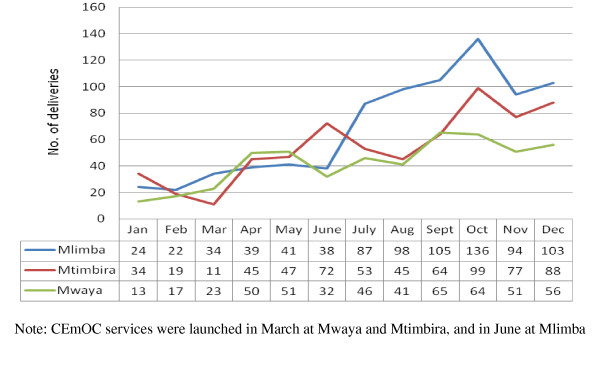
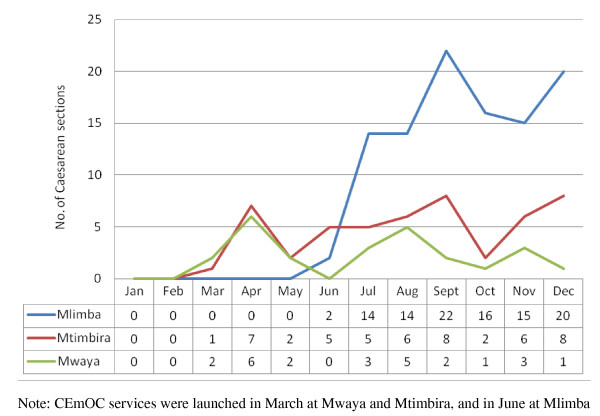
A total of 43 care providers from 12 health centres located in 11 rural districts in Tanzania and 2 from Somalia were trained from June 2009 to April 2010. Of these 14 were AMOs trained in CEmOC and 31 nurse-midwives and clinical officers trained in anaesthesia. During training, participants performed 278 major obstetric surgeries, 141 manual removal of placenta and evacuation of incomplete and septic abortions, and 1161 anaesthetic procedures under supervision. The first 8 months after introduction of CEmOC services in 3 health centres resulted in 179 caesarean sections, a remarkable increase of institutional deliveries by up to 300%, decreased fresh stillbirth rate (OR: 0.4; 95% CI: 0.1-1.7) and reduced obstetric referrals (OR: 0.2; 95% CI: 0.1-0.4)). There were two maternal deaths, both arriving in a moribund condition.
Tanzanian AMOs, clinical officers, and nurse-midwives can be trained as a team, in a three-month course, to provide effective CEmOC and anaesthesia in remote health centres.
坦桑尼亚仅有 15-30%的人能够获得全面的产科急诊护理(CEmOC)服务,剖宫产率仅为 3%,因此需要在更偏远的地区增加提供这些服务的医疗机构数量。考虑到该国卫生人力资源严重短缺,目前仅达到所需熟练劳动力的 32%,因此开发了一个为期三个月的强化课程,以培训非医师临床医生在偏远地区的医疗中心工作。
为助理医疗官(AMO)制定了 CEmOC 培训课程,以及为护士、助产士和临床医生制定了麻醉和手术室礼仪课程,在坦桑尼亚的伊法卡拉实施。确定了所需的关键能力,并进行了教学和客观评估。培训包括实践课程、讲座和讨论。参与者是从计划提供 CEmOC 服务的偏远医疗中心的团队中挑选出来的。毕业后每月进行一次支持性监督,在升级后的医疗中心进行。
共有 43 名来自坦桑尼亚 11 个农村地区的 12 个卫生中心和 2 个来自索马里的卫生中心的护理人员接受了培训,培训时间为 2009 年 6 月至 2010 年 4 月。其中 14 人接受了 CEmOC 培训,31 人接受了麻醉培训。在培训期间,参与者共完成了 278 例主要产科手术、141 例手动胎盘剥离和不完全及感染性流产清除术,以及 1161 例麻醉程序。在 3 个卫生中心引入 CEmOC 服务后的头 8 个月,有 179 例剖宫产,医疗机构分娩量显著增加了 300%,新鲜死产率下降(比值比:0.4;95%置信区间:0.1-1.7),产科转诊减少(比值比:0.2;95%置信区间:0.1-0.4)。有两名产妇死亡,均处于生命垂危状态。
坦桑尼亚的 AMO、临床医生和助产士可以在三个月的课程中进行团队培训,以便在偏远医疗中心提供有效的 CEmOC 和麻醉服务。