Department of Mathematics, University of California Irvine, United States of America.
PLoS Comput Biol. 2011 Nov;7(11):e1002251. doi: 10.1371/journal.pcbi.1002251. Epub 2011 Nov 3.
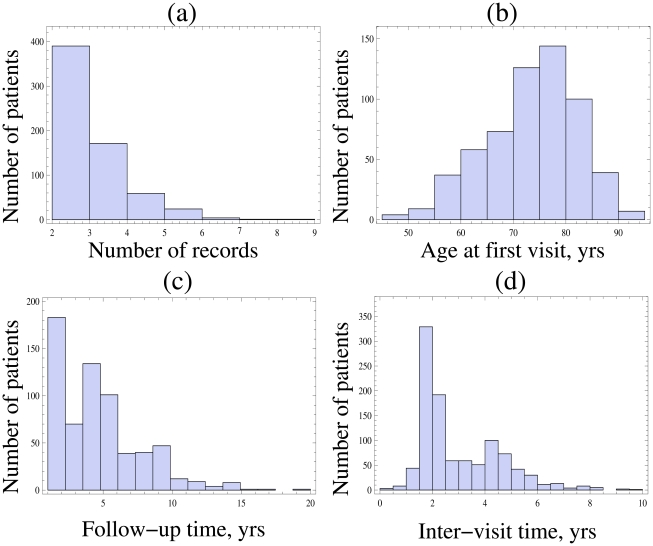
There have been several reports on the varying rates of progression among Alzheimer's Disease (AD) patients; however, there has been no quantitative study of the amount of heterogeneity in AD. Obtaining a reliable quantitative measure of AD progression rates and their variances among the patients for each stage of AD is essential for evaluating results of any clinical study. The Global Deterioration Scale (GDS) and Functional Assessment Staging procedure (FAST) characterize seven stages in the course of AD from normal aging to severe dementia. Each GDS/FAST stage has a published mean duration, but the variance is unknown. We use statistical analysis to reconstruct GDS/FAST stage durations in a cohort of 648 AD patients with an average follow-up time of 4.78 years. Calculations for GDS/FAST stages 4-6 reveal that the standard deviations for stage durations are comparable with their mean values, indicating the presence of large variations in the AD progression among patients. Such amount of heterogeneity in the course of progression of AD is consistent with the existence of several sub-groups of AD patients, which differ by their patterns of decline.
已经有一些关于阿尔茨海默病(AD)患者进展速度差异的报告;然而,AD 患者的异质性程度尚无定量研究。对于 AD 的每个阶段,获得 AD 进展率的可靠定量测量及其在患者中的差异对于评估任何临床研究的结果至关重要。全球衰退量表(GDS)和功能评估分期程序(FAST)将 AD 从正常衰老到严重痴呆的七个阶段进行了特征描述。每个 GDS/FAST 阶段都有一个已发布的平均持续时间,但方差未知。我们使用统计分析方法,对平均随访时间为 4.78 年的 648 名 AD 患者的队列进行 GDS/FAST 阶段持续时间的重建。对 GDS/FAST 阶段 4-6 的计算表明,阶段持续时间的标准差与平均值相当,表明患者之间的 AD 进展存在较大差异。AD 进展过程中的这种异质性程度与 AD 患者存在几个亚组的事实一致,这些亚组在衰退模式上存在差异。