Anaesthetics, Pain Medicine and Intensive Care, Department of Surgery and Cancer, Imperial College London, Chelsea and Westminster Hospital, London, United Kingdom.
PLoS One. 2011;6(11):e26394. doi: 10.1371/journal.pone.0026394. Epub 2011 Nov 3.
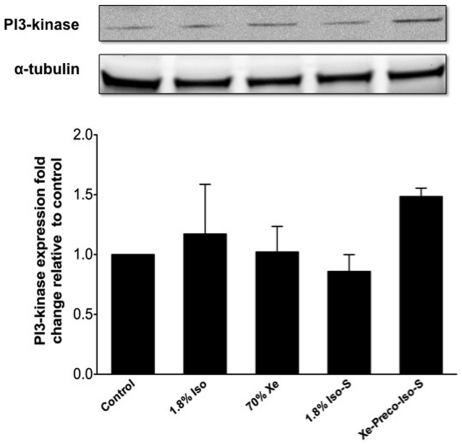
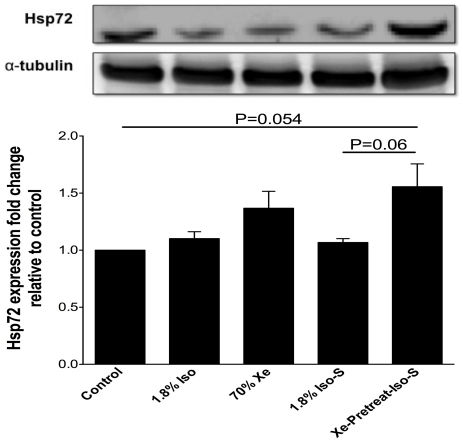
Postoperative cognitive decline (POCD) is a common complication following surgery, but its aetiology remains unclear. We hypothesized that xenon pretreatment prevents POCD by suppressing the systemic inflammatory response or through an associated protective signaling pathway involving heat shock protein 72 (Hsp72) and PI3-kinase. Twenty-four hours after establishing long-term memory using fear conditioning training, C57BL/6 adult male mice (n = 12/group) received one of the following treatments: 1) no treatment group (control); 2) 1.8% isoflurane anesthesia; 3) 70% xenon anesthesia; 4) 1.8% isoflurane anesthesia with surgery of the right hind leg tibia that was pinned and fractured; or 5) pretreatment with 70% xenon for 20 minutes followed immediately by 1.8% isoflurane anesthesia with the surgery described above. Assessments of hippocampal-dependent memory were performed on days 1 and 7 after treatment. Hsp72 and PI3-kinase in hippocampus, and plasma IL-1β, were measured using western blotting and ELISA respectively, from different cohorts on day 1 after surgery. Isoflurane induced memory deficit after surgery was attenuated by xenon pretreatment. Xenon pretreatment prevented the memory deficit typically seen on day 1 (P = 0.04) but not on day 7 (P = 0.69) after surgery under isoflurane anesthesia, when compared with animals that underwent surgery without pretreatment. Xenon pretreatment modulated the expression of Hsp72 (P = 0.054) but had no significant effect on PI3-kinase (P = 0.54), when compared to control. Xenon pretreatment also reduced the plasma level increase of IL-1β induced by surgery (P = 0.028). Our data indicated that surgery and/or Isoflurane induced memory deficit was attenuated by xenon pretreatment. This was associated with a reduction in the plasma level of IL-1β and an upregulation of Hsp72 in the hippocampus.
术后认知功能障碍(POCD)是手术后常见的并发症,但发病机制尚不清楚。我们假设氙预处理通过抑制全身炎症反应或通过涉及热休克蛋白 72(Hsp72)和 PI3-激酶的相关保护信号通路来预防 POCD。在使用恐惧条件反射训练建立长期记忆 24 小时后,C57BL/6 成年雄性小鼠(每组 12 只)接受以下治疗之一:1)无治疗组(对照);2)1.8%异氟烷麻醉;3)70%氙气麻醉;4)1.8%异氟烷麻醉加右后腿胫骨钉和骨折手术;或 5)70%氙预处理 20 分钟,然后立即进行上述手术加 1.8%异氟烷麻醉。治疗后第 1 天和第 7 天进行海马依赖性记忆评估。使用 Western blot 和 ELISA 分别测量手术后第 1 天不同队列中海马中的 Hsp72 和 PI3-激酶以及血浆 IL-1β。异氟烷麻醉后手术引起的记忆缺陷被氙预处理减弱。与未预处理的手术动物相比,氙预处理可预防术后第 1 天(P=0.04)而非第 7 天(P=0.69)通常观察到的记忆缺陷。与对照组相比,氙预处理还调节了 Hsp72 的表达(P=0.054),但对 PI3-激酶没有显著影响(P=0.54)。氙预处理还降低了手术引起的血浆 IL-1β水平升高(P=0.028)。我们的数据表明,手术和/或异氟烷引起的记忆缺陷被氙预处理减弱。这与海马中血浆 IL-1β水平降低和 Hsp72 上调有关。