Department of Chemistry and Biology, Ryerson University, and Programme in Molecular Structure and Function, Research Institute, Hospital for Sick Children, 350 Victoria Street, Toronto, Ontario M5B 2K3, Canada.
J Med Chem. 2011 Dec 22;54(24):8693-701. doi: 10.1021/jm201335c. Epub 2011 Nov 21.
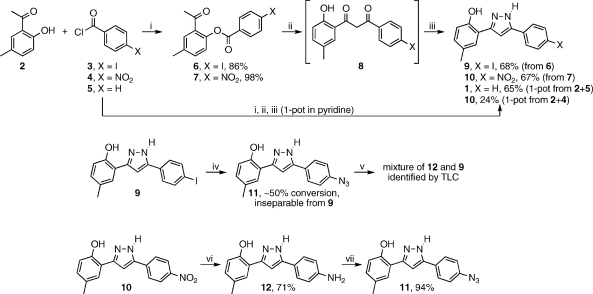
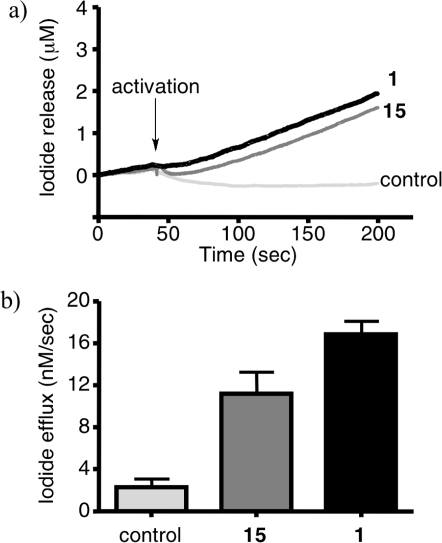
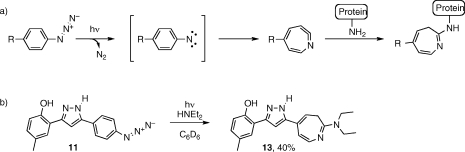
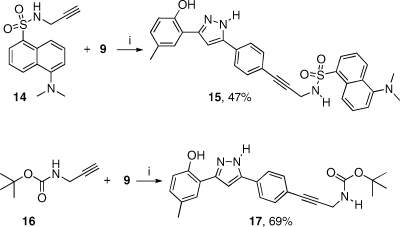
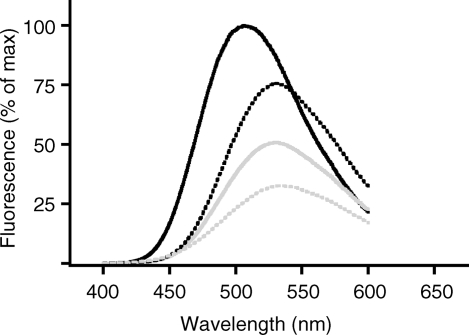
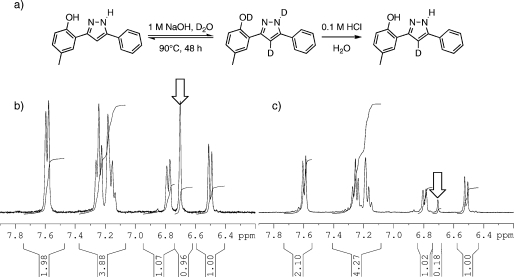
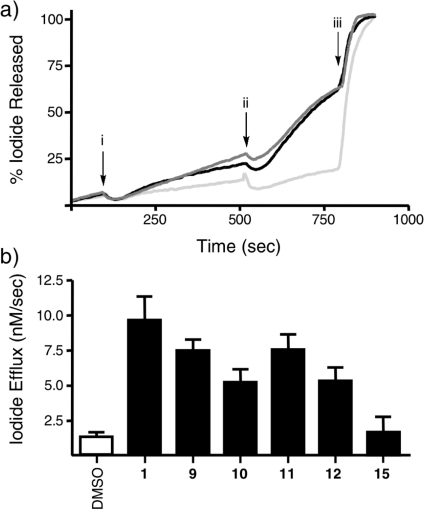
Cystic fibrosis is a genetic disease caused by mutations in the gene for the cystic fibrosis transmembrane conductance regulator (CFTR) protein. In vitro experiments have demonstrated that 4-methyl-2-(5-phenyl-1H-pyrazol-3-yl)phenol (VRT-532, 1) is able to partially restore the function of mutant CFTR proteins. To help elucidate the nature of the interactions between 1 and mutant CFTR, molecular probes based on the structure of 1 have been prepared. These include a photoreactive aryl azide derivative 11 and a fluorescent dansyl sulfonamide 15. Additionally, a method for hydrogen isotope exchange on 1 has been developed, which could be used for the incorporation of radioactive tritium. Using iodide efflux assays, the probe molecules have been demonstrated to modulate the activity of mutant CFTR in the same manner as 1. These probe molecules enable a number of biochemical experiments aimed at understanding how 1 rescues the function of mutant CFTR. This understanding can in turn aid in the design and development of more efficacious compounds which may serve as therapeutic agents in the treatment of cystic fibrosis.
囊性纤维化是一种由囊性纤维化跨膜电导调节蛋白(CFTR)基因突变引起的遗传性疾病。体外实验表明,4-甲基-2-(5-苯基-1H-吡唑-3-基)苯酚(VRT-532,1)能够部分恢复突变 CFTR 蛋白的功能。为了帮助阐明 1 与突变 CFTR 之间相互作用的性质,已经基于 1 的结构制备了分子探针。这些探针包括光反应性芳基叠氮衍生物 11 和荧光丹磺酰基磺酰胺 15。此外,还开发了一种在 1 上进行氚同位素交换的方法,该方法可用于掺入放射性氚。通过碘化物外排测定,这些探针分子已被证明能够以与 1 相同的方式调节突变 CFTR 的活性。这些探针分子使许多旨在了解 1 如何挽救突变 CFTR 功能的生化实验成为可能。这种理解反过来又有助于设计和开发更有效的化合物,这些化合物可能作为囊性纤维化治疗的治疗剂。