Unit of Medical Oncology and Innovative Therapies, Istituto Nazionale Tumori Fondazione Pascale, Naples, Italy.
J Transl Med. 2011 Nov 13;9:196. doi: 10.1186/1479-5876-9-196.
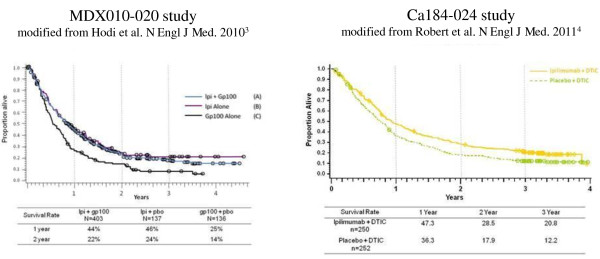
Recently, two studies using ipilimumab, an anti-CTLA-4 monoclonal antibody (mab) demonstrated improvements in overall survival in the treatment of advanced melanoma. These studies utilized two different schedules of treatment in different patient categories (first and second line of treatment). However, the results were quite similar despite of different dosage used and the combination with dacarbazine in the first line treatment. We reviewed the result of randomized phase II-III clinical studies testing anti-CTLA-4 antibodies (ipilimumab and tremelimumab) for the treatment of melanoma to focus on practical or scientific questions related to the broad utilization of these products in the clinics. These analyses raised some considerations about the future of these compounds, their potential application, dosage, the importance of the schedule (induction/manteinance compared to induction alone) and their role as adjuvants. Anti-CTLA-4 antibody therapy represents the start of a new era in the treatment of advanced melanoma but we are on the steep slope of the learning curve toward the optimization of their utilization either a single agents or in combination.
最近,两项使用抗 CTLA-4 单克隆抗体(mab)伊匹单抗的研究表明,在治疗晚期黑色素瘤方面,总生存期有所改善。这些研究在不同的患者类别(一线和二线治疗)中使用了两种不同的治疗方案。然而,尽管使用了不同的剂量并在一线治疗中与达卡巴嗪联合使用,结果却非常相似。我们回顾了测试抗 CTLA-4 抗体(伊匹单抗和 tremelimumab)治疗黑色素瘤的随机 II-III 期临床研究的结果,重点关注与这些产品在临床广泛应用相关的实际或科学问题。这些分析提出了一些关于这些化合物未来、其潜在应用、剂量、方案(诱导/维持与仅诱导相比)的重要性及其作为佐剂的作用的考虑因素。抗 CTLA-4 抗体治疗代表了晚期黑色素瘤治疗的新时代的开始,但我们正处于学习曲线的陡峭阶段,以优化其作为单一药物或联合治疗的应用。