Department of Pharmaceutical Chemistry, University of California San Francisco, San Francisco, California, United States of America.
PLoS One. 2011;6(11):e27303. doi: 10.1371/journal.pone.0027303. Epub 2011 Nov 11.
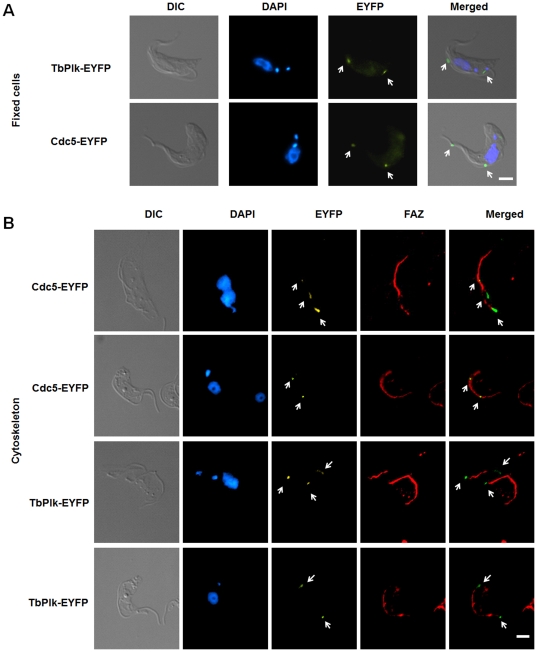
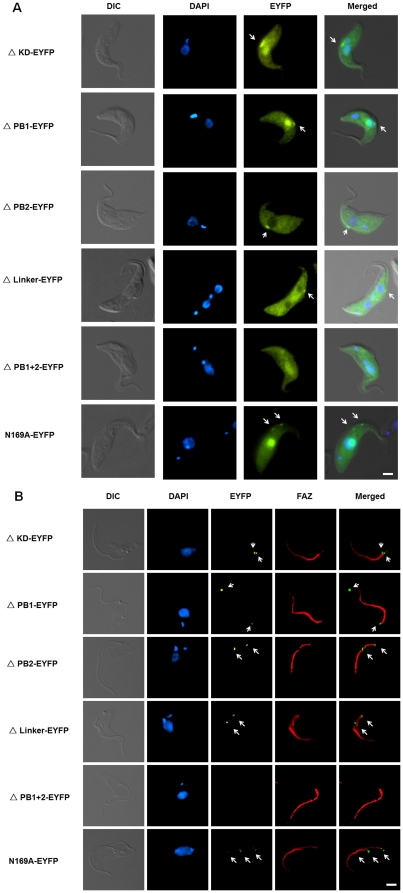
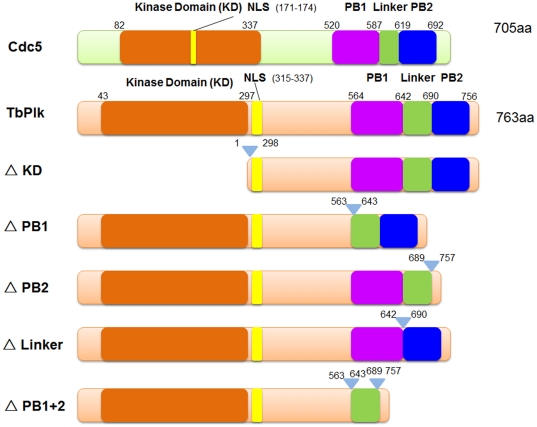
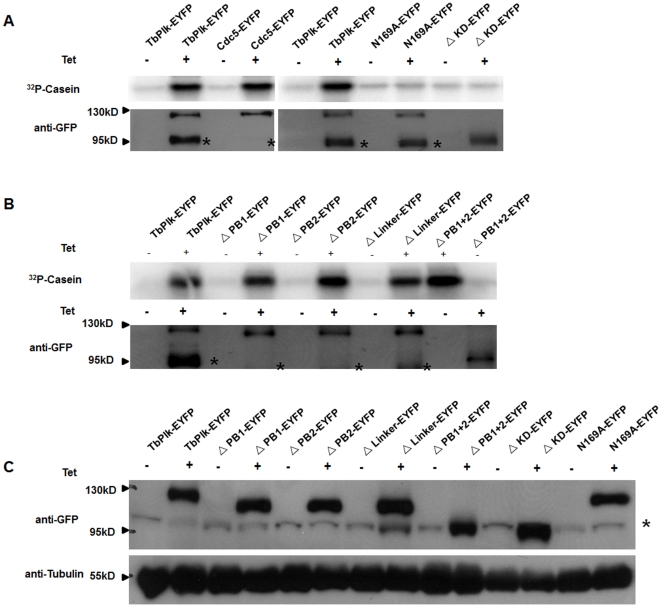
The polo-like kinase in the deep branching eukaryote Trypanosoma brucei (TbPlk) has many unique features. Unlike all the other polo-like kinases known to associate with the nucleus and controlling both mitosis and cytokinesis, TbPlk localizes to the flagellum attachment zone (FAZ) and regulates only cytokinesis in T. brucei. TbPlk was, however, previously found capable of complementing all the multiple Plk (Cdc5) functions in Saccharomyces cerevisiae, indicating that it has acquired all the functions of Cdc5. In the present study, Cdc5 tagged with an enhanced yellow fluorescence protein (EYFP) localized exclusively in the FAZ of T. brucei, suggesting that the unusual localization and limited function of TbPlk are probably attributed to the particular environment in T. brucei cells. Structural basis for the FAZ localization of TbPlk was further investigated with TbPlk and TbPlk mutants tagged with EYFP and expressed in T. brucei. The results indicated that a kinase-inactive mutant N169A and a TbPlk mutant with the entire kinase domain (KD) deleted both localized to the FAZ. Substantial association with FAZ was also maintained when one of the two polo-boxes (PB1 or 2) or the linker region between them was deleted from TbPlk. But a deletion of both polo-boxes led to a complete exclusion of the protein from FAZ. All the deletion mutants retained the kinase activity, further indicating that the TbPlk kinase function does not play a role for FAZ localization. The two polo boxes in TbPlk are most likely instrumental in localizing the protein to FAZ through potential interactions with certain FAZ structural component(s). A putative cryptic bipartite nuclear targeting signal was identified in TbPlk, which was capable of directing TbPlk into the nucleus when either the kinase activity was lost or the PB1 was deleted from the protein.
在深根系真核生物布氏锥虫(Trypanosoma brucei)中,类 Polo 激酶(TbPlk)具有许多独特的特征。与所有已知与核结合并控制有丝分裂和胞质分裂的其他类 Polo 激酶不同,TbPlk 定位于鞭毛附着区(FAZ),仅在 T. brucei 中调节胞质分裂。然而,先前发现 TbPlk 能够在酿酒酵母(Saccharomyces cerevisiae)中补充所有多个 Plk(Cdc5)的功能,这表明它已经获得了 Cdc5 的所有功能。在本研究中,标记有增强型黄色荧光蛋白(EYFP)的 Cdc5 仅在 T. brucei 的 FAZ 中定位,这表明 TbPlk 异常的定位和有限的功能可能归因于 T. brucei 细胞的特殊环境。进一步通过在 T. brucei 中表达 TbPlk 和 TbPlk 突变体及其 EYFP 标记物,研究了 TbPlk FAZ 定位的结构基础。结果表明,激酶失活突变体 N169A 和缺失整个激酶结构域(KD)的 TbPlk 突变体均定位于 FAZ。当从 TbPlk 中删除两个 Polo 盒(PB1 或 2)之一或它们之间的连接区时,也与 FAZ 保持大量的结合。但是,当两个 Polo 盒都被删除时,该蛋白完全被排除在 FAZ 之外。所有缺失突变体均保留激酶活性,进一步表明 TbPlk 激酶功能对于 FAZ 定位没有作用。在 TbPlk 中,两个 Polo 盒很可能通过与 FAZ 结构成分(或多个成分)的潜在相互作用,有助于将蛋白定位到 FAZ。在 TbPlk 中鉴定出一个假定的隐蔽二分体核靶向信号,当激酶活性丧失或从蛋白中删除 PB1 时,该信号能够将 TbPlk 引导到核内。