Department of Surgery, University of New South Wales, Sydney, NSW, Australia,
Cancer Metastasis Rev. 2012 Jun;31(1-2):143-62. doi: 10.1007/s10555-011-9337-5.
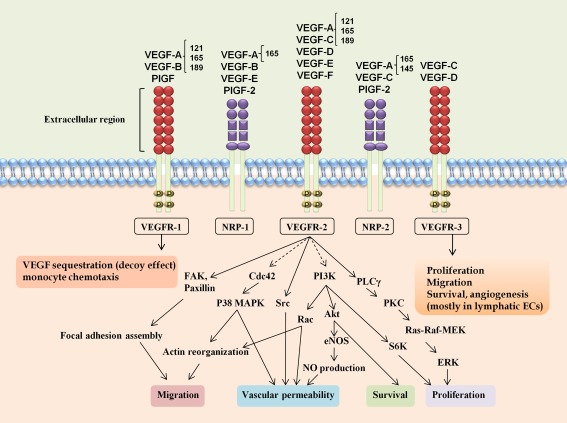
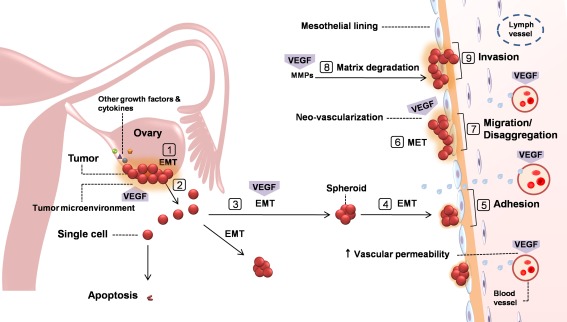
Vascular endothelial growth factor (VEGF) is a key regulator of angiogenesis which drives endothelial cell survival, proliferation, and migration while increasing vascular permeability. Playing an important role in the physiology of normal ovaries, VEGF has also been implicated in the pathogenesis of ovarian cancer. Essentially by promoting tumor angiogenesis and enhancing vascular permeability, VEGF contributes to the development of peritoneal carcinomatosis associated with malignant ascites formation, the characteristic feature of advanced ovarian cancer at diagnosis. In both experimental and clinical studies, VEGF levels have been inversely correlated with survival. Moreover, VEGF inhibition has been shown to inhibit tumor growth and ascites production and to suppress tumor invasion and metastasis. These findings have laid the basis for the clinical evaluation of agents targeting VEGF signaling pathway in patients with ovarian cancer. In this review, we will focus on VEGF involvement in the pathophysiology of ovarian cancer and its contribution to the disease progression and dissemination.
血管内皮生长因子(VEGF)是血管生成的关键调节因子,可促进内皮细胞的存活、增殖和迁移,同时增加血管通透性。VEGF 在正常卵巢的生理学中发挥着重要作用,也与卵巢癌的发病机制有关。VEGF 通过促进肿瘤血管生成和增加血管通透性,有助于形成与恶性腹水相关的腹膜癌病,这是诊断时晚期卵巢癌的特征。在实验和临床研究中,VEGF 水平与生存率呈负相关。此外,VEGF 抑制已被证明可抑制肿瘤生长和腹水产生,并抑制肿瘤侵袭和转移。这些发现为评估卵巢癌患者靶向 VEGF 信号通路药物的临床疗效奠定了基础。在这篇综述中,我们将重点关注 VEGF 在卵巢癌病理生理学中的作用及其对疾病进展和扩散的贡献。