Department of Neuroscience, Canadian Centre for Behavioural Neuroscience, The University of Lethbridge, Lethbridge, Alberta, Canada.
PLoS One. 2011;6(11):e27426. doi: 10.1371/journal.pone.0027426. Epub 2011 Nov 14.
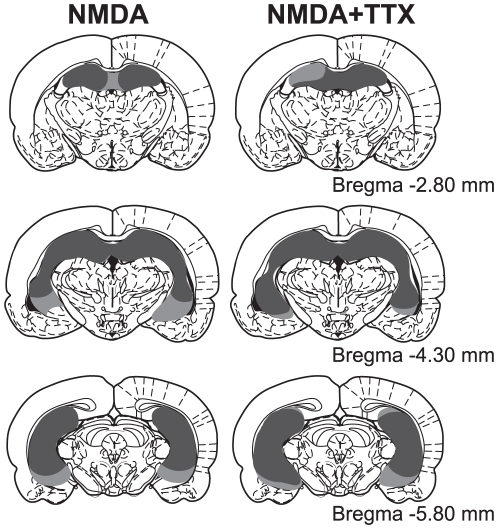
Damage to the hippocampus (HPC) using the excitotoxin N-methyl-D-aspartate (NMDA) can cause retrograde amnesia for contextual fear memory. This amnesia is typically attributed to loss of cells in the HPC. However, NMDA is also known to cause intense neuronal discharge (seizure activity) during the hours that follow its injection. These seizures may have detrimental effects on retrieval of memories. Here we evaluate the possibility that retrograde amnesia is due to NMDA-induced seizure activity or cell damage per se. To assess the effects of NMDA induced activity on contextual memory, we developed a lesion technique that utilizes the neurotoxic effects of NMDA while at the same time suppressing possible associated seizure activity. NMDA and tetrodotoxin (TTX), a sodium channel blocker, are simultaneously infused into the rat HPC, resulting in extensive bilateral damage to the HPC. TTX, co-infused with NMDA, suppresses propagation of seizure activity. Rats received pairings of a novel context with foot shock, after which they received NMDA-induced, TTX+NMDA-induced, or no damage to the HPC at a recent (24 hours) or remote (5 weeks) time point. After recovery, the rats were placed into the shock context and freezing was scored as an index of fear memory. Rats with an intact HPC exhibited robust memory for the aversive context at both time points, whereas rats that received NMDA or NMDA+TTX lesions showed a significant reduction in learned fear of equal magnitude at both the recent and remote time points. Therefore, it is unlikely that observed retrograde amnesia in contextual fear conditioning are due to disruption of non-HPC networks by propagated seizure activity. Moreover, the memory deficit observed at both time points offers additional evidence supporting the proposition that the HPC has a continuing role in maintaining contextual memories.
使用兴奋性氨基酸 NMDA 损伤海马体(HPC)会导致情景恐惧记忆的逆行性遗忘。这种遗忘通常归因于 HPC 细胞的丢失。然而,NMDA 注射后数小时内也会引起强烈的神经元放电(癫痫活动)。这些癫痫发作可能对记忆的提取产生不利影响。在这里,我们评估逆行性遗忘是否是由于 NMDA 诱导的癫痫活动或细胞损伤本身引起的。为了评估 NMDA 诱导的活动对情景记忆的影响,我们开发了一种利用 NMDA 的神经毒性作用,同时抑制可能相关的癫痫活动的损伤技术。NMDA 和河豚毒素(TTX),一种钠离子通道阻滞剂,同时输注到大鼠 HPC 中,导致 HPC 广泛的双侧损伤。TTX 与 NMDA 共同输注可抑制癫痫活动的传播。大鼠接受新环境与足部电击的配对,然后在最近(24 小时)或远程(5 周)时间点接受 NMDA 诱导、TTX+NMDA 诱导或 HPC 无损伤。恢复后,将大鼠放入电击环境中,并将冻结作为恐惧记忆的指标进行评分。具有完整 HPC 的大鼠在两个时间点都表现出对厌恶环境的强烈记忆,而接受 NMDA 或 NMDA+TTX 损伤的大鼠在最近和远程时间点都表现出相同程度的学习恐惧显著降低。因此,观察到的情景恐惧条件反射中的逆行性遗忘不太可能是由于传播的癫痫活动破坏了非 HPC 网络所致。此外,在两个时间点观察到的记忆缺陷提供了额外的证据,支持 HPC 在维持情景记忆方面具有持续作用的观点。