Institute of Biological Sciences & Institute of Ocean and Earth Sciences, University of Malaya, Kuala Lumpur, 50603 Malaysia.
Parasit Vectors. 2011 Nov 24;4:220. doi: 10.1186/1756-3305-4-220.
Myxosporeans are known from aquatic annelids but parasitism of platyhelminths by myxosporeans has not been widely reported. Hyperparasitism of gill monogeneans by Myxidium giardi has been reported from the European eel and Myxidium-like hyperparasites have also been observed during studies of gill monogeneans from Malaysia and Japan.The present study aimed to collect new hyperparasite material from Malaysia for morphological and molecular descriptions. In addition, PCR screening of host fish was undertaken to determine whether they are also hosts for the myxosporean.
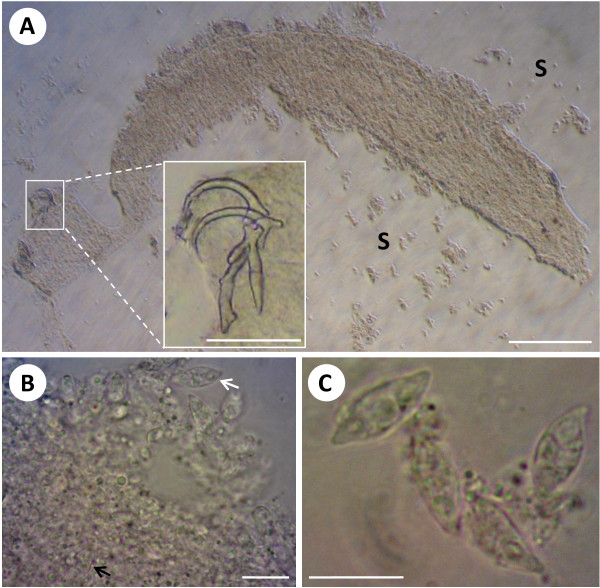
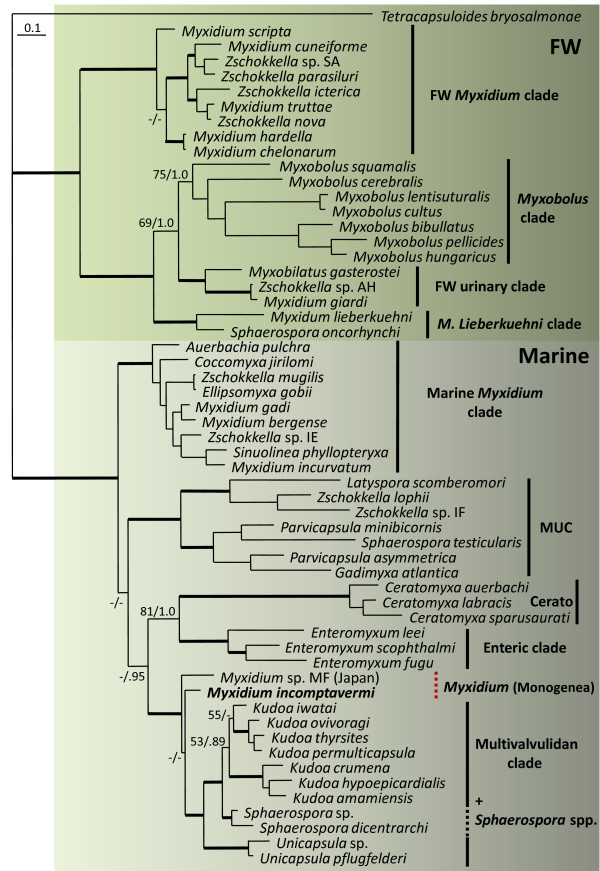
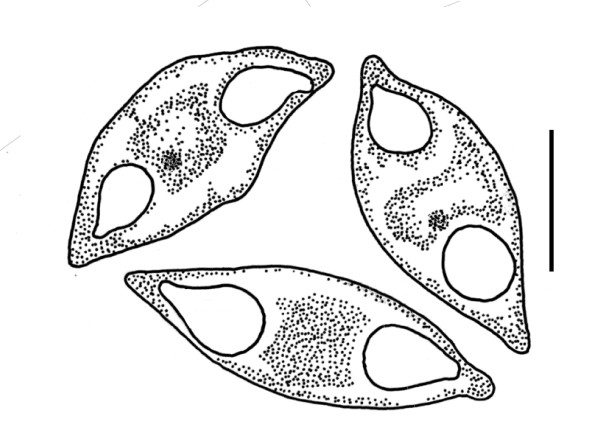
Heavy myxosporean infections were observed in monogeneans from two out of 14 fish and were detected from a further five fish using specific PCRs and pooled monogenean DNA. Positive DNA isolates were sequenced and were from a single species of myxosporean. Myxospore morphology was consistent with Myxidium with histozoic development in the parenchymal tissues of the monogenean. Simultaneous infections in the fish could not be confirmed microscopically; however, identical myxosporean DNA could be amplified from kidney, spleen and intestinal tract tissues using the specific PCR. Small subunit (SSU) rDNA for the myxosporean was amplified and was found to be most similar (92%) to that of another hyperparasitic myxosporean from a gill monogenean from Japan and to numerous multivalvulidan myxosporeans from the genus Kudoa (89-91%). Phylogenetic analyses placed the hyperparasite sequence basally to clades containing Kudoa, Unicapsula and Sphaerospora.
The myxosporean infecting the gill monogenean, Diplectanocotyla gracilis, from the Indo-Pacific tarpon, Megalops cyprinoides, is described as a new species, Myxidium incomptavermi, based on a histozoic development in the monogenean host and its phylogenetic placement.We have demonstrated for the first time that a myxosporean hyperparasite of gill monogeneans is detectable in the fish host. However, myxospores could not be isolated from the fish and confirmation was by PCR alone. The relationship between the myxosporean infection in gill monogeneans and the presence of parasitic DNA in fish is not yet fully understood. Nonetheless, myxospores with a Myxidium-like morphology, two of which we have shown to be phylogenetically related, have now been reported to develop in three different gill monogeneans, indicating that myxosporeans are true parasites of monogeneans.
粘孢子虫已知存在于水生环节动物中,但粘孢子虫寄生扁形动物的情况并未得到广泛报道。已报道从欧洲鳗鱼中发现粘孢子虫寄生在鳃单殖吸虫上,并且在对来自马来西亚和日本的鳃单殖吸虫的研究中也观察到了类似粘孢子虫的超寄生现象。本研究旨在从马来西亚收集新的超寄生材料进行形态学和分子描述。此外,还对宿主鱼进行了 PCR 筛选,以确定它们是否也是粘孢子虫的宿主。
在 14 条鱼中的两条鱼的单殖吸虫中观察到严重的粘孢子虫感染,并通过特定的 PCR 和混合单殖吸虫 DNA 在另外五条鱼中检测到。阳性 DNA 分离物进行了测序,均来自一种粘孢子虫。粘孢子形态与粘孢子虫一致,在单殖吸虫的实质组织中呈组织内发育。虽然无法在显微镜下确认鱼类的同时感染,但使用特定的 PCR 可以从肾脏、脾脏和肠道组织中扩增出相同的粘孢子虫 DNA。扩增了粘孢子虫的小亚基 (SSU) rDNA,发现其与来自日本鳃单殖吸虫的另一种超寄生粘孢子虫(92%)以及来自 Kudoa 属的许多多瓣粘孢子虫(89-91%)最为相似。系统发育分析将该超寄生序列置于包含 Kudoa、Unicapsula 和 Sphaerospora 的分支的基部。
从印度洋-太平洋鲥鱼 Megalops cyprinoides 的鳃单殖吸虫 Diplectanocotyla gracilis 中感染的粘孢子虫被描述为一个新物种,即 Myxidium incomptavermi,其依据是在单殖吸虫宿主中存在组织内发育及其系统发育位置。我们首次证明,鳃单殖吸虫的粘孢子虫超寄生在鱼类宿主中是可检测到的。然而,无法从鱼类中分离出粘孢子虫,仅通过 PCR 进行确认。粘孢子虫感染鳃单殖吸虫与鱼类中寄生 DNA 的存在之间的关系尚未完全清楚。尽管如此,具有 Myxidium 样形态的粘孢子虫,其中两种已被证明在系统发育上相关,现已在三种不同的鳃单殖吸虫中报告发育,这表明粘孢子虫确实是单殖吸虫的寄生虫。