
药物遗传学分析与西妥昔单抗治疗晚期结直肠癌患者的疗效关系。
Pharmacogenetic profiling and cetuximab outcome in patients with advanced colorectal cancer.
机构信息
Assistance Publique-Hôpitaux de Marseille, Hôpital Timone, Université de la Méditerranée, Marseille, France.
出版信息
BMC Cancer. 2011 Nov 25;11:496. doi: 10.1186/1471-2407-11-496.
BACKGROUND
We analyzed the influence of 8 germinal polymorphisms of candidate genes potentially related to EGFR signalling (EGFR, EGF, CCND1) or antibody-directed cell cytotoxicity (FCGR2A and FCGR3A) on outcome of colorectal cancer (CRC) patients receiving cetuximab-based therapy.
METHODS
Fifty-eight advanced CRC patients treated with cetuximab-irinotecan salvage therapy between 2001 and 2007 were analyzed (mean age 60; 50 PS 0-1). The following polymorphisms were analyzed on blood DNA: EGFR (CA repeats in intron 1, -216 G > T, -191C > A, R497K), EGF (A61G), CCND1 (A870G), FCGR2A (R131H), FCGR3A (F158V). Statistical analyses were conducted on the total population and on patients with wt KRas tumors. All SNPs were considered as ternary variables (wt/wt vs wt/mut vs mut/mut), with the exception of -191C > A EGFR polymorphism (AA patient merged with CA patients).
RESULTS
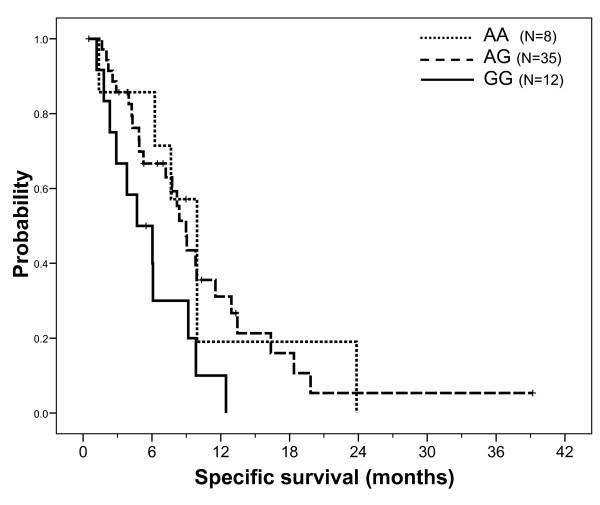
Analysis of skin toxicity as a function of EGFR intron 1 polymorphism showed a tendency for higher toxicity in patients with a low number of CA-repeats (p = 0.058). CCND1 A870G polymorphism was significantly related to clinical response, both in the entire population and in KRas wt patients, with the G allele being associated with a lack of response. In wt KRas patients, time to progression (TTP) was significantly related to EGFR -191C > A polymorphism with a longer TTP in CC patients as compared to others, and to CCND1 A870G polymorphism with the G allele being associated with a shorter TTP; a multivariate analysis including these two polymorphisms only retained CCND1 polymorphism. Overall survival was significantly related to CCND1 polymorphism with a shorter survival in patients bearing the G allele, and to FCGR3A F158V polymorphism with a shorter survival in VV patients (in the entire population and in KRas wt patients). FCGR3A F158V and CCND1 A870G polymorphisms were significant independent predictors of overall survival.
CONCLUSIONS
Present original data obtained in wt KRas patients corresponding to the current cetuximab-treated population clearly suggest that CCND1 A870G polymorphism may be used as an additional marker for predicting cetuximab efficacy, TTP and overall survival. In addition, FCGR3A F158V polymorphism was a significant independent predictor of overall survival.
背景
我们分析了 8 个候选基因的生殖突变,这些基因可能与表皮生长因子受体(EGFR)信号转导(EGFR、EGF、CCND1)或抗体导向的细胞细胞毒性(FCGR2A 和 FCGR3A)有关,以评估其对接受西妥昔单抗为基础治疗的结直肠癌(CRC)患者结局的影响。
方法
对 2001 年至 2007 年间接受西妥昔单抗-伊立替康挽救治疗的 58 例晚期 CRC 患者进行了分析(平均年龄 60 岁;50 例 PS 0-1)。在血液 DNA 中分析了以下突变:EGFR(内含子 1 的 CA 重复、-216 G>T、-191C>A、R497K)、EGF(A61G)、CCND1(A870G)、FCGR2A(R131H)、FCGR3A(F158V)。对总人群和 wt KRas 肿瘤患者进行了统计学分析。所有 SNPs 均被视为三态变量(wt/wt 与 wt/mut 与 mut/mut),除了 EGFR-191C>A 突变(AA 患者与 CA 患者合并)。
结果
分析皮肤毒性作为 EGFR 内含子 1 突变的函数,表明在 CA 重复次数较少的患者中,毒性更高的趋势(p=0.058)。CCND1 A870G 突变与临床反应显著相关,无论是在整个人群中还是在 wt KRas 患者中,G 等位基因与无反应相关。在 wt KRas 患者中,无进展生存期(TTP)与 EGFR-191C>A 突变显著相关,CC 患者的 TTP 明显长于其他患者,与 CCND1 A870G 突变相关,G 等位基因与 TTP 较短相关;包括这两个突变的多变量分析仅保留了 CCND1 突变。总生存期与 CCND1 突变显著相关,携带 G 等位基因的患者生存期较短,与 FCGR3A F158V 突变显著相关,VV 患者的生存期较短(在整个人群和 wt KRas 患者中)。FCGR3A F158V 和 CCND1 A870G 突变是总生存期的显著独立预测因子。
结论
目前在 wt KRas 患者中获得的原始数据与当前接受西妥昔单抗治疗的人群相对应,明确表明 CCND1 A870G 突变可作为预测西妥昔单抗疗效、TTP 和总生存期的附加标志物。此外,FCGR3A F158V 突变是总生存期的显著独立预测因子。


 Zotero 插件