
FCGR2A和FCGR3A基因多态性与接受一线5-氟尿嘧啶/亚叶酸钙和奥沙利铂±西妥昔单抗治疗的转移性结直肠癌患者的临床结局
FCGR2A and FCGR3A polymorphisms and clinical outcome in metastatic colorectal cancer patients treated with first-line 5-fluorouracil/folinic acid and oxaliplatin +/- cetuximab.
作者信息
Kjersem Janne B, Skovlund Eva, Ikdahl Tone, Guren Tormod, Kersten Christian, Dalsgaard Astrid M, Yilmaz Mette K, Fokstuen Tone, Tveit Kjell M, Kure Elin H
机构信息
Department of Genetics, Institute for Cancer Research, Oslo University Hospital, Postboks 4953 Nydalen, 0424 Oslo, Norway.
出版信息
BMC Cancer. 2014 May 19;14:340. doi: 10.1186/1471-2407-14-340.
BACKGROUND
Polymorphisms of genes encoding the Fcy receptors (Fc fragment of IgG receptor 2A (FCGR2A) and 3A (FCGR3A)), which influence their affinity for the Fc fragment, have been linked to the pharmacodynamics of monoclonal antibodies. Most studies have been limited by small samples sizes and have reported inconsistent associations between the FCGR2A and the FCGR3A polymorphisms and clinical outcome in metastatic colorectal cancer (mCRC) patients treated with cetuximab. We investigated the association of these polymorphisms and clinical outcome in a large cohort of mCRC patients treated with first-line 5-fluorouracil/folinic acid and oxaliplatin (Nordic FLOX) +/- cetuximab in the NORDIC-VII study (NCT00145314).
METHODS
504 and 497 mCRC patients were evaluable for the FCGR2A and FCGR3A genotyping, respectively. Genotyping was performed on TaqMan ABI HT 7900 (Applied Biosystems, Foster City, CA, USA) with pre-designed SNP genotyping assays for FCGR2A (rs1801274) and FCGR3A (rs396991).
RESULTS
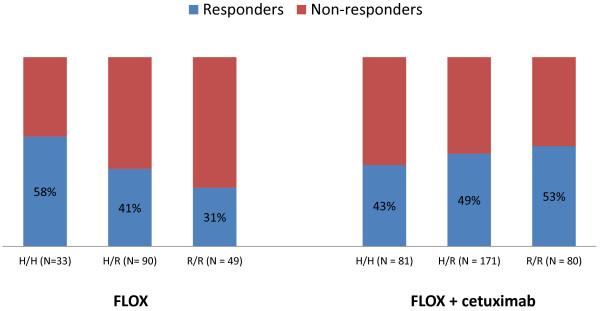
The response rate for patients with the FCGR2A R/R genotype was significantly increased when cetuximab was added to Nordic FLOX (31% versus 53%, interaction P = 0.03), but was not significantly different compared to the response rate of patients with the FCGR2A H/H or H/R genotypes given the same treatment. A larger increase in response rate with the addition of cetuximab to Nordic FLOX in patients with KRAS mutated tumors and the FCGR2A R/R genotype was observed (19% versus 50%, interaction P = 0.04). None of the FCGR3A polymorphisms were associated with altered response when cetuximab was added to Nordic FLOX (interaction P = 0.63). Neither of the FCGR polymorphisms showed any significant associations with progression-free survival or overall survival.
CONCLUSION
Patients with KRAS mutated tumors and the FCGR2A R/R polymorphism responded poorly when treated with chemotherapy only, and experienced the most benefit of the addition of cetuximab in terms of response rate.
背景
编码Fcγ受体(免疫球蛋白G受体2A(FCGR2A)和3A(FCGR3A)的Fc片段)的基因多态性会影响其对Fc片段的亲和力,这与单克隆抗体的药效学有关。大多数研究受限于样本量小,并且在接受西妥昔单抗治疗的转移性结直肠癌(mCRC)患者中,关于FCGR2A和FCGR3A多态性与临床结局之间的关联报道并不一致。我们在北欧- VII研究(NCT00145314)中调查了这些多态性与一大群接受一线5-氟尿嘧啶/亚叶酸和奥沙利铂(北欧FLOX)+/-西妥昔单抗治疗的mCRC患者临床结局之间的关联。
方法
分别有504例和497例mCRC患者可进行FCGR2A和FCGR3A基因分型。使用针对FCGR2A(rs1801274)和FCGR3A(rs396991)的预设计SNP基因分型检测试剂盒,在TaqMan ABI HT 7900(美国应用生物系统公司,加利福尼亚州福斯特城)上进行基因分型。
结果
当在北欧FLOX方案中添加西妥昔单抗时,FCGR2A R/R基因型患者的缓解率显著提高(31%对53%,交互作用P = 0.03),但与接受相同治疗的FCGR2A H/H或H/R基因型患者的缓解率相比,差异无统计学意义。在KRAS突变肿瘤且FCGR2A R/R基因型的患者中,观察到在北欧FLOX方案中添加西妥昔单抗后缓解率有更大幅度的提高(19%对50%,交互作用P = 0.04)。当在北欧FLOX方案中添加西妥昔单抗时,FCGR3A的任何多态性均与缓解改变无关(交互作用P = 0.63)。FCGR多态性均未显示与无进展生存期或总生存期有任何显著关联。
结论
KRAS突变肿瘤且具有FCGR2A R/R多态性的患者仅接受化疗时缓解较差,在缓解率方面,添加西妥昔单抗获益最大。


 Zotero 插件