Computational System Biology Lab, Department of Biochemistry and Molecular Biology, and Institute of Bioinformatics, University of Georgia, Athens, Georgia, United States of America.
PLoS One. 2011;6(11):e27995. doi: 10.1371/journal.pone.0027995. Epub 2011 Nov 18.
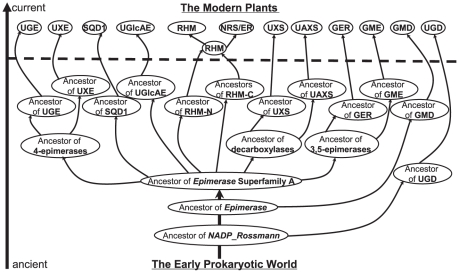
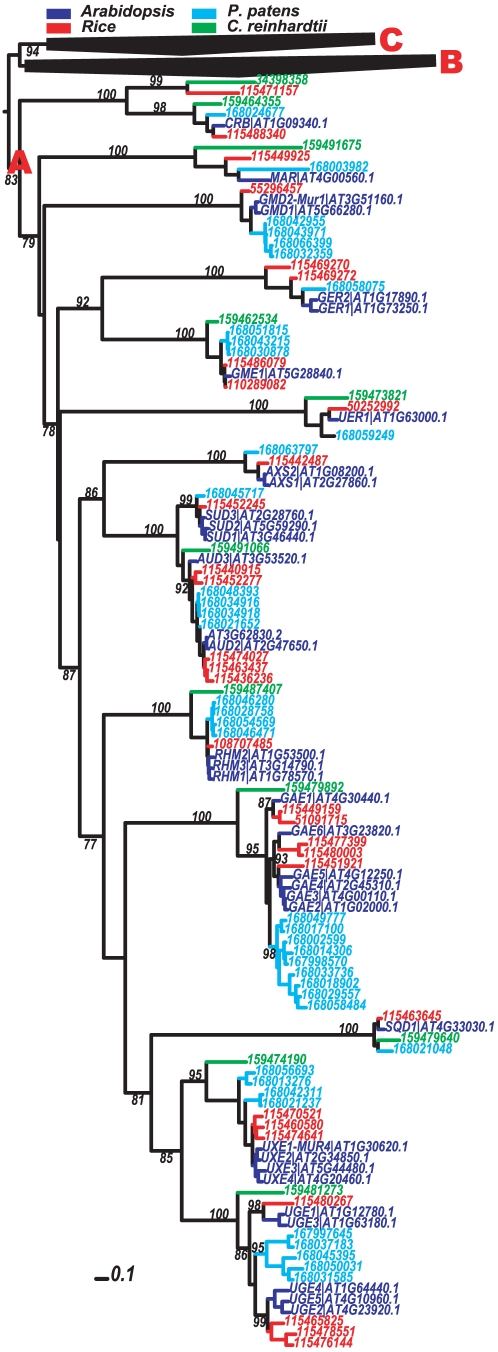
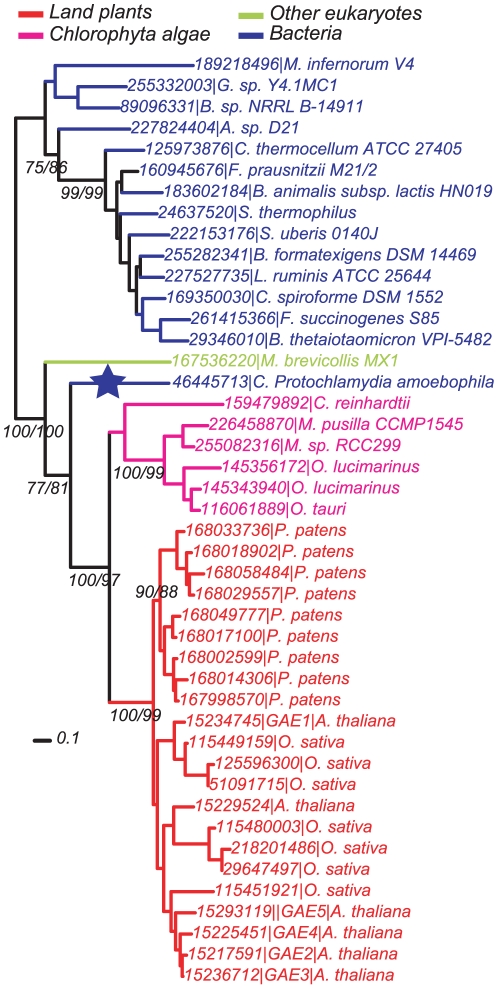
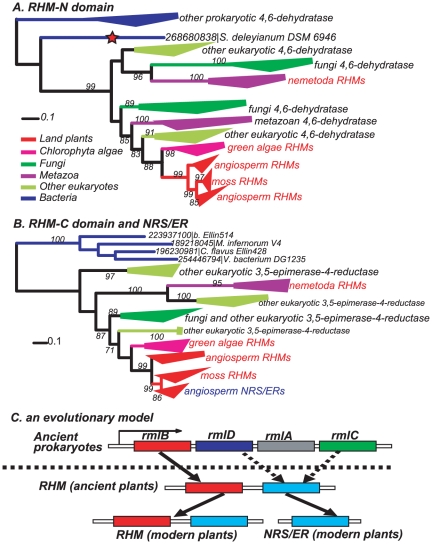
Nucleotide-diphospho-sugars (NDP-sugars) are the building blocks of diverse polysaccharides and glycoconjugates in all organisms. In plants, 11 families of NDP-sugar interconversion enzymes (NSEs) have been identified, each of which interconverts one NDP-sugar to another. While the functions of these enzyme families have been characterized in various plants, very little is known about their evolution and origin. Our phylogenetic analyses indicate that all the 11 plant NSE families are distantly related and most of them originated from different progenitor genes, which have already diverged in ancient prokaryotes. For instance, all NSE families are found in the lower land plant mosses and most of them are also found in aquatic algae, implicating that they have already evolved to be capable of synthesizing all the 11 different NDP-sugars. Particularly interesting is that the evolution of RHM (UDP-L-rhamnose synthase) manifests the fusion of genes of three enzymatic activities in early eukaryotes in a rather intriguing manner. The plant NRS/ER (nucleotide-rhamnose synthase/epimerase-reductase), on the other hand, evolved much later from the ancient plant RHMs through losing the N-terminal domain. Based on these findings, an evolutionary model is proposed to explain the origin and evolution of different NSE families. For instance, the UGlcAE (UDP-D-glucuronic acid 4-epimerase) family is suggested to have evolved from some chlamydial bacteria. Our data also show considerably higher sequence diversity among NSE-like genes in modern prokaryotes, consistent with the higher sugar diversity found in prokaryotes. All the NSE families are widely found in plants and algae containing carbohydrate-rich cell walls, while sporadically found in animals, fungi and other eukaryotes, which do not have or have cell walls with distinct compositions. Results of this study were shown to be highly useful for identifying unknown genes for further experimental characterization to determine their functions in the synthesis of diverse glycosylated molecules.
核苷酸二磷酸糖(NDP-sugars)是所有生物中各种多糖和糖缀合物的结构单元。在植物中,已经鉴定出 11 种 NDP-糖相互转化酶(NSE)家族,每个家族都将一种 NDP-糖转化为另一种。虽然这些酶家族的功能在各种植物中已经得到了表征,但它们的进化和起源知之甚少。我们的系统发育分析表明,所有 11 种植物 NSE 家族都远缘相关,其中大多数起源于不同的前体基因,这些基因在古代原核生物中已经分化。例如,所有的 NSE 家族都存在于低等植物苔藓中,其中大多数也存在于水生藻类中,这表明它们已经进化到能够合成所有 11 种不同的 NDP-sugars。特别有趣的是,RHM(UDP-L-鼠李糖合酶)的进化以一种相当有趣的方式展示了早期真核生物中三种酶活性基因的融合。另一方面,植物 NRS/ER(核苷酸-鼠李糖合酶/差向异构酶-还原酶)则是通过失去 N 端结构域,从古老的植物 RHMs 中进化而来的。基于这些发现,提出了一个进化模型来解释不同 NSE 家族的起源和进化。例如,UGlcAE(UDP-D-葡萄糖醛酸 4-差向异构酶)家族被认为是从某些衣原体细菌中进化而来的。我们的数据还显示,现代原核生物中 NSE 样基因的序列多样性相当高,与原核生物中发现的更高的糖多样性一致。所有的 NSE 家族都广泛存在于含有富含碳水化合物细胞壁的植物和藻类中,而在动物、真菌和其他真核生物中则零星存在,这些生物没有或具有组成不同的细胞壁。本研究的结果对于鉴定未知基因以进一步进行实验表征以确定它们在合成各种糖基化分子中的功能非常有用。