Department of Biology, Stanford University, Pacific Grove, CA 93950, USA.
BMC Genomics. 2011 Nov 29;12:585. doi: 10.1186/1471-2164-12-585.
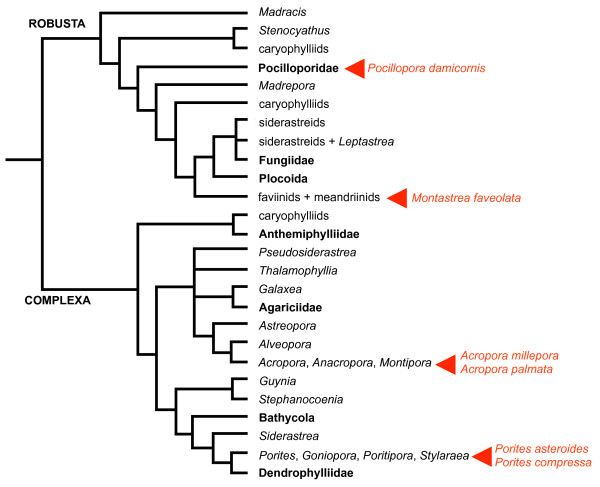
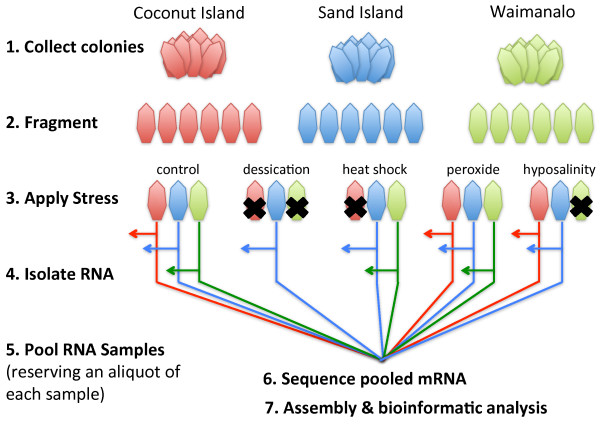
Motivated by the precarious state of the world's coral reefs, there is currently a keen interest in coral transcriptomics. By identifying changes in coral gene expression that are triggered by particular environmental stressors, we can begin to characterize coral stress responses at the molecular level, which should lead to the development of more powerful diagnostic tools for evaluating the health of corals in the field. Furthermore, the identification of genetic variants that are more or less resilient in the face of particular stressors will help us to develop more reliable prognoses for particular coral populations. Toward this end, we performed deep mRNA sequencing of the cauliflower coral, Pocillopora damicornis, a geographically widespread Indo-Pacific species that exhibits a great diversity of colony forms and is able to thrive in habitats subject to a wide range of human impacts. Importantly, P. damicornis is particularly amenable to laboratory culture. We collected specimens from three geographically isolated Hawaiian populations subjected to qualitatively different levels of human impact. We isolated RNA from colony fragments ("nubbins") exposed to four environmental stressors (heat, desiccation, peroxide, and hypo-saline conditions) or control conditions. The RNA was pooled and sequenced using the 454 platform.
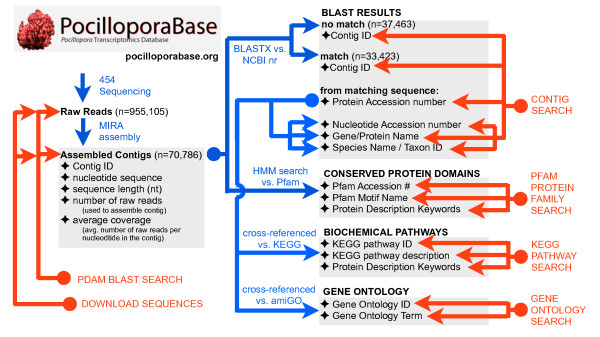
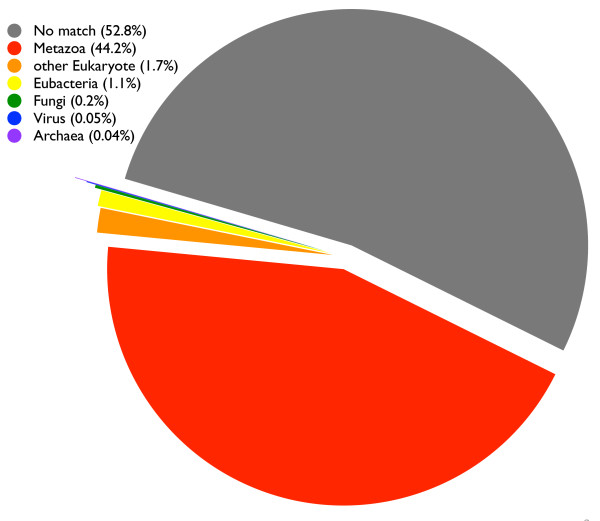
Both the raw reads (n=1, 116, 551) and the assembled contigs (n=70, 786; mean length=836 nucleotides) were deposited in a new publicly available relational database called PocilloporaBase http://www.PocilloporaBase.org. Using BLASTX, 47.2% of the contigs were found to match a sequence in the NCBI database at an E-value threshold of ≤.001; 93.6% of those contigs with matches in the NCBI database appear to be of metazoan origin and 2.3% bacterial origin, while most of the remaining 4.1% match to other eukaryotes, including algae and amoebae.
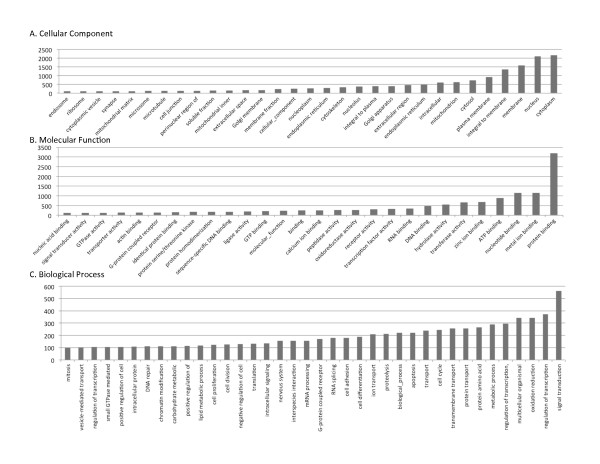
P. damicornis now joins the handful of coral species for which extensive transcriptomic data are publicly available. Through PocilloporaBase http://www.PocilloporaBase.org, one can obtain assembled contigs and raw reads and query the data according to a wide assortment of attributes including taxonomic origin, PFAM motif, KEGG pathway, and GO annotation.
由于世界珊瑚礁的脆弱状态,目前人们对珊瑚转录组学产生了浓厚的兴趣。通过鉴定特定环境胁迫引发的珊瑚基因表达变化,我们可以开始从分子水平上描述珊瑚的应激反应,这将有助于开发更强大的诊断工具,用于评估野外珊瑚的健康状况。此外,鉴定在面对特定胁迫时具有更高或更低弹性的遗传变异,将有助于我们对特定珊瑚种群的预后做出更可靠的预测。为此,我们对分布广泛的印度-太平洋地区物种——花脑珊瑚(Pocillopora damicornis)进行了深度 mRNA 测序,该物种具有多种群体形态,能够在受到各种人类影响的栖息地中茁壮成长。重要的是,P. damicornis 特别适合实验室培养。我们从三个地理位置上相互隔离的夏威夷种群中采集了样本,这些种群受到不同程度的人类影响。我们从暴露于四种环境胁迫(高温、干燥、过氧化物和低盐条件)或对照条件下的珊瑚碎片(“小块”)中分离出 RNA。使用 454 平台对 RNA 进行了混合测序。
原始读数(n=1,116,551)和组装的连续(n=70,786;平均长度=836 个核苷酸)都被存入一个名为 PocilloporaBase http://www.PocilloporaBase.org 的新的公开可用的关系数据库中。通过 BLASTX,47.2%的连续序列在 NCBI 数据库中与 E 值阈值≤.001 的序列匹配;在 NCBI 数据库中有匹配的连续序列中,93.6%似乎来自后生动物,2.3%来自细菌,而其余 4.1%主要与其他真核生物(包括藻类和变形虫)匹配。
P. damicornis 现在加入了少数几种有大量转录组数据公开的珊瑚物种之列。通过 PocilloporaBase http://www.PocilloporaBase.org,人们可以获得组装的连续序列和原始读数,并根据广泛的属性(包括分类学起源、PFAM 基序、KEGG 途径和 GO 注释)查询数据。