Laboratory of Laboratory Animal Science and Medicine, Department of Disease Control, Graduate School of Veterinary Medicine, Hokkaido University, Hokkaido, Japan.
PLoS One. 2011;6(11):e27902. doi: 10.1371/journal.pone.0027902. Epub 2011 Nov 22.
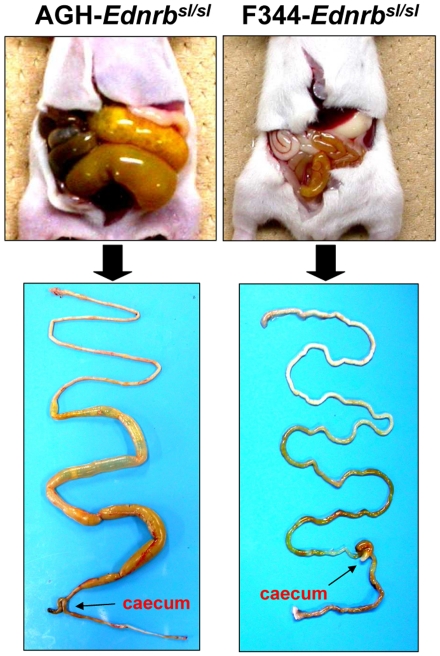
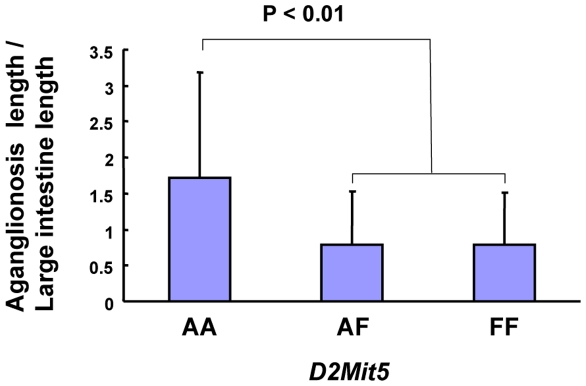
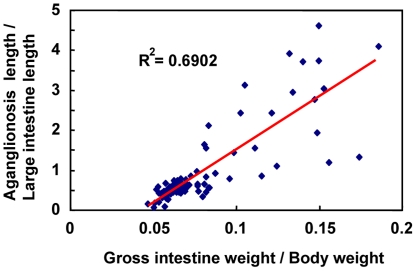
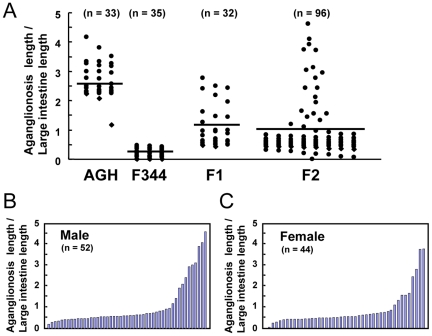
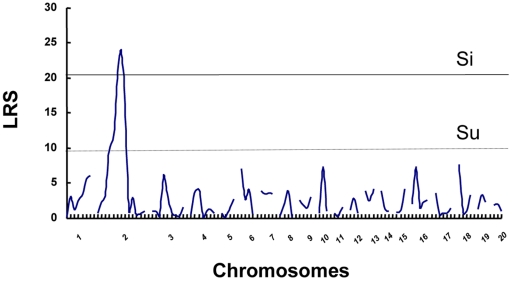
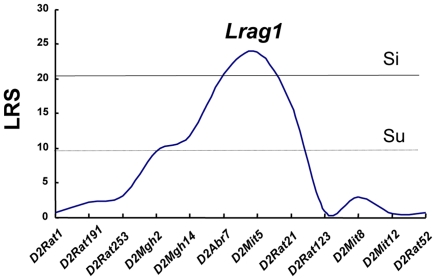
Hirschsprung disease (HSCR) exhibits complex genetics with incomplete penetrance and variable severity thought to result as a consequence of multiple gene interactions that modulate the ability of enteric neural crest cells to populate the developing gut. As reported previously, when the same null mutation of the Ednrb gene, Ednrb(sl), was introgressed into the F344 strain, almost 60% of F344-Ednrb(sl/sl) pups did not show any symptoms of aganglionosis, appearing healthy and normally fertile. These findings strongly suggested that the severity of HSCR was affected by strain-specific genetic factor (s). In this study, the genetic basis of such large strain differences in the severity of aganglionosis in the rat model was studied by whole-genome scanning for quantitative trait loci (QTLs) using an intercross of (AGH-Ednrb(sl)×F344-Ednrb(sl)) F(1) with the varying severity of aganglionosis. Genome linkage analysis identified one significant QTL on chromosome 2 for the severity of aganglionosis. Our QTL analyses using rat models of HSCR revealed that multiple genetic factors regulated the severity of aganglionosis. Moreover, a known HSCR susceptibility gene, Gdnf, was found in QTL that suggested a novel non-coding sequence mutation in GDNF that modifies the penetrance and severity of the aganglionosis phenotype in EDNRB-deficient rats. A further identification and analysis of responsible genes located on the identified QTL could lead to the richer understanding of the genetic basis of HSCR development.
先天性巨结肠(HSCR)表现出复杂的遗传学特征,不完全外显和可变的严重程度,被认为是多种基因相互作用的结果,这些基因相互作用调节肠神经嵴细胞在发育中的肠道中定植的能力。正如之前报道的那样,当 Ednrb 基因的相同缺失突变(Ednrb(sl))被引入 F344 品系时,近 60%的 F344-Ednrb(sl/sl) 幼仔没有表现出任何无神经节细胞的症状,看起来健康且正常繁殖。这些发现强烈表明 HSCR 的严重程度受到特定于品系的遗传因素(s)的影响。在这项研究中,通过对具有不同严重程度无神经节细胞的(AGH-Ednrb(sl)×F344-Ednrb(sl)) F1 杂交鼠进行全基因组扫描,以寻找数量性状基因座(QTLs),研究了这种大鼠模型中无神经节细胞严重程度的巨大品系差异的遗传基础。基因组连锁分析确定了染色体 2 上一个与无神经节细胞严重程度相关的显著 QTL。我们使用 HSCR 大鼠模型进行的 QTL 分析表明,多个遗传因素调节无神经节细胞的严重程度。此外,在 QTL 中发现了一个已知的 HSCR 易感性基因 Gdnf,这表明 GDNF 中的一个新的非编码序列突变改变了 EDNRB 缺陷型大鼠无神经节细胞表型的外显率和严重程度。进一步鉴定和分析位于鉴定出的 QTL 上的相关基因可能会更深入地了解 HSCR 发展的遗传基础。