Alavian Seyed Moayed, Tabatabaei Seyed Vahid, Behnava Bita, Mahboobi Nastaran
Baqiyatallah Research Center for Gastroenterology and Liver Diseases, Baqiyatallah University of Medical Sciences, Tehran, Iran.
Hepat Mon. 2011 Aug;11(8):612-9. doi: 10.5812/kowsar.1735143x.721.
A head-to-head comparison of the 72-week and 48-week anti-HCV therapies in slow responders with genotype 1 infection has been performed in several randomized clinical trials (RCTs).
This review aimed at summarizing and pooling the results of these studies.
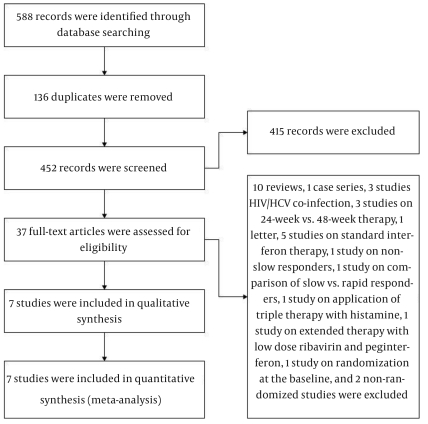
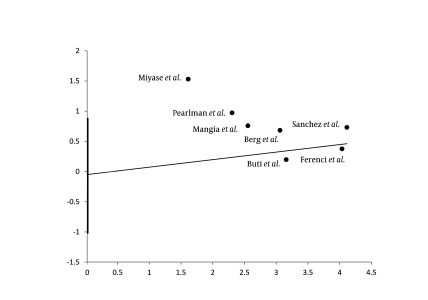
RCTs that had evaluated the 72-week vs. 48-week anti-HCV therapy (peginterferon and ribavirin) in slow responders with HCV genotype 1 infection were systematically identified. A meta-analysis was performed using the random effects model. Heterogeneity in results was assessed on the basis of the Q statistics, and publication bias was evaluated by using Harbord's modified test. The end point was set as a sustained virological response (SVR).
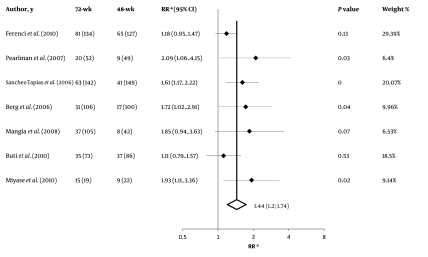
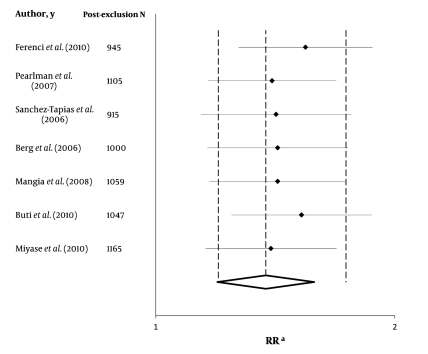
Data of 1206 subjects were retrieved from 7 studies. A total of 631 patients had received extended therapy. Slow virological responders who received the 72-week therapy had a significantly higher probability of achieving SVR than their counterpartswho received the 48-week therapy [RR = 1.44 (95% CI, 1.20-1.73)]. With regard to publication biases, the heterogeneity in funnel plots was not significant (P = 0.19, I2 = 30%, PHarbord = 0.1).
Our meta-analysis showed that the 72-week therapy with peginterferon and ibavirin is significantly superior to the standard 48-week therapy in slow responders th HCV genotype 1 infection.
在多项随机临床试验(RCT)中,对基因1型感染的慢反应者使用72周和48周抗丙肝病毒(HCV)疗法进行了直接比较。
本综述旨在总结和汇总这些研究的结果。
系统检索评估基因1型HCV感染慢反应者使用72周与48周抗HCV疗法(聚乙二醇干扰素和利巴韦林)的RCT。采用随机效应模型进行荟萃分析。根据Q统计量评估结果的异质性,并使用哈伯德改良检验评估发表偏倚。终点设定为持续病毒学应答(SVR)。
从7项研究中检索到1206名受试者的数据。共有631名患者接受了延长疗程治疗。接受72周治疗的慢病毒学反应者实现SVR的概率显著高于接受48周治疗的对应者[相对危险度(RR)=1.44(95%可信区间,1.20 - 1.73)]。关于发表偏倚,漏斗图中的异质性不显著(P = 0.19,I² = 30%,哈伯德检验P = 0.1)。
我们的荟萃分析表明,对于基因1型HCV感染的慢反应者,使用聚乙二醇干扰素和利巴韦林进行72周治疗显著优于标准的48周治疗。