School of Biomedical, Biomolecular and Chemical Sciences, University of Western Australia, Crawley, WA 6009, Australia.
Biochem Biophys Res Commun. 2012 Jan 13;417(2):653-8. doi: 10.1016/j.bbrc.2011.11.099. Epub 2011 Dec 1.
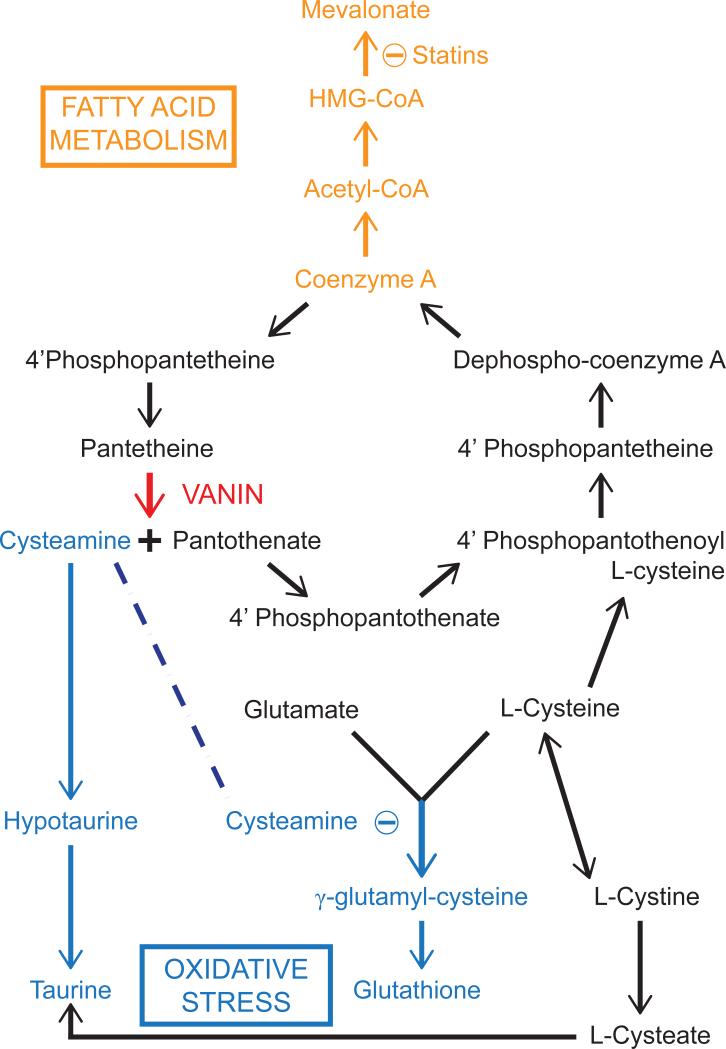
The Vanin genes are a family that encode pantetheinases involved in recycling Coenzyme A, catalysing the breakdown of intermediate pantetheine to vitamin B5 for reuse in CoA biosynthesis. The role of pantetheinase in this most fundamental of cellular processes, was substantially characterised by the 1970s. The next 20 years saw little further interest in pantetheinase until various genetic studies implicated the Vanin locus in a range of normal and disease phenotypes, and a consequent interest in the other product of pantetheinase activity, cysteamine. This report seeks to bring together the early biochemical studies with recent biological data implicating cysteamine as a regulator of the oxidative state of a cell. Numerous studies now report a role for Vanin in inflammation, oxidative stress, cell migration and numerous diseases including cardiovascular disease.
Vanin 基因家族编码泛肽酶,参与辅酶 A 的循环,催化中间产物泛肽分解为维生素 B5,用于辅酶 A 生物合成的再利用。泛肽酶在这一最基本的细胞过程中的作用在 20 世纪 70 年代得到了充分的描述。在接下来的 20 年里,人们对泛肽酶的兴趣不大,直到各种遗传研究将 Vanin 基因座与一系列正常和疾病表型联系起来,人们对泛肽酶活性的另一种产物半胱胺产生了兴趣。本报告旨在将早期的生化研究与最近的生物学数据结合起来,这些数据表明半胱胺是细胞氧化状态的调节剂。现在有许多研究报告称 Vanin 在炎症、氧化应激、细胞迁移和许多疾病中发挥作用,包括心血管疾病。