Dahm Matthew M, Evans Douglas E, Schubauer-Berigan Mary K, Birch M Eileen, Fernback Joseph E
Industrywide Studies Branch, Division of Surveillance, Hazard Evaluations, and Field Studies, 4676 Columbia Parkway, MS-R14, Cincinnati, OH 45226, USA.
Ann Occup Hyg. 2012 Jul;56(5):542-56. doi: 10.1093/annhyg/mer110. Epub 2011 Dec 8.
RESEARCH SIGNIFICANCE: Toxicological evidence suggests the potential for a wide range of health effects, which could result from exposure to carbon nanotubes (CNTs) and carbon nanofibers (CNFs). The National Institute for Occupational Safety and Health (NIOSH) has proposed a recommended exposure limit (REL) for CNTs/CNFs at the respirable size fraction. The current literature is lacking exposure information, with few studies reporting results for personal breathing zone (PBZ) samples in occupational settings. To address this gap, exposure assessments were conducted at six representative sites identified as CNT/CNF primary or secondary manufacturers.
Personal and area filter-based samples were collected for both the inhalable mass concentration and the respirable mass concentration of elemental carbon (EC) as well as CNT structure count analysis by transmission electron microscopy to assess exposures. When possible, full-shift PBZ samples were collected; area samples were collected on a task-based approach.
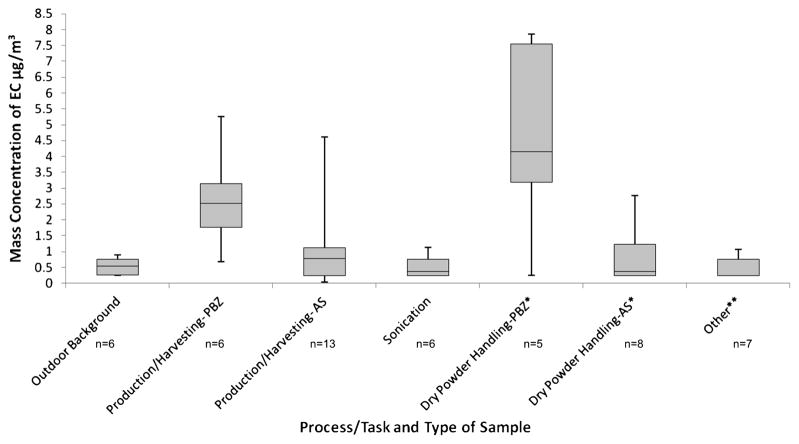
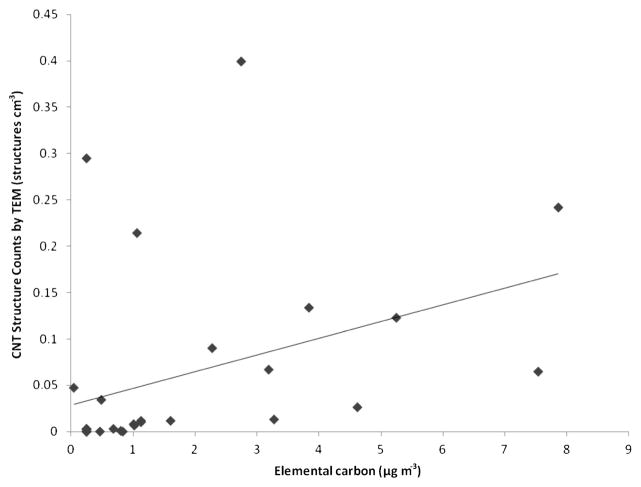
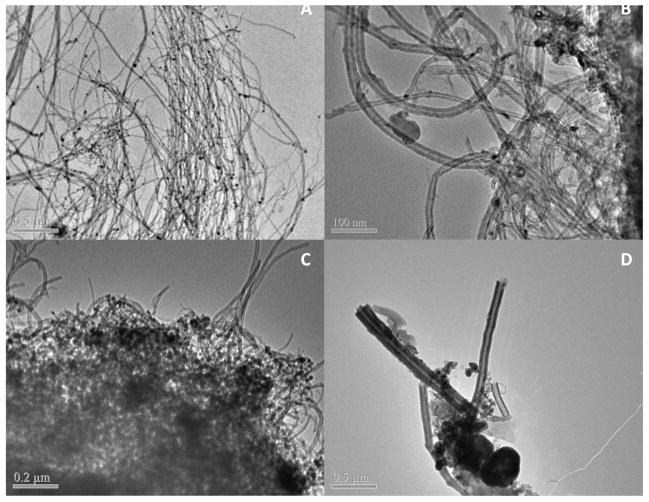
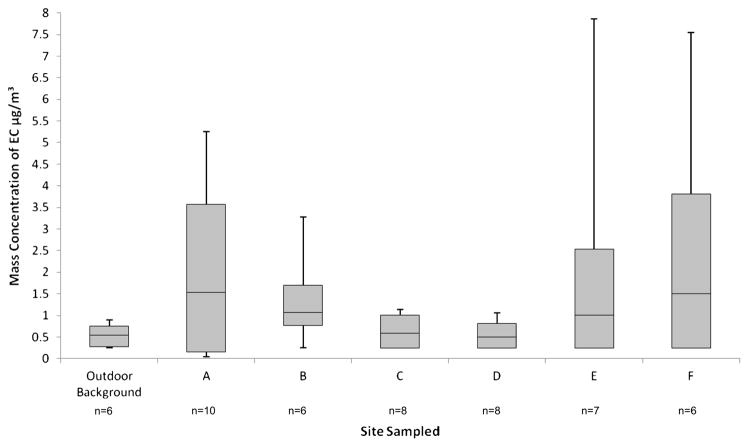
The vast majority of samples collected in this study were below the proposed REL (7 μg m(-3)). Two of the three secondary manufacturers' surveyed found concentrations above the proposed REL. None of the samples collected at primary manufacturers were found to be above the REL. Visual and microscopy-based evidence of CNTs/CNFs were found at all sites, with the highest CNT/CNF structure counts being found in samples collected at secondary manufacturing sites. The statistical correlations between the filter-based samples for the mass concentration of EC and CNT structure counts were examined. A general trend was found with a P-value of 0.01 and a corresponding Pearson correlation coefficient of 0.44.
CNT/CNF concentrations were above the proposed NIOSH REL for PBZ samples in two secondary manufacturing facilities that use these materials for commercial applications. These samples were collected during dry powder handling processes, such as mixing and weighing, using fairly large quantities of CNTs/CNFs.
研究意义:毒理学证据表明,接触碳纳米管(CNT)和碳纳米纤维(CNF)可能会对健康产生广泛影响。美国国家职业安全与健康研究所(NIOSH)已针对可吸入粒径范围内的CNT/CNF提出了建议暴露限值(REL)。当前文献缺乏暴露信息,很少有研究报告职业环境中个人呼吸区(PBZ)样本的结果。为填补这一空白,在六个被确定为CNT/CNF主要或次要制造商的代表性场所进行了暴露评估。
采集基于个人和区域过滤器的样本,用于评估元素碳(EC)的可吸入质量浓度和可呼吸质量浓度,以及通过透射电子显微镜进行CNT结构计数分析以评估暴露情况。尽可能采集全时段的PBZ样本;区域样本则基于任务进行采集。
本研究中采集的绝大多数样本低于建议的REL(7μg/m³)。在接受调查的三家次要制造商中,有两家发现浓度高于建议的REL。在主要制造商处采集的样本均未发现高于REL。在所有场所均发现了基于视觉和显微镜的CNT/CNF证据,在次要制造场所采集的样本中发现的CNT/CNF结构计数最高。研究了基于过滤器的样本中EC质量浓度与CNT结构计数之间的统计相关性。发现了一个总体趋势,P值为0.01,相应的皮尔逊相关系数为0.44。
在两家将这些材料用于商业应用的次要制造设施中,PBZ样本的CNT/CNF浓度高于NIOSH建议的REL。这些样本是在干粉处理过程(如混合和称重)中采集的,使用了相当大量的CNT/CNF。