Lung Cancer Program, Lovelace Respiratory Research Institute, Albuquerque, NM 87108, USA.
Oncogene. 2012 Sep 13;31(37):4107-16. doi: 10.1038/onc.2011.577. Epub 2011 Dec 12.
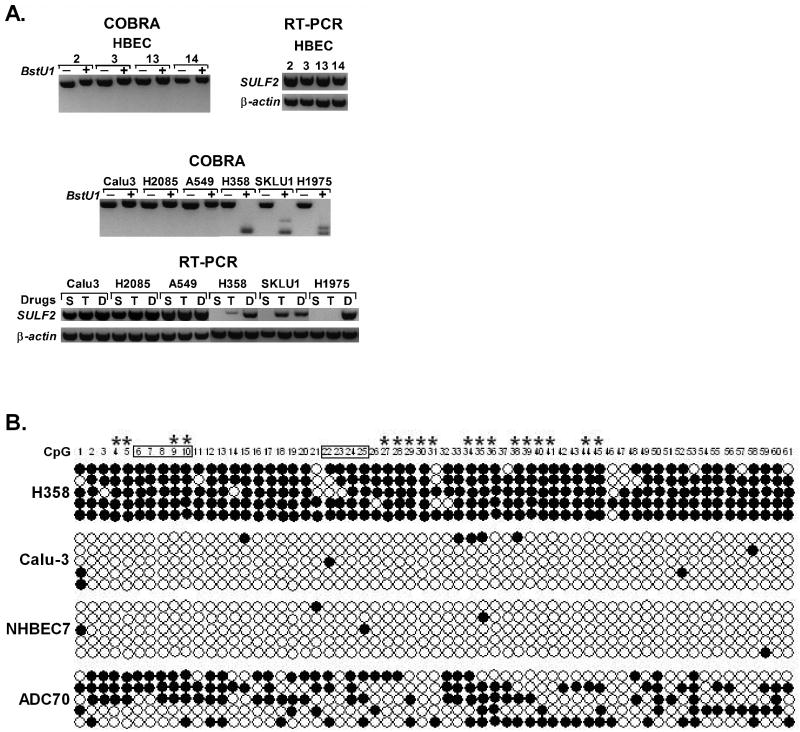
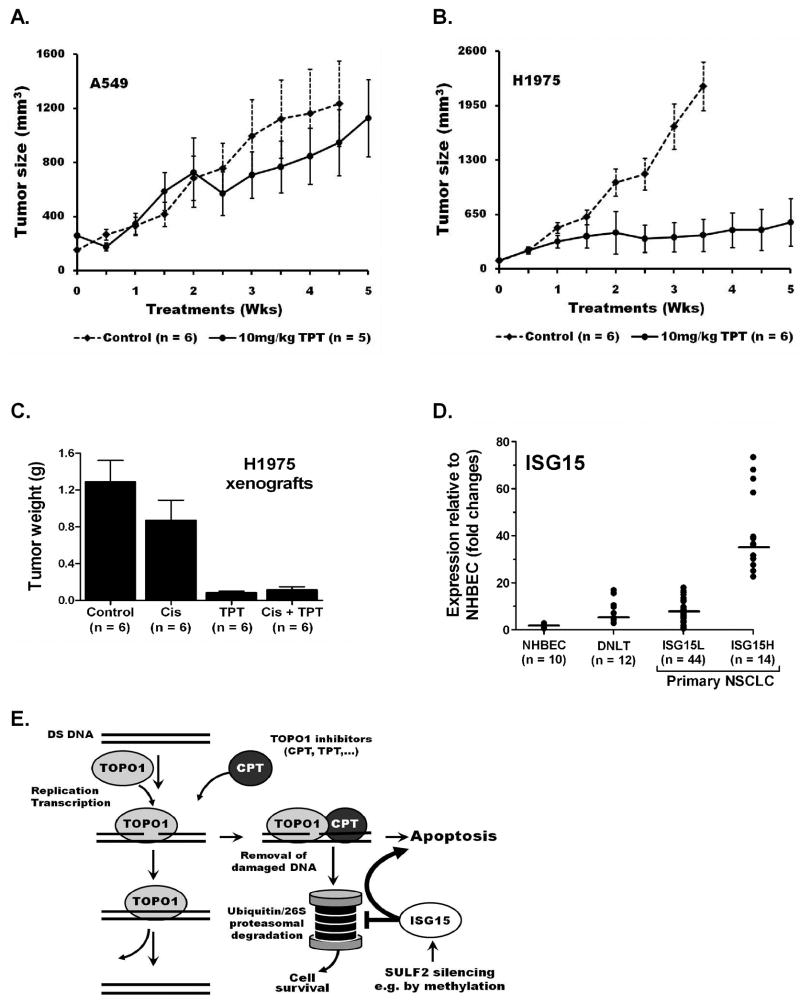
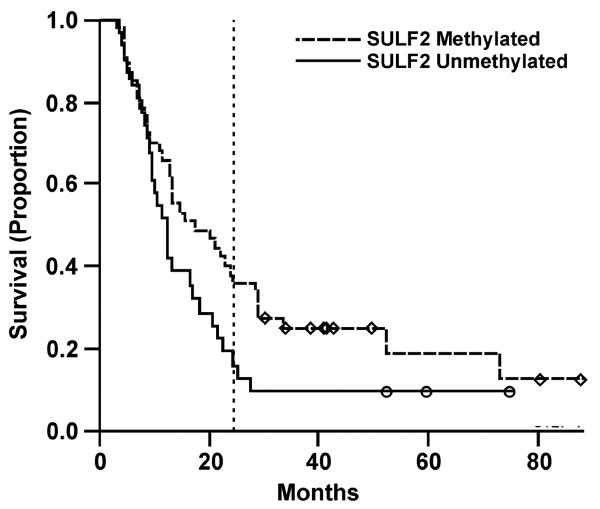
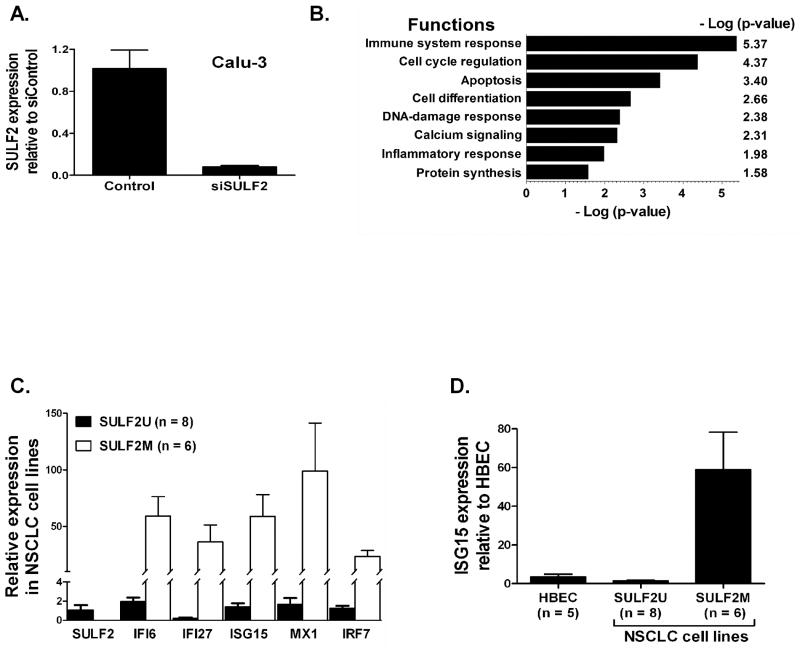
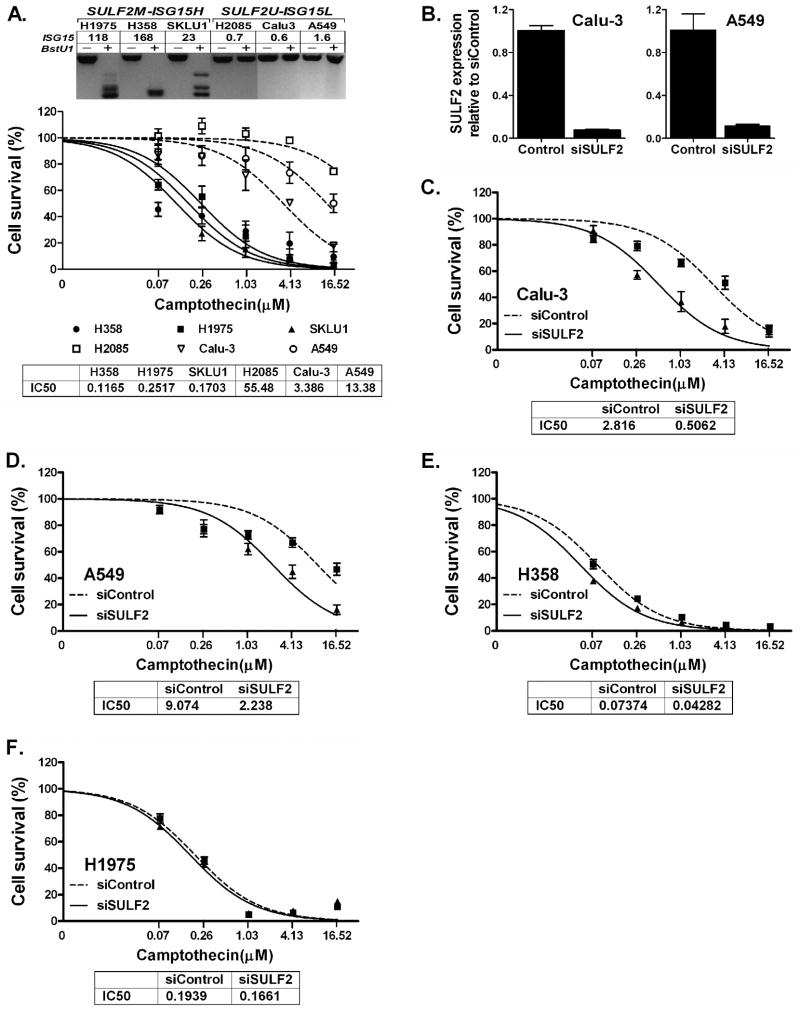
The heparan sulfate 6-O-endosulfatase (SULF2) promotes growth and metastasis of solid tumors. We recently identified that cytosine methylation of the SULF2 promoter is associated with better survival of resected lung adenocarcinoma patients, and now also demonstrates a marginal improvement in survival of advanced non-small cell lung cancer (NSCLC) patients receiving standard chemotherapy (hazard ratio=0.63, P=0.07). Subsequent studies focused on investigating the effect of methylation on SULF2 expression and its genome-wide impact. The genes and pathways modulated by epigenetic inactivation of SULF2 and the effects on sensitivity to chemotherapy were characterized in vitro and in vivo. Silencing SULF2 through small interfering RNA or methylation primarily increased expression of interferon-inducible genes including ISG15, a marker for increased sensitivity to topoisomerase-1 inhibitors such as camptothecin (CPT). NSCLC cell lines with methylated SULF2 (SULF2M) express 60-fold higher ISG15 compared with SULF2 unmethylated (SULF2U) NSCLC cell lines and normal human bronchial epithelial cells. In vitro, SULF2M and high ISG15 (ISG15H)-expressing NSCLC cell lines were 134-fold more sensitive to CPT than SULF2U and low ISG15 (ISG15L)-expressing cell lines. Topotecan, a soluble analog of CPT and FDA-approved anticancer drug, dramatically arrested the growth of SULF2M-ISG15H, but not SULF2U-ISG15L lung tumors in nude mice (P<0.002). Similarly, high ISG15 expression that is comparable to the topotecan (TPT)-sensitive NSCLC cell lines was found in tumors from 25% of NSCLC patients compared with normal lung, indicating a potential to identify and target the most sensitive NSCLC subpopulation for personalized TPT therapy.
硫酸乙酰肝素 6-O-内切酶(SULF2)可促进实体瘤的生长和转移。我们最近发现,SULF2 启动子的胞嘧啶甲基化与接受手术切除的肺腺癌患者的生存改善有关,现在也表明接受标准化疗的晚期非小细胞肺癌(NSCLC)患者的生存有一定程度的改善(风险比=0.63,P=0.07)。随后的研究集中在调查甲基化对 SULF2 表达的影响及其对全基因组的影响。在体外和体内研究了 SULF2 去甲基化对基因和通路的调节作用及其对化疗敏感性的影响。通过小干扰 RNA 或甲基化沉默 SULF2 主要增加了干扰素诱导基因的表达,包括 ISG15,这是对拓扑异构酶-1 抑制剂(如喜树碱(CPT))敏感性增加的标志物。与 SULF2 未甲基化(SULF2U)的 NSCLC 细胞系和正常的人支气管上皮细胞相比,SULF2 甲基化(SULF2M)的 NSCLC 细胞系中 ISG15 的表达增加了 60 倍。体外,SULF2M 和高表达 ISG15(ISG15H)的 NSCLC 细胞系对 CPT 的敏感性比 SULF2U 和低表达 ISG15(ISG15L)的细胞系高 134 倍。拓扑替康是 CPT 的可溶性类似物,也是 FDA 批准的抗癌药物,可显著抑制 SULF2M-ISG15H 但不抑制 SULF2U-ISG15L 肺肿瘤在裸鼠中的生长(P<0.002)。同样,与正常肺相比,在 25%的 NSCLC 患者的肿瘤中发现了与拓扑替康(TPT)敏感的 NSCLC 细胞系相当的高 ISG15 表达,表明有可能识别和针对最敏感的 NSCLC 亚群进行个性化 TPT 治疗。