Wu Treena, Chan Angelique
Health Services & Systems Research, Duke-NUS Graduate Medical School, Level 4, 8 College Road, Singapore 169857.
J Aging Res. 2012;2012:659806. doi: 10.1155/2012/659806. Epub 2011 Nov 22.
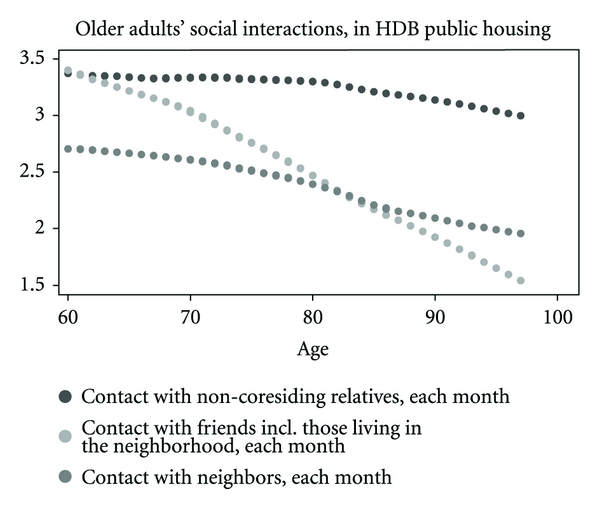
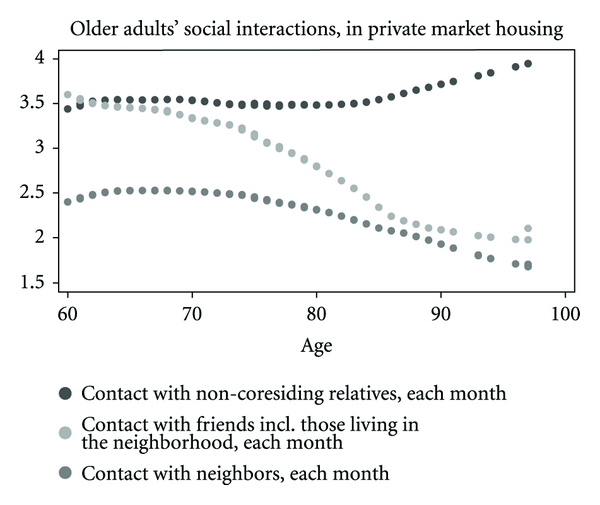
Introduction. This empirical paper examines how the Housing Development Board (HDB) public housing neighborhood influences older urban Singaporeans' social interactions and ameliorates social isolation. Methods. Using 4,542 observations of noninstitutionalized urban adults aged 60 and above, ordered logistic regressions are run to determine the predictors of isolation while controlling for physical health and demographics. Results. 87% of older Singaporeans reside in public housing apartments while 13% reside in private market housing. The main predictor of social isolation is living alone and the second main predictor is coresidence with adult children. The relationship between coresidence with adult children and isolation is mediated when controlling for older adult functional limitations. The public apartment neighborhood and daily participation in public neighborhood events have substantial effects on reducing the risk of isolation. Older adult contact with friends alleviates isolation more than contact with non-coresiding relatives. Conclusion. Findings suggest that the public neighborhood-built environment in Singapore plays a positive role in the social interactions of the elderly. Knowledge of the factors that decrease the risk of social isolation will have implications for studying morbidity and mortality among the elderly.
引言。本实证研究探讨新加坡建屋发展局(HDB)的公共住房邻里环境如何影响新加坡城市老年人的社交互动并缓解社会隔离。方法。对4542名60岁及以上的非机构化城市成年人进行观察,运用有序逻辑回归来确定在控制身体健康和人口统计学因素的情况下社会隔离的预测因素。结果。87%的新加坡老年人居住在公共住房公寓中,13%居住在私人市场住房中。社会隔离的主要预测因素是独居,第二大主要预测因素是与成年子女同住。在控制老年人功能限制后,与成年子女同住和社会隔离之间的关系得到调节。公共公寓邻里环境以及日常参与公共邻里活动对降低隔离风险有显著影响。老年人与朋友的接触比与不住在一起的亲属的接触更能缓解隔离。结论。研究结果表明,新加坡的公共邻里建筑环境在老年人的社交互动中发挥着积极作用。了解降低社会隔离风险的因素将对研究老年人的发病率和死亡率具有启示意义。