Plant Research Laboratory, Department of Energy, Michigan State University, 106 Plant Biology Building, East Lansing, MI 48824-1312, USA.
Sensors (Basel). 2010;10(7):6969-79. doi: 10.3390/s100706969. Epub 2010 Jul 19.
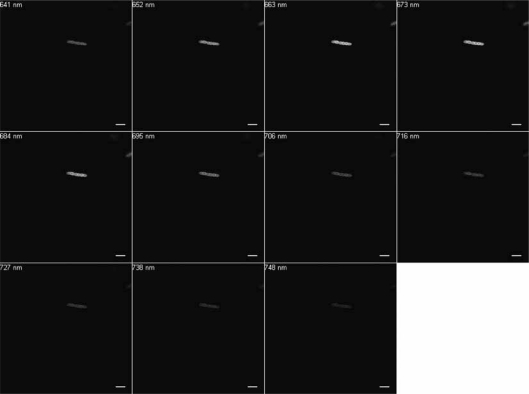
Fremyella diplosiphon is a freshwater, filamentous cyanobacterium that exhibits light-dependent regulation of photosynthetic pigment accumulation and cellular and filament morphologies in a well-known process known as complementary chromatic adaptation (CCA). One of the techniques used to investigate the molecular bases of distinct aspects of CCA is confocal laser scanning microscopy (CLSM). CLSM capitalizes on the autofluorescent properties of cyanobacterial phycobiliproteins and chlorophyll a. We employed CLSM to perform spectral scanning analyses of F. diplosiphon strains grown under distinct light conditions. We report optimized utilization of CLSM to elucidate the molecular basis of the photoregulation of pigment accumulation and morphological responses in F. diplosiphon.
菲氏真枝藻是一种淡水丝状蓝藻,在一个被称为互补色适应(CCA)的著名过程中,表现出对光合作用色素积累和细胞及丝状形态的光依赖性调节。研究 CCA 不同方面的分子基础的技术之一是共聚焦激光扫描显微镜(CLSM)。CLSM 利用蓝藻藻胆蛋白和叶绿素 a 的自发荧光特性。我们采用 CLSM 对在不同光照条件下生长的菲氏真枝藻菌株进行光谱扫描分析。我们报告了优化利用 CLSM 来阐明菲氏真枝藻中色素积累和形态响应的光调控的分子基础。