Hadi M F, Sander E A, Ruberti J W, Barocas V H
Department of Biomedical Engineering, University of Minnesota, 7-105 Hasselmo Hall, 312 Church St SE, Minneapolis MN 55455, United States.
Mech Mater. 2012 Jan 1;44:72-82. doi: 10.1016/j.mechmat.2011.07.003.
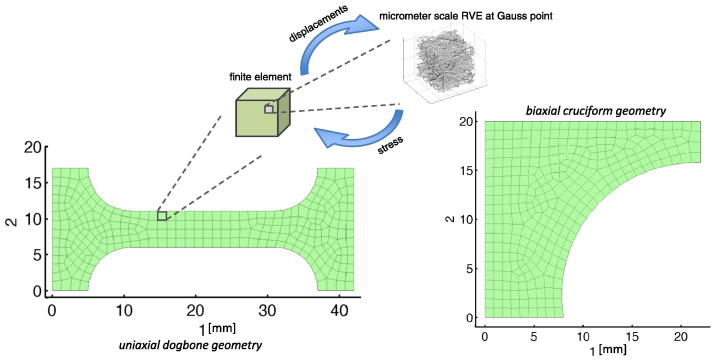
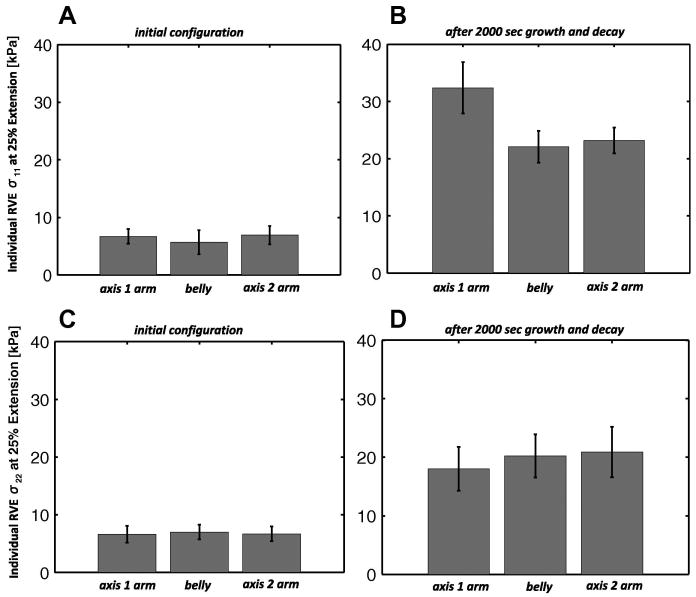
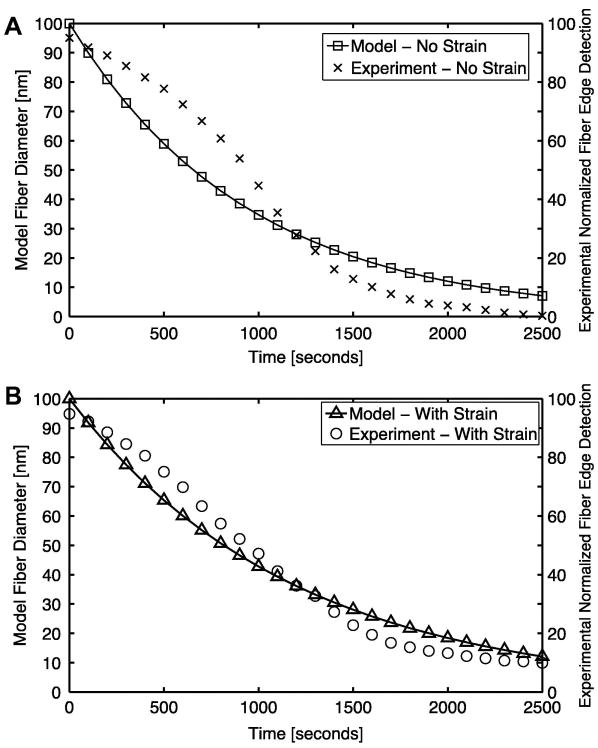
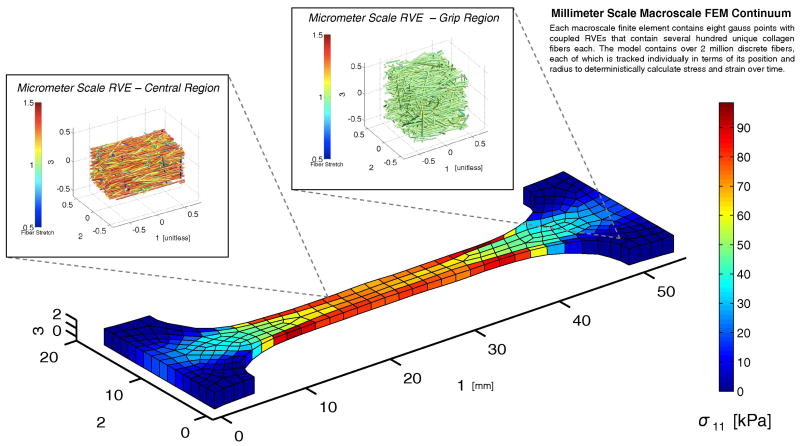
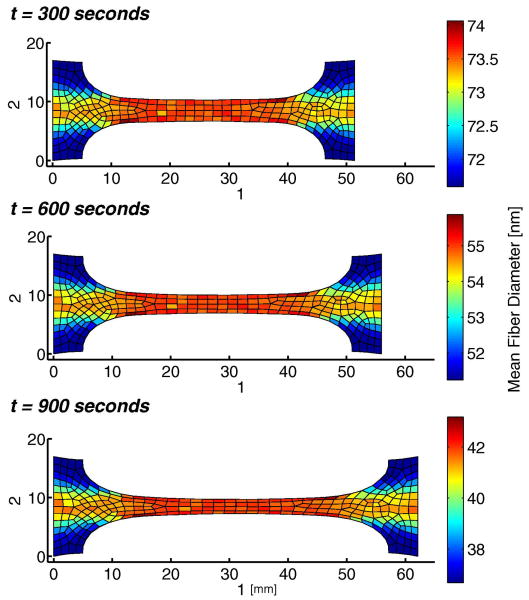
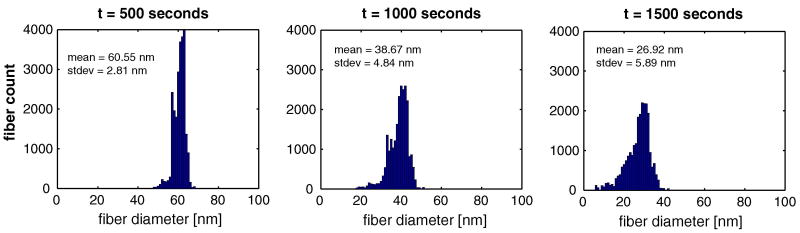
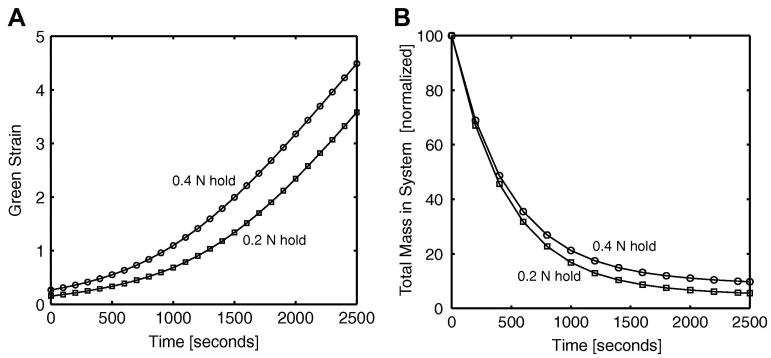
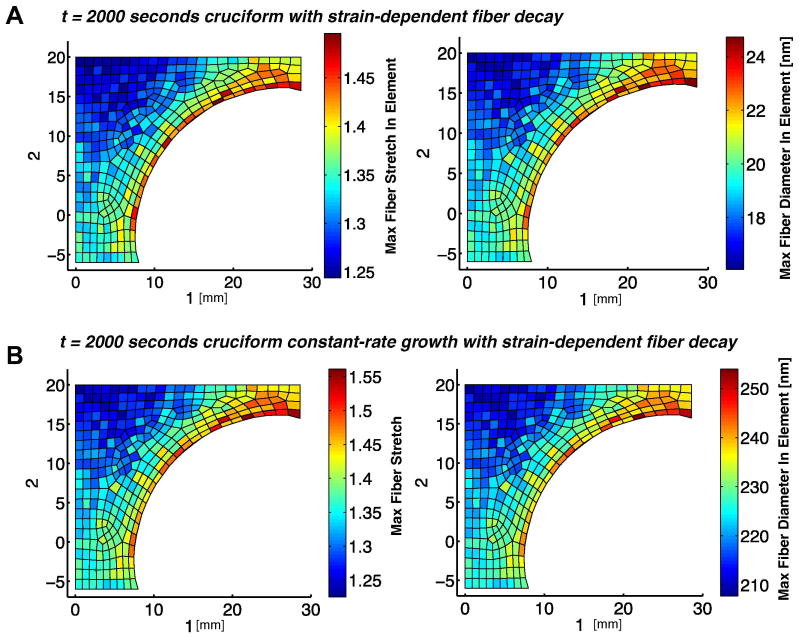
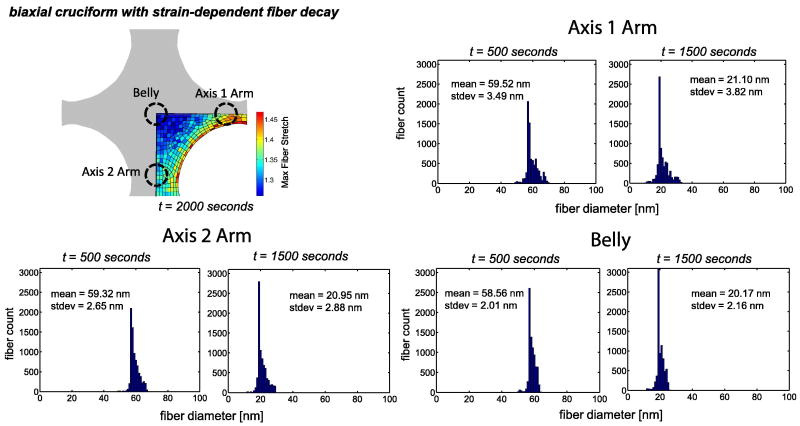
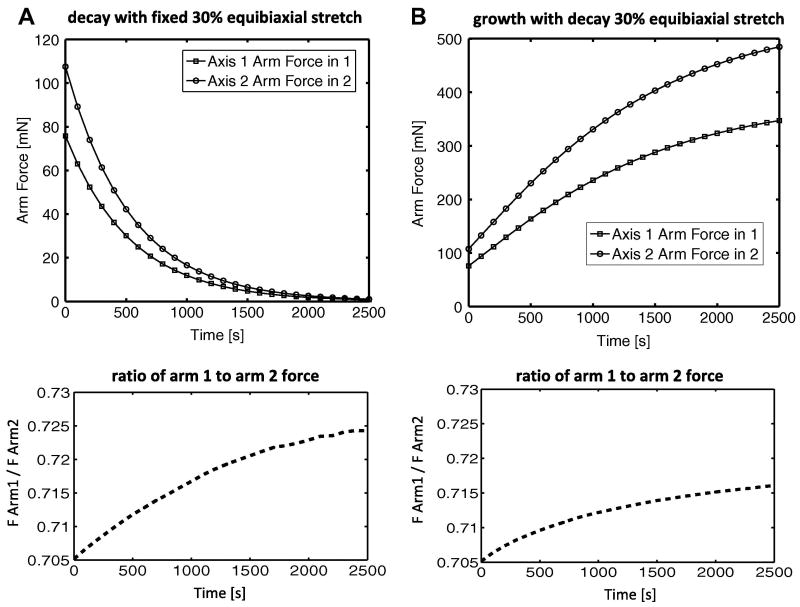
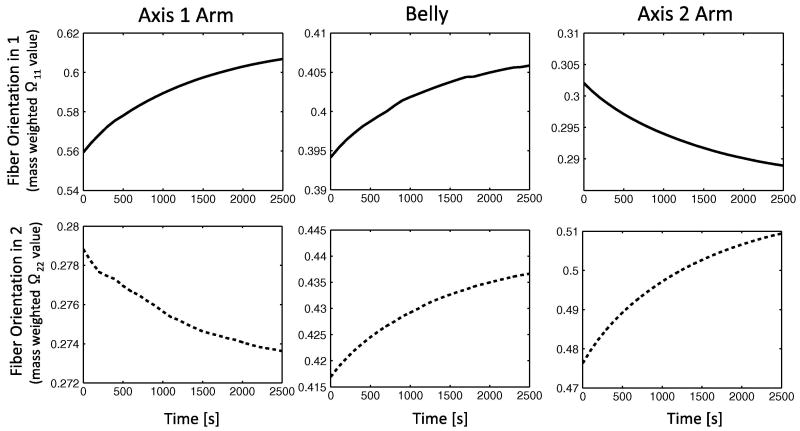
Recent work has demonstrated that enzymatic degradation of collagen fibers exhibits strain-dependent kinetics. Conceptualizing how the strain dependence affects remodeling of collagenous tissues is vital to our understanding of collagen management in native and bioengineered tissues. As a first step towards this goal, the current study puts forward a multiscale model for enzymatic degradation and remodeling of collagen networks for two sample geometries we routinely use in experiments as model tissues. The multiscale model, driven by microstructural data from an enzymatic decay experiment, includes an exponential strain-dependent kinetic relation for degradation and constant growth. For a dogbone sample under uniaxial load, the model predicted that the distribution of fiber diameters would spread over the course of degradation because of variation in individual fiber load. In a cross-shaped sample, the central region, which experiences smaller, more isotropic loads, showed more decay and less spread in fiber diameter compared to the arms. There was also a slight shift in average orientation in different regions of the cruciform.
近期研究表明,胶原纤维的酶促降解呈现出应变依赖性动力学。理解应变依赖性如何影响胶原组织的重塑,对于我们了解天然组织和生物工程组织中的胶原管理至关重要。作为实现这一目标的第一步,当前研究针对我们在实验中常规用作模型组织的两种样品几何形状,提出了一个用于胶原网络酶促降解和重塑的多尺度模型。该多尺度模型由酶促降解实验的微观结构数据驱动,包括一个用于降解和持续生长的指数应变依赖性动力学关系。对于单轴加载下的狗骨形样品,该模型预测,由于单个纤维负载的变化,纤维直径分布在降解过程中会变宽。在十字形样品中,与臂部相比,承受较小、更各向同性负载的中心区域显示出更多的降解且纤维直径变宽较少。十字形不同区域的平均取向也有轻微偏移。