Raja Beharelle Anjali, Tisserand Danielle, Stuss Donald T, McIntosh Anthony R, Levine Brian
Rotman Research Institute of Baycrest Centre, University of Toronto Toronto, ON, Canada.
Front Hum Neurosci. 2011 Dec 9;5:164. doi: 10.3389/fnhum.2011.00164. eCollection 2011.
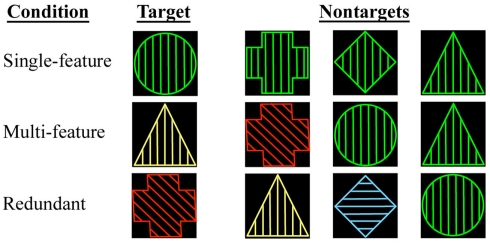
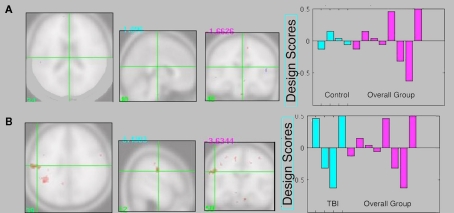
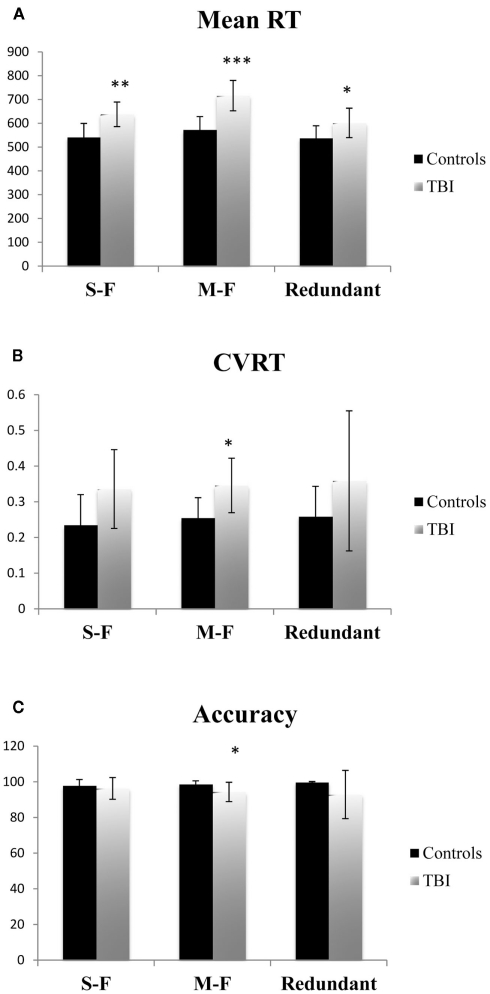
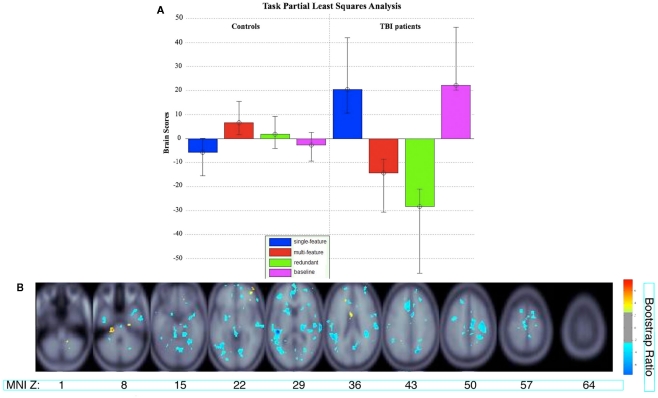
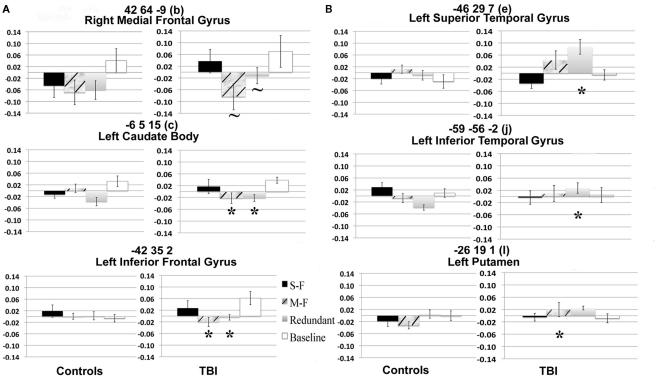
Traumatic brain injury (TBI) patients typically respond more slowly and with more variability than controls during tasks of attention requiring speeded reaction time. These behavioral changes are attributable, at least in part, to diffuse axonal injury (DAI), which affects integrated processing in distributed systems. Here we use a multivariate method sensitive to distributed neural activity to compare brain activity patterns of patients with chronic phase moderate to-severe TBI to those of controls during performance on a visual feature integration task assessing complex attentional processes that has previously shown sensitivity to TBI. The TBI patients were carefully screened to be free of large focal lesions that can affect performance and brain activation independently of DAI. The task required subjects to hold either one or three features of a Target in mind while suppressing responses to distracting information. In controls, the multi-feature condition activated a distributed network including limbic, prefrontal, and medial temporal structures. TBI patients engaged this same network in the single-feature and baseline conditions. In multi-feature presentations, TBI patients alone activated additional frontal, parietal, and occipital regions. These results are consistent with neuroimaging studies using tasks assessing different cognitive domains, where increased spread of brain activity changes was associated with TBI. Our results also extend previous findings that brain activity for relatively moderate task demands in TBI patients is similar to that associated with of high task demands in controls.
在需要快速反应时间的注意力任务中,创伤性脑损伤(TBI)患者的反应通常比对照组更慢且变异性更大。这些行为变化至少部分归因于弥漫性轴索损伤(DAI),它会影响分布式系统中的整合处理。在此,我们使用一种对分布式神经活动敏感的多变量方法,在一项评估复杂注意力过程的视觉特征整合任务中,比较慢性期中度至重度TBI患者与对照组在执行任务时的脑活动模式,该任务先前已显示出对TBI敏感。对TBI患者进行了仔细筛选,以排除那些可能独立于DAI影响表现和脑激活的大的局灶性病变。该任务要求受试者在抑制对干扰信息的反应时,记住目标的一个或三个特征。在对照组中,多特征条件激活了一个包括边缘系统、前额叶和颞叶内侧结构的分布式网络。TBI患者在单特征和基线条件下也激活了这个相同的网络。在多特征呈现中,只有TBI患者激活了额外的额叶、顶叶和枕叶区域。这些结果与使用评估不同认知领域任务的神经影像学研究一致,在这些研究中,脑活动变化的扩散增加与TBI相关。我们的结果还扩展了先前的发现,即TBI患者在相对中等任务需求下的脑活动与对照组在高任务需求下的脑活动相似。