Arias Juan F, Iwabu Yukie, Tokunaga Kenzo
Department of Pathology, National Institute of Infectious Diseases Tokyo, Japan.
Front Microbiol. 2011 Dec 12;2:250. doi: 10.3389/fmicb.2011.00250. eCollection 2011.
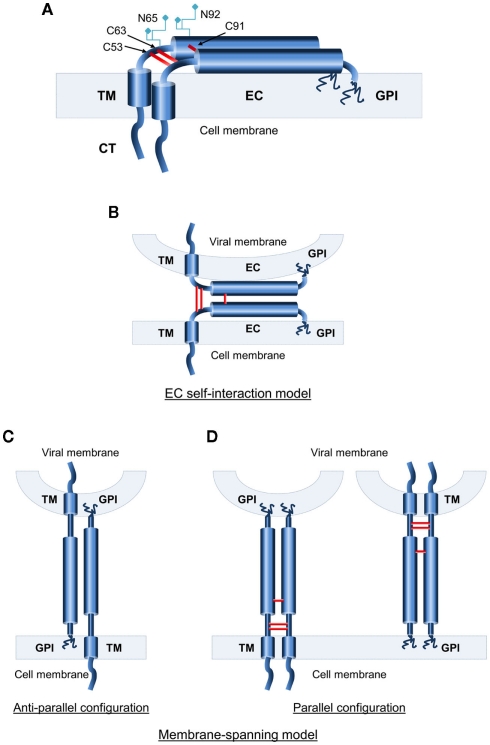
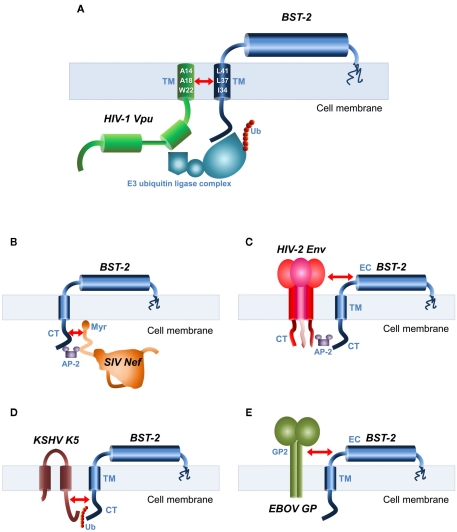
The interferon-inducible host restriction factor bone marrow stromal antigen 2 (BST-2/tetherin) blocks the release of HIV-1 and other enveloped viruses. In turn, these viruses have evolved specific antagonists to counteract this host antiviral molecule, such as the HIV-1 protein Vpu. BST-2 is a type II transmembrane protein with an unusual topology consisting of an N-terminal cytoplasmic tail (CT) followed by a single transmembrane (TM) domain, a coiled-coil extracellular (EC) domain, and a glycosylphosphatidylinositol (GPI) anchor at the C terminus. We and others showed that BST-2 restricts enveloped virus release by bridging the host and virion membranes with its two opposing membrane anchors and that deletion of either one completely abrogates antiviral activity. The EC domain also shows conserved structural properties that are required for antiviral function. It contains several destabilizing amino acids that confer the molecule with conformational flexibility to sustain the protein's function as a virion tether, and three conserved cysteine residues that mediate homodimerization of BST-2, as well as acting as a molecular ruler that separates the membrane anchors. Conversely, the efficient release of virions is promoted by the HIV-1 Vpu protein and other viral antagonists. Our group and others provided evidence from mutational analyses indicating that Vpu antagonism of BST-2-mediated viral restriction requires a highly specific interaction of their mutual TM domains. This interpretation is further supported and expanded by the findings of the latest structural modeling studies showing that critical amino acids in a conserved helical face of these TM domains are required for Vpu-BST-2 interaction and antagonism. In this review, we summarize the current advances in our understanding of the structural basis for BST-2 antiviral function as well as BST-2-specific viral antagonism.
干扰素诱导的宿主限制因子骨髓基质抗原2(BST-2/栓系蛋白)可阻止HIV-1和其他包膜病毒的释放。反过来,这些病毒已经进化出特定的拮抗剂来对抗这种宿主抗病毒分子,比如HIV-1蛋白Vpu。BST-2是一种II型跨膜蛋白,具有不寻常的拓扑结构,由N端细胞质尾巴(CT)、单个跨膜(TM)结构域、卷曲螺旋细胞外(EC)结构域以及C端的糖基磷脂酰肌醇(GPI)锚组成。我们和其他人的研究表明,BST-2通过其两个相对的膜锚将宿主膜和病毒体膜连接起来,从而限制包膜病毒的释放,而且删除其中任何一个都会完全消除抗病毒活性。EC结构域也显示出抗病毒功能所需的保守结构特性。它包含几个使分子具有构象灵活性以维持其作为病毒体栓系蛋白功能的不稳定氨基酸,以及三个保守的半胱氨酸残基,这些残基介导BST-2的同源二聚化,同时还充当分隔膜锚的分子标尺。相反,HIV-1 Vpu蛋白和其他病毒拮抗剂可促进病毒体的有效释放。我们团队和其他研究提供的突变分析证据表明,Vpu对BST-2介导的病毒限制的拮抗作用需要其相互的TM结构域之间高度特异性的相互作用。最新的结构建模研究结果进一步支持并扩展了这一解释,该研究表明这些TM结构域保守螺旋面上的关键氨基酸对于Vpu-BST-2相互作用和拮抗作用是必需的。在这篇综述中,我们总结了目前在理解BST-2抗病毒功能以及BST-2特异性病毒拮抗作用的结构基础方面取得的进展。