Department of Biochemistry and Molecular Genetics, University of Illinois at Chicago, Chicago, IL, USA.
Biochem J. 2012 Apr 1;443(1):65-73. doi: 10.1042/BJ20111867.
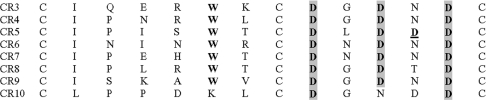
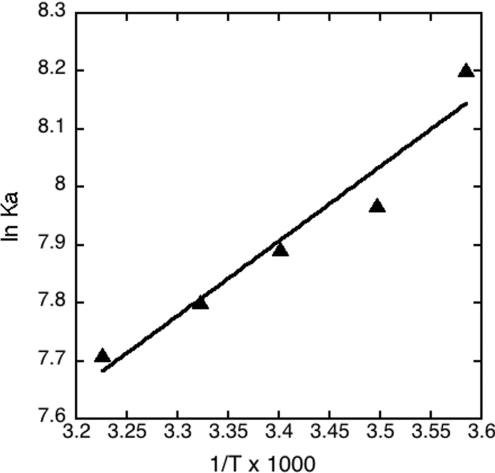
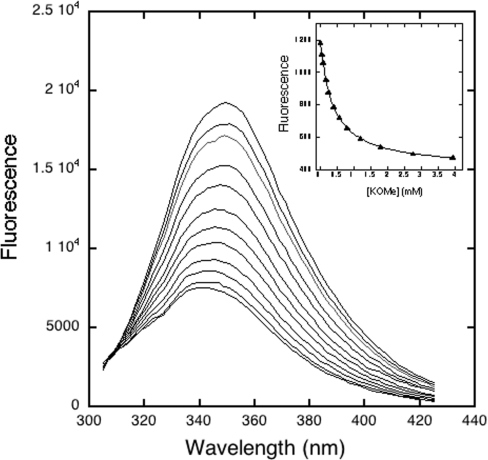
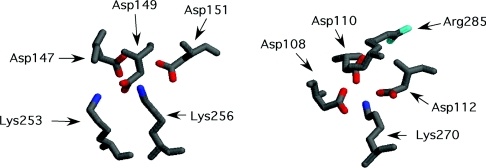
The LRP (low-density lipoprotein receptor-related protein) can bind a wide range of structurally diverse ligands to regions composed of clusters of ~40 residue Ca2+-dependent, disulfide-rich, CRs (complement-like repeats). Whereas lysine residues from the ligands have been implicated in binding, there has been no quantification of the energetic contributions of such interactions and hence of their relative importance in overall affinity, or of the ability of arginine or histidine residues to bind. We have used four representative CR domains from the principal ligand-binding cluster of LRP to determine the energetics of interaction with well-defined small ligands that include methyl esters of lysine, arginine, histidine and aspartate, as well as N-terminally blocked lysine methyl ester. We found that not only lysine but also arginine and histidine bound well, and when present with an additional proximal positive charge, accounted for about half of the total binding energy of a protein ligand such as PAI-1 (plasminogen activator inhibitor-1). Two such sets of interactions, one to each of two CR domains could thus account for almost all of the necessary binding energy of a real ligand such as PAI-1. For the CR domains, a central aspartate residue in the sequence DxDxD tightens the Kd by ~20-fold, whereas DxDDD is no more effective. Together these findings establish the rules for determining the binding specificity of protein ligands to LRP and to other LDLR (low-density lipoprotein receptor) family members.
LRP(低密度脂蛋白受体相关蛋白)可以结合广泛的结构多样的配体到由约 40 个残基组成的簇区域,这些区域含有 Ca2+依赖性、富含二硫键的 CR(补体样重复)。虽然配体中的赖氨酸残基与结合有关,但尚未对这些相互作用的能量贡献进行定量,因此也无法确定它们在整体亲和力中的相对重要性,或者精氨酸或组氨酸残基结合的能力。我们使用 LRP 的主要配体结合簇中的四个代表性 CR 结构域来确定与明确定义的小分子配体相互作用的能量,这些配体包括赖氨酸、精氨酸、组氨酸和天冬氨酸的甲酯,以及 N-末端封闭的赖氨酸甲酯。我们发现,不仅赖氨酸,而且精氨酸和组氨酸也能很好地结合,并且当与另外一个近端正电荷结合时,它们占蛋白质配体(如 PAI-1(纤溶酶原激活物抑制剂-1))总结合能的约一半。这样的两个相互作用组,每个 CR 结构域一个,可以解释几乎所有真实配体(如 PAI-1)所必需的结合能。对于 CR 结构域,序列中的中央天冬氨酸残基使 Kd 约增加 20 倍,而 DxDDD 则没有更有效。这些发现共同确立了确定蛋白质配体与 LRP 和其他 LDLR(低密度脂蛋白受体)家族成员结合特异性的规则。