Department of Biological Sciences, National University of Singapore, Singapore.
BMC Med Genet. 2011 Dec 21;12:170. doi: 10.1186/1471-2350-12-170.
Recent genome-wide association studies (GWAS) for asthma have been successful in identifying novel associations which have been well replicated. The aim of this study is to identify the genetic variants that influence predisposition towards asthma in an ethnic Chinese population in Singapore using a GWAS approach.
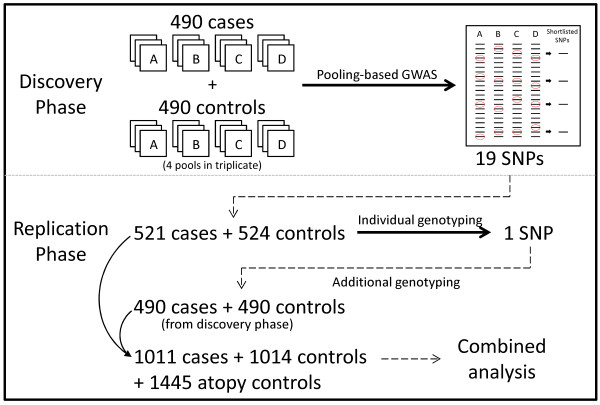
A two-stage GWAS was performed in case samples with allergic asthma, and in control samples without asthma and atopy. In the discovery stage, 490 case and 490 control samples were analysed by pooled genotyping. Significant associations from the first stage were evaluated in a replication cohort of 521 case and 524 control samples in the second stage. The same 980 samples used in the discovery phase were also individually genotyped for purposes of a combined analysis. An additional 1445 non-asthmatic atopic control samples were also genotyped.
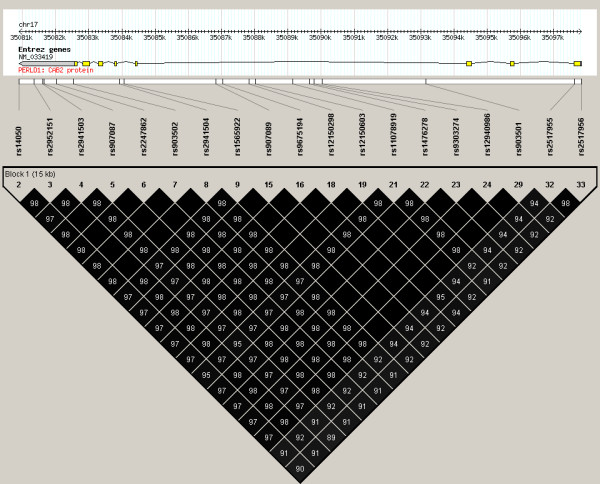
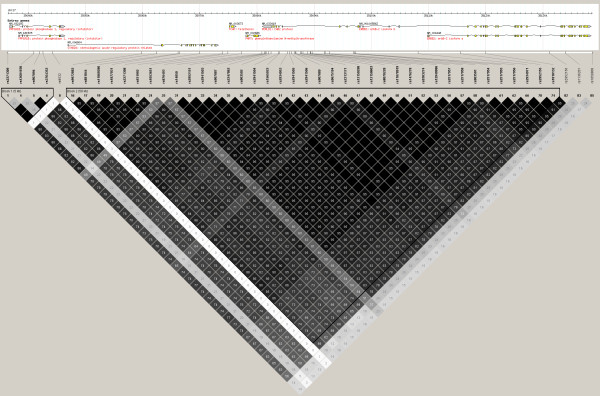
19 promising SNPs which passed our genome-wide P value threshold of 5.52 × 10⁻⁸ were individually genotyped. In the combined analysis of 1011 case and 1014 control samples, SNP rs2941504 in PERLD1 on chromosome 17q12 was found to be significantly associated with asthma at the genotypic level (P = 1.48 × 10⁻⁶, ORAG = 0.526 (0.369-0.700), ORAA = 0.480 (0.361-0.639)) and at the allelic level (P = 9.56 × 10⁻⁶, OR = 0.745 (0.654-0.848)). These findings were found to be replicated in 3 other asthma GWAS studies, thus validating our own results. Analysis against the atopy control samples suggested that the SNP was associated with allergic asthma and not to either the asthma or allergy components. Genotyping of additional SNPs in 100 kb flanking rs2941504 further confirmed that the association was indeed to PERLD1. PERLD1 is involved in the modification of the glycosylphosphatidylinositol anchors for cell surface markers such as CD48 and CD59 which are known to play multiple roles in T-cell activation and proliferation.
These findings reveal the association of a PERLD1 as a novel asthma candidate gene and reinforce the involvement of genes on the 17q12-21 chromosomal region in the etiology of asthma.
最近针对哮喘的全基因组关联研究(GWAS)成功鉴定了新的关联,这些关联已经得到了很好的复制。本研究旨在采用 GWAS 方法,鉴定新加坡华裔人群中影响哮喘易感性的遗传变异。
采用两阶段 GWAS 分析方法,在过敏性哮喘病例样本和无哮喘和无过敏史的对照样本中进行。在发现阶段,通过 pooled genotyping 对 490 例病例和 490 例对照样本进行分析。第一阶段的显著关联在第二阶段的 521 例病例和 524 例对照样本的复制队列中进行评估。在发现阶段使用的相同的 980 个样本也用于合并分析。还对 1445 个非哮喘过敏对照样本进行了基因分型。
通过我们设定的全基因组 P 值阈值 5.52×10⁻⁸,鉴定出 19 个有前途的 SNP。在对 1011 例病例和 1014 例对照样本的合并分析中,在染色体 17q12 上的 PERLD1 中的 SNP rs2941504 发现与哮喘的基因型水平显著相关(P=1.48×10⁻⁶,ORAG=0.526(0.369-0.700),ORAA=0.480(0.361-0.639))和等位基因水平(P=9.56×10⁻⁶,OR=0.745(0.654-0.848))。在另外 3 项哮喘 GWAS 研究中发现了这些发现得到了复制,从而验证了我们自己的结果。针对过敏对照样本的分析表明,该 SNP 与过敏性哮喘相关,而与哮喘或过敏成分无关。对 100kb 侧翼 rs2941504 进一步进行的其他 SNP 基因分型进一步证实,该关联确实与 PERLD1 有关。PERLD1 参与细胞表面标记物(如 CD48 和 CD59)的糖基磷脂酰肌醇锚的修饰,这些标记物已知在 T 细胞激活和增殖中发挥多种作用。
这些发现揭示了 PERLD1 作为一个新的哮喘候选基因的关联,并加强了 17q12-21 染色体区域基因在哮喘发病机制中的作用。