Division of Inflammation Biology, La Jolla Institute for Allergy and Immunology, CA 92037, USA.
Circ Res. 2012 Feb 3;110(3):416-27. doi: 10.1161/CIRCRESAHA.111.253377. Epub 2011 Dec 22.
NR4A1 (Nur77) is a nuclear receptor that is expressed in macrophages and within atherosclerotic lesions, yet its function in atherosclerosis is unknown.
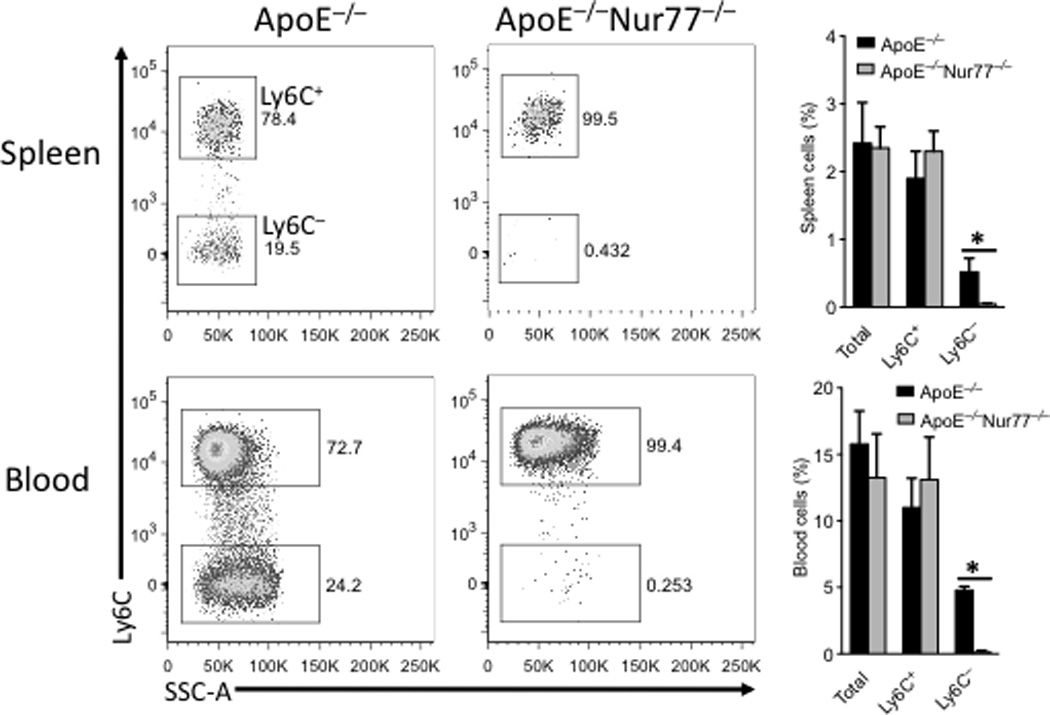
Nur77 regulates the development of monocytes, particularly patrolling Ly6C(-) monocytes that may be involved in resolution of inflammation. We sought to determine how absence of nuclear receptor subfamily 4, group A, member 1 (NR4A1) in hematopoietic cells affected atherosclerosis development.
Nur77(-/-) chimeric mice on a Ldlr(-/-) background showed a 3-fold increase in atherosclerosis development when fed a Western diet for 20 weeks, despite having a drastic reduction in Ly6C(-) patrolling monocytes. In a second model, mice deficient in both Nur77 and ApoE (ApoE(-/-)Nur77(-/-)) also showed increased atherosclerosis after 11 weeks of Western diet. Atherosclerosis was associated with a significant change in macrophage polarization toward a proinflammatory phenotype, with high expression of tumor necrosis factor-α and nitric oxide and low expression of Arginase-I. Moreover, we found increased expression of toll-like receptor 4 mRNA and protein in Nur77(-/-) macrophages as well as increased phosphorylation of the p65 subunit of NFκB. Inhibition of NFκB activity blocked excess activation of Nur77(-/-) macrophages.
We conclude that the absence of Nur77 in monocytes and macrophages results in enhanced toll-like receptor signaling and polarization of macrophages toward a proinflammatory M1 phenotype. Despite having fewer monocytes, Nur77(-/-) mice developed significant atherosclerosis when fed a Western diet. These studies indicate that Nur77 is a novel target for modulating the inflammatory phenotype of monocytes and macrophages and may be important for regulation of atherogenesis.
NR4A1(Nur77)是一种在巨噬细胞和动脉粥样硬化病变中表达的核受体,但它在动脉粥样硬化中的功能尚不清楚。
Nur77 调节单核细胞的发育,特别是参与炎症消退的巡逻 Ly6C(-)单核细胞。我们试图确定造血细胞中核受体亚家族 4 组 A 成员 1(NR4A1)的缺失如何影响动脉粥样硬化的发展。
在喂食西方饮食 20 周的情况下,Ldlr(-/-)背景下的 Nur77(-/-)嵌合小鼠的动脉粥样硬化发展增加了 3 倍,尽管 Ly6C(-)巡逻单核细胞急剧减少。在第二个模型中,缺乏 Nur77 和 ApoE 的小鼠(ApoE(-/-)Nur77(-/-))在西方饮食 11 周后也表现出动脉粥样硬化增加。动脉粥样硬化与巨噬细胞向促炎表型的极化发生显著变化有关,肿瘤坏死因子-α和一氧化氮表达增加,精氨酸酶-I 表达降低。此外,我们发现 Nur77(-/-)巨噬细胞中 TLR4mRNA 和蛋白的表达增加,以及 NFκB 的 p65 亚单位的磷酸化增加。NFκB 活性的抑制阻断了 Nur77(-/-)巨噬细胞过度激活。
我们得出结论,单核细胞和巨噬细胞中 Nur77 的缺失导致 Toll 样受体信号转导增强,巨噬细胞向促炎 M1 表型极化。尽管单核细胞较少,喂食西方饮食的 Nur77(-/-)小鼠仍发展出明显的动脉粥样硬化。这些研究表明,Nur77 是调节单核细胞和巨噬细胞炎症表型的新靶点,可能对动脉粥样硬化的调节很重要。