Department of Ophthalmology, Medical University, Lublin, Poland.
J Neural Transm (Vienna). 2012 Jun;119(6):679-84. doi: 10.1007/s00702-011-0750-2. Epub 2011 Dec 27.
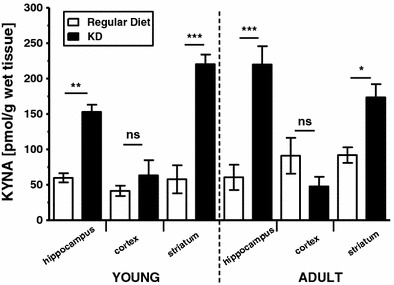
Targeting mechanisms that result in increased concentrations of kynurenic acid (KYNA) in the brain has been considered as a therapeutic approach for the treatment of epilepsy and certain neurodegenerative disorders. Recently, KYNA has been implicated in the effects produced by the high-fat and low-protein/carbohydrate ketogenic diet (KD) in a report demonstrating an increased production of KYNA in vitro by one of the ketone bodies, β-hydroxybutyrate, elevated by the KD. To further explore this association, brain concentrations of KYNA were compared in young (3 weeks old) and adult (8-10 weeks old) rats that were chronically exposed to the KD and regular diet. Exposure to the KD resulted in the anticipated elevations of β-hydroxybutyrate with accompanying decreases in glucose concentrations. In comparison to rats fed the regular diet, KYNA concentrations were significantly (p < 0.05) increased in the hippocampus (256 and 363% increase in young and adult rats, respectively) and in the striatum (381 and 191% increase in young and adult rats, respectively) in KD-fed rats. KD-induced increases in KYNA concentrations in young versus adult rats in the hippocampus and striatum were comparable (p > 0.05). Exposure to the KD had no effect on KYNA concentrations in the cortex of young and adult rats (p > 0.05). In summary, chronic exposure to the KD resulted in several-fold increases in KYNA concentrations in discrete brain structures in the rats. Thus, the relevant clinical question for further exploration is whether KD-induced increases in KYNA concentrations can translate into clinically significant improvements in neuropsychiatric diseases associated with KYNA hypofunction.
靶向导致脑中犬尿酸(KYNA)浓度增加的机制已被认为是治疗癫痫和某些神经退行性疾病的一种治疗方法。最近,有报道称,在高脂肪、低碳水化合物/蛋白质 ketogenic 饮食(KD)的作用中涉及 KYNA,该饮食可使一种酮体β-羟基丁酸体外产生 KYNA 的产量增加,从而导致 KYNA 浓度升高。为了进一步探讨这种关联,比较了慢性暴露于 KD 和常规饮食的年轻(3 周龄)和成年(8-10 周龄)大鼠脑中 KYNA 的浓度。暴露于 KD 导致预期的β-羟基丁酸升高,同时伴随葡萄糖浓度降低。与常规饮食喂养的大鼠相比,KD 喂养的大鼠的海马体(年轻和成年大鼠分别增加 256%和 363%)和纹状体(年轻和成年大鼠分别增加 381%和 191%)中的 KYNA 浓度显著增加(p < 0.05)。KD 诱导的年轻和成年大鼠海马体和纹状体中 KYNA 浓度的增加相当(p > 0.05)。KD 暴露对年轻和成年大鼠皮质中的 KYNA 浓度没有影响(p > 0.05)。总之,慢性暴露于 KD 导致大鼠离散脑结构中 KYNA 浓度增加了数倍。因此,进一步探索的相关临床问题是,KD 诱导的 KYNA 浓度增加是否可以转化为与 KYNA 功能低下相关的神经精神疾病的临床显著改善。