Department of Internal Medicine II, Medical University of Innsbruck, Innsbruck, Austria.
Department of Internal Medicine V, Medical University of Innsbruck, Innsbruck, Austria.
Front Immunol. 2020 Feb 21;11:249. doi: 10.3389/fimmu.2020.00249. eCollection 2020.
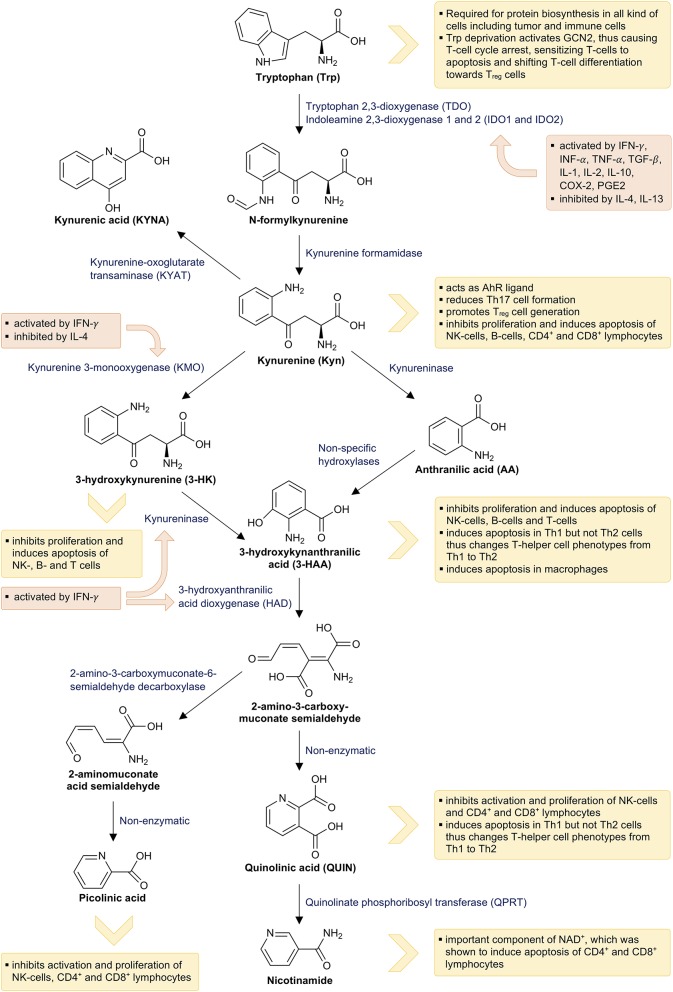
Many patients with cancer suffer from anemia, depression, and an impaired quality of life (QoL). These patients often also show decreased plasma tryptophan levels and increased kynurenine concentrations in parallel with elevated concentrations of Th1 type immune activation marker neopterin. In the course of anti-tumor immune response, the pro-inflammatory cytokine interferon gamma (IFN-γ) induces both, the enzyme indoleamine 2,3-dioxygenase (IDO) to degrade tryptophan and the enzyme GTP-cyclohydrolase I to form neopterin. High neopterin concentrations as well as an increased kynurenine to tryptophan ratio (Kyn/Trp) in the blood of cancer patients are predictive for a worse outcome. Inflammation-mediated tryptophan catabolism along the kynurenine pathway is related to fatigue and anemia as well as to depression and a decreased QoL in patients with solid tumors. In fact, enhanced tryptophan breakdown might greatly contribute to the development of anemia, fatigue, and depression in cancer patients. IDO activation and stimulation of the kynurenine pathway exert immune regulatory mechanisms, which may impair anti-tumor immune responses. In addition, tumor cells can degrade tryptophan to weaken immune responses directed against them. High IDO expression in the tumor tissue is associated with a poor prognosis of patients. The efficiency of IDO-inhibitors to inhibit cancer progression is currently tested in combination with established chemotherapies and with immune checkpoint inhibitors. Inflammation-mediated tryptophan catabolism and its possible influence on the development and persistence of anemia, fatigue, and depression in cancer patients are discussed.
许多癌症患者患有贫血、抑郁和生活质量(QoL)受损。这些患者通常还表现出血浆色氨酸水平降低和犬尿氨酸浓度升高,同时 Th1 型免疫激活标志物新蝶呤浓度升高。在抗肿瘤免疫反应过程中,促炎细胞因子干扰素γ(IFN-γ)诱导两种酶,即吲哚胺 2,3-双加氧酶(IDO)降解色氨酸和 GTP-环水解酶 I 形成新蝶呤。癌症患者血液中高浓度的新蝶呤和犬尿氨酸与色氨酸比值(Kyn/Trp)升高预测预后不良。炎症介导的色氨酸沿犬尿氨酸途径分解与疲劳、贫血以及实体瘤患者的抑郁和生活质量下降有关。事实上,增强的色氨酸分解可能极大地导致癌症患者贫血、疲劳和抑郁的发展。IDO 激活和犬尿氨酸途径的刺激发挥免疫调节机制,可能会损害抗肿瘤免疫反应。此外,肿瘤细胞可以分解色氨酸以削弱针对它们的免疫反应。肿瘤组织中 IDO 表达升高与患者预后不良有关。目前正在联合既定化疗方案和免疫检查点抑制剂测试 IDO 抑制剂抑制癌症进展的效率。讨论了炎症介导的色氨酸分解及其对癌症患者贫血、疲劳和抑郁的发展和持续存在的可能影响。